Filtering Coffee Through 3D Printed Glass

Typically, when we think of 3D printing, we think of gooey melted plastics or perhaps UV-cured resins. However, there’s a great deal of research going on around printing special impregnated filaments with alternative materials inside. [Ahron Wayne] has been working on these very materials, and decided to make himself a brew with a prototype print.

Tasty, but [Ahron] notes you shouldn’t drink in the lab.
The subject of [Ahron]’s experimentation is a glass-impregnated filament under development by The Virtual Foundry. The filament is full of tiny glass particles, and the idea is that it can be printed like any regular plastic filament. From there, it’s heated in what’s known as a debinding process, which removes the plastic in the print. Then, it’s heated again in a sintering process to bond the remaining glass particles together.

It’s a complex process, and one that leads to some shrinkage in dimensions as well as porosity in the final part. However, where some might see failure, [Ahron] saw opportunity. The porous printed part was used to filter coffee, with the aid of a little vacuum from what sounds like a water venturi.

[Ahron] notes it’s not a particularly efficient way to make coffee but it did work. We’ve seen exciting work with steel-impregnated filaments, too. Video after the break.

Continue reading “Filtering Coffee Through 3D Printed Glass”

Retrotechtacular: LA’s Hilarious Subway Safety Film From 1992

Subways! They’ve been around for an awfully long time; almost as long as modern railways themselves, believe it or not. Building underground was undertaken in earnest by those in the 19th century, who set out to build networks of stations to allow residents to get around a city quickly and effectively.

That fact should stick in your mind as you sample this glorious retro video from 1992. “L.A. Underground – Safety in the Extreme” is a guide for Californians, aiming to educate residents about the new B Line subway that opened the following year. The video acts as if the subway is a new fangled, mysterious thing, with a couple of confusing off-the-wall moments as well. If you’re a transport enthusiast or get excited about weird public films, this one’s for you.

Continue reading “Retrotechtacular: LA’s Hilarious Subway Safety Film From 1992”

Tesla’s Megapack Battery Burned For Days In Grid Storage Fire

Lithium rechargeable batteries have been heralded for their high-density energy storage, enabling all manner of technologies to come to fruition. From drones to practical electric cars to large-scale grid storage, the applications are endless.

The fire as seen from a drone overhead. Source: Twitter/@FireRescueVic

However, the lithium rechargeable battery has always had one major flaw–flammability. Pushed outside their operating range or otherwise tipped into thermal runaway, and they can burn ferociously as a result.

This came to pass in late July, at the Victorian Big Battery in Geelong, Australia, and it took significant effort to extinguish the blaze. Let’s take a look at the project and see how this came to occur.

Grid-Scale Storage

The Victorian Big Battery is a grid storage project similar in construction to the Hornsdale Power Reserve in neighboring South Australia. However, where the Hornsdale facility fields 194 MWh of capacity and 150MW peak power delivery, the new project aims to go much further. The Victorian project aims to install 450 MWh of capacity and deliver a peak power output of 300 MW.

Continue reading “Tesla’s Megapack Battery Burned For Days In Grid Storage Fire”

Thrashed, Damaged NES Controller Gets Brought Back To Life

Electronics might as well be a magical black box to some people. Where some would see a broken NES controller destined for the bin, [Taylor] saw the opportunity for a repair. Thus, the damaged hardware was brought back into useful service.

The controller was bought as part of a job lot, and was heavily damaged when it entered [Taylor]’s ownership. Nintendo built its hardware tough in those days, but the controller had nevertheless been smashed apart, with the case cracked and split and the PCB itself snapped in two.

For someone with basic electronics skills, though, repair was simple. The broken PCB was glued back together with epoxy. The broken traces had solder mask scraped back so that jumper wires could bridge the damaged area and return the circuit to functionality.

From there, it was a simple matter of 3D printing a new case, and the controller was back in service. The case in question was designed by [Alexander Myrman], and has a neat little inset Mario design that’s made visible by paint-filling the inlay.

While it was an easy fix, to the uninitiated in the electronic arts, it might as well be magic. It pays to remember that there are always new people joining the electronics hobby, and projects like these are a great way to learn. It’s also important to note that bringing back old retro hardware is often of great value, as in many cases, they’re not making any more! We see some great restorations around these parts, too. Video after the break.

Continue reading “Thrashed, Damaged NES Controller Gets Brought Back To Life”

3D Printing Steel Parts At Home Via Special Filaments

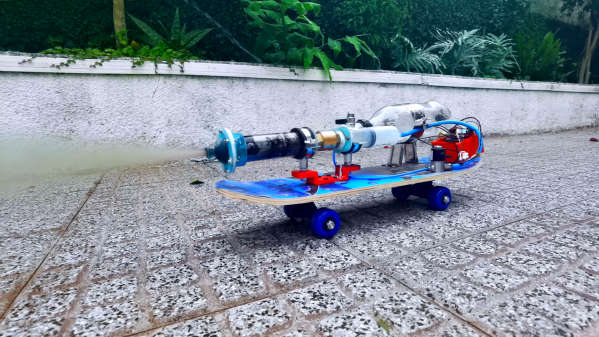
Rocket engines are great for producing thrust from fire and fury, but they’re also difficult to make. They require high-strength materials that can withstand the high temperatures involved. [Integza], however, has tried for a long time to 3D print himself a working rocket engine. His latest attempt involves printing an aerospike design out of metal.

Even steel couldn’t hold up to the fury of the rocket exhaust!

The project relies on special metal-impregnated 3D printer filaments. The part can be printed with a regular 3D printer and then fired to leave just the metal behind. The filament can be harsh, so [Integza] uses a ruby nozzle to handle the metal-impregnated material. Processing the material requires a medium-temperature “debinding” stage in a kiln which removes the plastic, before a high-temperature sintering process that bonds the remaining metal particles into a hopefully-contiguous whole. The process worked well for bronze, though was a little trickier for steel.

Armed with a steel aerospike rocket nozzle, [Integza] attempts using the parts with his 3D printed rocket fuel we’ve seen before. The configuration does generate some thrust, and lasts longer than most of [Integza]’s previous efforts, though still succumbs to the intense heat of the rocket exhaust.

Overall, though, it’s a great example of what it takes to print steel parts at home. You’ll need a quality 3D printer, ruby nozzles and a controllable kiln, but it can be done. If you manage to print something awesome, be sure to drop us a line. Video after the break.

Continue reading “3D Printing Steel Parts At Home Via Special Filaments”

Making A Left-Handed NES Controller

The controller for the original Nintendo Entertainment System is a classic, but perhaps not best known for its adherence to good ergonomic principles. Regardless, it can grow awkward to use for long stretches of time. To help alleviate this, [Taylor] whipped up an easy way to convert a NES controller to left-handed operation.

The mod board in question, installed on a NES controller PCB.

The crux of the hack is simple, with the controller’s buttons swapped left-to-right to enable the controller to be flipped upside down. In this orientation, the D-pad is used by the right hand and the action buttons by the left–the opposite of the usual way. Thus, left and right on the D-pad must be switched, as well as A and B, so all the controls are otherwise in a logical layout.

This is achieved through the use of a little mod board of [Taylor]’s own design. The original HD14021BP chip is desoldered from the controller’s PCB, and installed in the mod board instead. The modboard can then be soldered back into the controller, rerouting the traces to swap the buttons. There’s also a version that [Taylor] designed that can flip between right-handed and left-handed operation thanks to some onboard DIP switches.

It’s a tidy hack that could save the thumbs of some dedicated Tetris players. Alternatively, you can always make your own NES controller from scratch. Video after the break.

Continue reading “Making A Left-Handed NES Controller”

China MagLev Train Aspirations Boosted By New 600 Km/h Design

Maglev trains have long been touted as the new dawn for train technology. Despite keen and eager interest in the mid-20th century, development has been slow, and only limited commercial operations have ever seen service. One of the most well-known examples is the Shanghai Maglev Train which connects the airport to the greater city area. The system was purchased as a turnkey installation from Germany, operates over a distance of just 30.5 km, and according to Civil Engineering magazine cost $1.2 billion to build in 2001. Ever since, it’s served as a shining example of maglev technology — and a reminder of difficult and expensive maglev can be.

However, China has fallen in love with high-speed rail transport in the last few decades and has invested heavily. With an aggressive regime of pursuing technology transfers from foreign firms while building out the world’s largest high-speed rail network, the country has made great progress. Now, Chinese rail transit manufacturer, CRRC Corporation, have demonstrated their newest maglev train, which hopes to be the fastest in the world.

Continue reading “China MagLev Train Aspirations Boosted By New 600 Km/h Design”