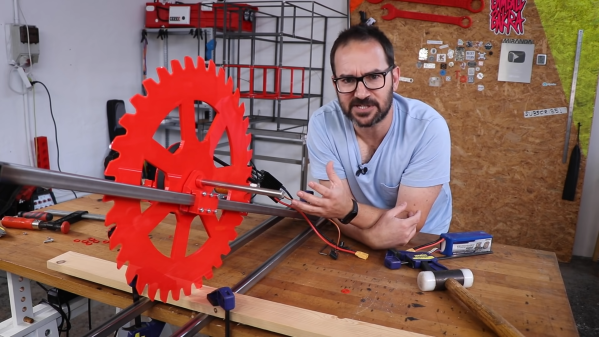
Robot with star shaped wheels made of foam.

Build An Amphibious Robot Using Pool Noodles For Wheels

If you only think of wheels as round, you’re limiting yourself from experiencing the true wider world of whacky designs. [wadevag] has been experimenting with some such concepts, and has had success building an amphibious robot platform using star-shaped wheels built out of pool noodles.

The concept is similar to that of whegs. A portmanteau of wheel-legs, they’re in effect a form of leg that moves with a rotating motion. Essentially, the points of the stars on the wheels act like legs, pushing the robot along one by one, rather than having continuous contact with the ground as in a typical round wheel.

The flotation provided by the foam allows the robot to easily sit on top of the water’s surface, and the star shape allows them to act as viable paddles too. This is perhaps their primary advantage. A round wheel would not provide anywhere near as much forward propulsion.

[wadevag] shows off the concept’s abilities on water, concrete, and snow, and it handles them all ably. Impressively, it can both enter and exit the water under its own power. While it’s probably not a viable solution for a very heavy robot, for a lightweight design, it could work wonders. It’s not the first time we’ve seen some oddball wheel designs, either. Video after the break.

Continue reading “Build An Amphibious Robot Using Pool Noodles For Wheels”

Airdropping Live Fish Is A Thing And It Looks Magnificent

Utah is a place that features a wonderful and varied wilderness. Its mountainous terrain is home to many valleys, ponds, and streams. They’re a particular favorite of recreational anglers who visit the region for the great fishing. Oftentimes, however, these areas are fished out by visitors and need to be restocked. Other environmental factors also come into play in reducing populations, too.

A plane delivering live fish to the lakes of Utah via air drop. Source: Utah DWR

When this happens in some areas, it’s as simple as driving up a truck full of water and fish and dumping them into the lake. The problem is that many of these lakes and streams are difficult to access by foot or by road. Believe it or not, the most practical method found to deal with the problem thus far is dropping in live fish by air. Here’s how it all goes down.

Live Cargo

Typically, the fish dropped into these remote watercourses are quite young, and on the order of 1-3″ long. The fish are specifically raised to later be fished, and are also usually sterile, making it easier for Utah’s Division of Wildlife Resources to manage numbers. When it comes time to restock remote lakes, waterbombing planes are pumped full of water and loaded up with fish.

Continue reading “Airdropping Live Fish Is A Thing And It Looks Magnificent”

VGA PCB.

Running Six VGA Projectors From A Single ESP32

Today’s microcontrollers are high-speed powerhouses that can do absolutely wonderous things. By virtue of fast clock speeds and special DMA hardware, it’s often possible to achieve great feats that seem almost ridiculous at face value. [Bitluni] decided to demonstrate just that, running six (6!) VGA displays from a single ESP32.  (Video, embedded below.)

The ESP32 clocks in at 240 MHz at top speed. It also features some nifty DMA hardware along with GPIO mapping that makes it perfectly suited to this task. [Bitluni] was thus able to set it up to drive up to six VGA displays at one bit per pixel monochrome output. Alternatively, ganging up six output pins into two sets of three, he was able to run two VGA displays with 3-bit color. The resolution is an impressive 640 x 400 in both cases, and [Bitluni] demonstrated the hardware by driving six projectors with a starfield display.

Is it useful? Perhaps not yet, but there’s certainly a few applications we could think of. Share your own ideas in the comments. In the meantime, check out [Bitluni]’s other great works for the ESP32.

Continue reading “Running Six VGA Projectors From A Single ESP32”

Light Painting With An 19th Century Inspired Plotter

The geometric chuck was a device that stacked up multiple rotating wheels that could vary their speed and their offset to a central shaft, in order to machine ornate designs using a lathe. It’s this piece of machining obscura from the 19th century that inspired this light painting build from [Ted Kinsman].

Rather than the complicated gears and wheels used in the distant past, [Ted] instead elected to use stepper motors. Three stepper motors are stacked on top of each other, each one able to rotate at an independent rate. The design only implements three steppers as the slip rings needed to send power and control signals to each stepper are prohibitively expensive.

An Arduino is programmed to run the show, changing the speed of each motor and thus the patterns the system generates. Put LEDs on the spinning plates, or install a pen to mark a piece of paper, and it’s possible to generate all manner of beautiful spirograph-like patterns. Vary the motor speeds or the positioning of the lights, and the patterns vary in turn.

It’s a fun build for light painting, with some great visuals produced. We also appreciate the use of the Arduino which makes varying the parameters far easier than having to change out gearsets in classical designs.

If you miss the old school spirograph, you can always build one out of Lego. Else, consider experimenting with other light painting techniques. If you’ve built a fancy rig of your own, be sure to let us know!

[Thanks to zit for the tip!]

Solar Display Case Is A Portable Triple Monitor Setup

They say once you start using twin monitors on the desktop, you’ll never want to go back. It’s even worse when you upgrade to three or more. However, it can be difficult to take such a set up on the road. Desiring better productivity on the go is what spurred [Brian Whitsett] to develop the Solar Display Case to solve this problem.

The Solar Display Case aims to pack three 17″ full-size monitors into a portable waterproof case. Brian has already built a prototype, which puts the monitors on folding arms so that they can be quickly stowed or deployed when needed.

The build also relies on solar power to charge batteries, in order to make the solution as portable as any laptop or other hardware you may be using with it. It’s no good having three mains-powered monitors sitting in the field with no AC power, after all. [Brian] aims to use a flexible solar panel to make the most of the surface area of the deployed assembly, for maximum power generation.

It’s a great project, and one we’d love to see fleshed out to the fullest. Imagining a briefcase that folds out into a triple-monitor workstation is exciting, and it looks like [Brian] is well on the way to making it a reality.

A Cold Gas Thruster On An RC Car

Tesla have boldly claimed that one day they’ll ship a Roadster complete with a cold-gas thruster for truly ridiculous acceleration. Whether or not that ever comes to pass remains to be seen, but [Engineering After Hours] decided to try out the technology on an RC car instead.

The thruster uses a pair of disposable CO2 canisters to deliver 1770 g of thrust via a converging-diverging nozzle. Actuated by servos and a simple valve, the system dumps the high-pressure CO2 to help accelerate the car up to speed. Paired with sticky tires and a powerful brushless motor, the plan was to try and beat Tesla’s claimed 1.1 second 0-60mph acceleration figure for the thruster-boosted roadster.

Unfortunately, the high center of gravity of the RC car led to stability issues, largely due to the mounting of the thruster itself. Additionally, the high weight of the car – around 4.3kg – meant that at best, the thruster would only add 0.5g to the vehicle’s acceleration.

While the car didn’t net a quick 0-60 time, it’s still neat to see a cold gas thruster on an RC car. It may not have been a Tesla-beater like some earlier projects, but it was cool all the same. Video after the break.

Continue reading “A Cold Gas Thruster On An RC Car”

Touchscreen Makes For A Neat Wavetable Synth

A popular tool in chiptune software like LSDJ allows the user to draw a waveform and use it as the basis for a wavetable synth. It’s fun and it can produce some great bleeps and bloops. [Kevin] has created a similar tool using an Arduino and a touchscreen.

You can draw the waveform! That’s neat.

The build is based on the Arduino Uno, the humble mainstay of the Arduino line. It’s hooked up to an ILI9488 color touchscreen display, which acts as the primary user interface. Using a stylus, or presumably a finger, the user can draw directly on the screen to specify the desired waveform for the synth to produce. The Arduino reads the step-by-step amplitude values of the drawn waveform and uses them to synthesize audio according to MIDI messages received over its serial port. Audio output is via PWM, as is common in low-cost microcontroller projects.

It’s a fun build and we’re sure [Kevin] learned plenty about wavetable synthesis along the way. We’ve seen his work on other Arduino synthesis projects before, too! Video after the break.

Continue reading “Touchscreen Makes For A Neat Wavetable Synth”