Clay Pot MP3 Player Whipped Up With The Freedom-K64F

In the streaming era, few of us think about MP3s on a day to day basis anymore. Our music collection is managed by warring executives in streaming companies from far-off lands. However, for [vinod], they’re still useful — seeing as he just built himself an MP3 player that fits in a clay pot.

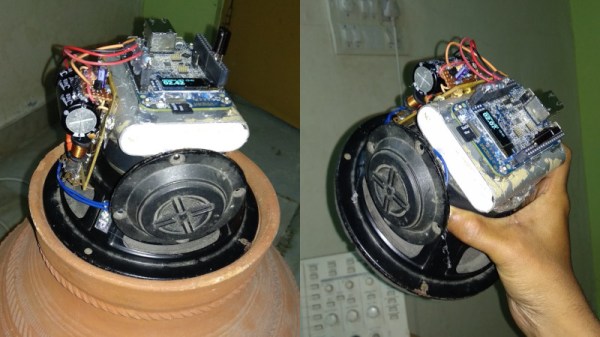
The build is based on the FRDMK64F development board, packing a powerful 120 MHz ARM chip. This has enough grunt to decode MP3s on the fly, using the Helix MP3 decoder library. The MP3s themselves are streamed off an SD card, using the faster SDIO access method rather than relying on slower SPI. Once decoded, the resulting PCM audio data is shifted out via a DAC using the chip’s DMA hardware, allowing for smooth, glitch-free playback. Output to a big woofer is via a 15 W class D amplifier, with the whole rig powered from a USB powerbank.

With all the electronics piled on the back of a big woofer speaker with lashings of hot glue, the final result is quite imposing; all the more so when installed neatly inside a clay pot acting as a bass reflex enclosure. We’ve seen some concrete cast speakers before, but not nearly enough hacker projects in clay. Please rectify this, and inform us once you’ve done so. Thanks in advance — video after the break!

Continue reading “Clay Pot MP3 Player Whipped Up With The Freedom-K64F” →

Building A Gas-Powered Pressure Washer

While you can always buy the tools you need, there’s something to be said for the satisfaction gained when you pick up a tool you built yourself. [Workshop From Scratch] has built a following out of building his own gear, the latest of which involved putting together a gas-powered pressure washer.

The key to the build was to keep things completely self-contained. All the consumables – water, soap, and wax – are kept onboard the washer to avoid having to run hoses and so on. A small gas engine is the heart of the build, hooked up to a high-pressure water pump. It even comes complete with a starter motor, making it a certified luxury garden tool. It’s also hooked up to two tanks holding cleaning solutions for car washing purposes, which feed into the pump via an auxiliary port for mixing. It’s all assembled on a custom steel frame welded together from rectangular hollow sections.

It’s a build that demonstrates how you can use your skills to build tools that suit your workflow, rather than just putting up with whatever is available off-the-shelf. We’ve seen his work before, too – building other tools like this motorised plasma cutter. Video after the break.

Continue reading “Building A Gas-Powered Pressure Washer” →

Modding A Hot Wheels Car Into A Radio Controlled Drift Weapon

Hot Wheels are some of the most popular diecast toy cars worldwide. The car bodies are faithful recreations of the real thing, though the models are mere stationary playthings. That wasn’t good enough for [Jakarta Diecast Project], who set about modifying a little BMW E30 M3 into an awesome radio-controlled drift car.

The build starts by disassembling the original car, and pulling out the original wheels. The baseplate is then modified to accept a new rear suspension and axle assembly. A small DC motor is mounted to the assembly to drive the rear wheels. A set of front steering knuckles are then installed up front, with their own suspension and hooked up to a tiny servo for steering. Everything’s controlled by a compact off-the-shelf RC receiver, which even features a gyro to help keep the tiny car straight under acceleration. The bodyshell is then stripped of paint, and given a sweet bodykit, before receiving a lurid orange paint job and decals. It’s reattached to the car’s baseplate via magnets, which make taking the car apart easy when service or modifications are required.

While the build doesn’t go into the nitty gritty on some of the harder parts, like the construction of the incredibly complex front knuckles, it’s nonetheless a great guide to building such a tiny and well-presented RC car. In looks and performance, the result trounces typical commercial offerings in the same scale, as you’d expect from such a hand-crafted masterpiece. It may not be the smallest RC car we’ve featured, but it is one of the coolest. Video after the break.

Continue reading “Modding A Hot Wheels Car Into A Radio Controlled Drift Weapon” →

An Anamorphic Lens Adapter For Very Pretty Video

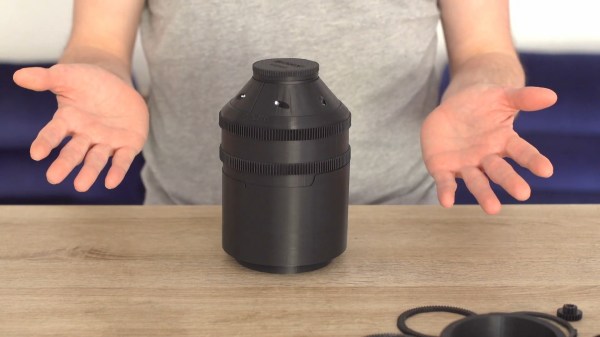
Anamorphic lenses are a great way to shoot in widescreen, but they’re prohibitively expensive on digital formats. Enthusiasts have experimented with using anamorphic adapter lenses from old projectors, but focusing can be a chore and results sub-par. [Andrew] found a way to use these cheap old anamorphic adaptors on a modern camera without sacrificing too much functionality.

Pretty, no?

Anamorphic filming techniques came about in the era of film. The aim was to record cinema-style widescreen footage on 3:2 aspect ratio 35 mm film. The way this was done was by using a lens that squeezes a wide aspect ratio to fit the format, and then a corresponding lens to squeeze it back on the projector. This allows for higher resolution than simply letterboxing onto the 35 mm frame and wasting the extra space.

Adam’s hack involves 3D printing a lens housing that pairs an anamorphic projector adapter lens with a Sony E-mount taking lens. Gears are set up so that both lenses can be focused together, rather than typical adapter setups that require the user to juggle multiple focus rings at once. This makes the rig much more usable in real shoots where there’s no time for messing about.

It’s a useful hack, and one we could imagine quite a few low-budget filmmakers will be rushing out to replicate. Files are on Thingiverse for the eager. Consider whipping yourself up a camera slider while you’re at it for really boss shots. Video after the break.

Continue reading “An Anamorphic Lens Adapter For Very Pretty Video” →

Turn On Your Lights With A Wave Of A Magic Wand

Smartphones and voice assistants are the typical way most of us interact with our smart devices around the home, but it doesn’t have to be the only way. [Sam March] wanted things to feel a little more magical – so built a wand to do the job instead.

The wand relies on a DA14531 Bluetooth Low Energy (BLE) system-on-chip, and is paired with what appear to be smart plugs running on the same hardware. With an accelerometer in the wand, it’s able to detect waving motions, and then signal the smartplugs over Bluetooth to switch outlets on or off. As far as the magic side of things is concerned, [Sam] took his lead from [Arthur C. Clarke], who famously stated “Any sufficiently advanced technology is indistinguishable from magic.” Thus, efforts were made to miniaturize the electronics down to a single tiny PCB, allowing it to be secreted inside a turned wooden wand that’s wrapped in leather.

The end result is a fun project that’s also probably useful when [Sam] wants to turn the lights off without getting out of bed. We could imagine that, configured properly to work on a room-by-room basis, it could be useful for guests who don’t know where the light switches are.

If the name sounds familiar, it’s because we’ve heard from [Sam] before – with his great DIY smartwatch build. Video after the break.

Continue reading “Turn On Your Lights With A Wave Of A Magic Wand” →

TR-109 Raspberry Picorder 2 Really Nails The Star Trek Aesthetic

Star Trek famously showed its medical staff using a multifunctional device by the name of the tricorder. While no such devices are regularly used by current medical staff in this timeline, the concept is nonetheless appealing to fans of the show. [directive0] is one such person, and built himself a replica by the name of the Picorder 2.

Picorder 2 is inspired by the tricorders from Star Trek: The Next Generation. The name is an indication that this isn’t a first attempt; it builds upon an earlier project based on the models from the original series. It’s built with a nifty 3D printed case that folds in half, just like the real deal. Plenty of attention to detail has been invested in the decals and backlit controls to really complete the look.

Inside, a Raspberry Pi Zero W runs the show, paired with a bunch of sensors and accessories to get the job done. The human interface is via capacitive touch, and data is displayed on an ST7735 LCD display for output. The graphing software [directive0] built does a great job of creating a Trekesque aesthetic, displaying data from various in-built sensors, such as temperature, humidity, and barometric pressure. There’s also a low-resolution thermal imaging camera – and it’s hard to get more sci-fi than that.

While we’re a ways off from medically-useful tricorders, it’s nonetheless fun to see replica props that have some life and functionality built into them. The tricorder remains a popular build – we see them pretty regularly! – and we can’t wait to see where the fandom takes them over the next few years.  Video after the break.

Continue reading “TR-109 Raspberry Picorder 2 Really Nails The Star Trek Aesthetic” →

Build Your Own Bluetooth Notification Ticker

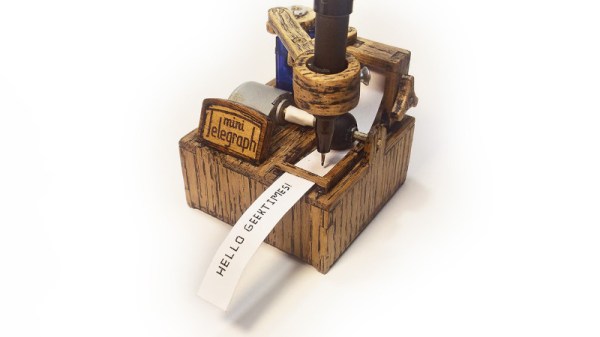
Stock tickers were telegraph-based machines from the 19th century, and quickly fell by the wayside with the advent of computer replacements from the 1960s onwards. However, there’s something charming about small machines that deliver us paper strips of information – as demonstrated by this notification ticker from [DIYprojects] (Russian language, Google Translate link).

The heart of the build is an Arduino Mini, which receives the text content of smartphone notifications via a Bluetooth module hooked up to its serial port. The machine mounts a small roll of paper strip, which is pulled along by a stepper motor fitted with a rubber earbud for added grip. The pen is moved along the paper by a servo using a Lambda mechanism to allow it to move nicely perpendicular to the paper’s direction of travel. Instead of moving the pen up and down, the paper is pushed into the pen by a solenoid mounted underneath.

It’s a fun little project, and one we can imagine being great for educational purposes. It teaches skills required to work with steppers, servos, solenoids and Bluetooth, all at once. It’s a little different from some other pen plotter designs, but the ticker format has a certain charm that’s hard to replicate any other way. Video after the break.

Continue reading “Build Your Own Bluetooth Notification Ticker” →