Building DIY Acoustic Panels To Cut Down On Echoes

Plenty of hackers and makers are passionate about content creation. In the dog-eat-ice-bucket-challenge world of online video, production value is everything. If you want to improve your audio quality then cutting down on echoes is a must, and these acoustic panels will help you to do just that. 

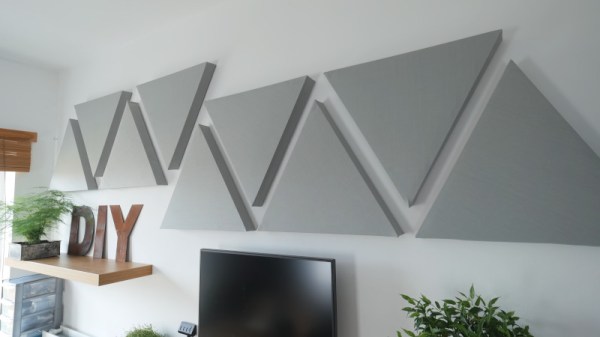
The build starts with aluminium L-channel, affixed together into an equilateral triangle with the help of some 3D printed brackets. Two of the triangular frames are then fitted together via a series of hexagonal standoffs. Foam or housing insulation is then added to act as the primary sound absorbing material. To give an attractive finish, the panels are covered in fabric. The panels are then placed on to drywall using nails glued into the standoffs.

While the panels are likely more expensive to build than off-the-shelf foam alternatives, they have an attractive look which is key in video studio environments. If you’re wondering where to position them for the best results, there’s a simple and easy approach to figure it out. Video after the break.

Continue reading “Building DIY Acoustic Panels To Cut Down On Echoes” →
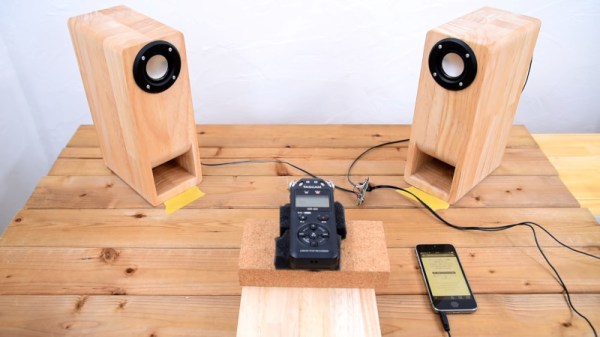
Cheap Speakers Sound Great In A Proper Enclosure

It’s possible to pick up a low-cost set of speakers for a few dollars, but by and large, you don’t get a lot of quality for your money. Expect a small pair of drivers, with tinny sound and ugly noises from the enclosure’s cheap materials. [JSK-koubou] has shown us, however, that these speakers can become so much more.

The internal structure helps improve the frequency response.

In this case at least, the basic speaker drivers and electronics inside were passable. Harvesting these, the builder then proceeds to create a stunning pair of tuned wooden enclosures for the speakers. This is achieved with a routing template, large blocks of wood and plenty of elbow grease.

The internal structure makes a huge difference to the bass response of the speakers, allowing them to far more faithfully recreate the music under test. Thanks to the artisan-level craftsmanship, the final product is stunning to look at, too. It’s impressive just how well a cheap pair of drivers can perform with a proper enclosure, and of course, there’s nothing to stop an even better set of drivers being installed, either.

When building your own speakers, your creativity is the limit. Video after the break.

Continue reading “Cheap Speakers Sound Great In A Proper Enclosure” →

College Project Nets 360 Degree POV Display

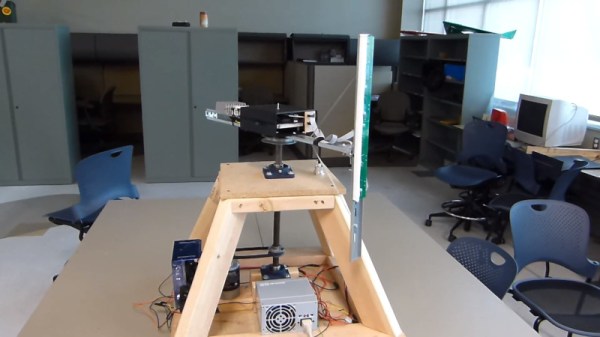
Senior college projects are the culmination of years of theoretical learning finally put into practice. For many students they are their first experience of doing some proper, real world engineering. [Melangeaddict] chose to take on a persistence of vision display for his final project, and learned plenty along the way.

The display consists of a row of 48 RGB LEDs mounted on an arm capable of rotating a full 360 degrees, with a simple paper diffuser. This arm is spun up by a belt drive from an electric motor at significant rotational speed, so getting close to this machine is quite inadvisable. Thanks to quality bearings and a careful build, rotating resistance is minimal. An infrared LED is mounted on the frame, and the light picked up by a photodiode on the rotating arm, allowing the images to remain fixed in space without drifting over time. Images can be loaded to the display wirelessly over a Bluetooth interface, which was quite advanced for a DIY project in 2011.

We’re a fan of the 360 degree approach to POV displays, and with the right rotational speed and fast data rates, it would be possible to get some seriously high resolution out of the device. Just be careful not to stick your hands in the mechanism.

There’s a deep well to explore when it comes to POV displays, from three-dimensional builds to vibrating flexible setups. Video after the break.

Continue reading “College Project Nets 360 Degree POV Display” →

Popstick Fan Car Is A Fun Bluetooth Build

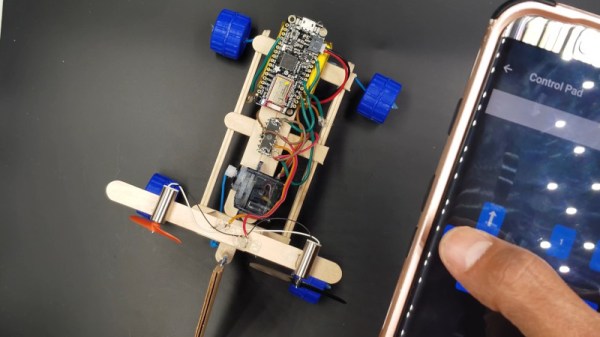
Archer fans already know, but for the rest of the world it bears saying – boats are fine, but fan boats are better. It’s much the same with land vehicles, too. [tinkeringtech] felt the same way, and built a Bluetooth-controlled fan car to scoot around the floor. (YouTube, embedded below.)

Construction starts with a series of popsticks glued together to create a chassis. Twist ties are then used to act as axles for bottle cap wheels, while steering is handled by a cardboard rudder controlled by a servo. Propulsion is via a pair of pager-sized motors fitted with fans. An Adafruit Bluefruit Feather M0 runs the show, receiving commands over Bluetooth and driving the motors through an H-bridge chip in the center of the vehicle.

It’s a fun craft-style build that would be a great project for kids interested in electronics and making. It teaches basic electronics, as well as serving as a good introduction into the world of microcontrollers. It’s one of the smaller radio-controlled builds we’ve seen, but you can always go full-scale if that takes your fancy.

Continue reading “Popstick Fan Car Is A Fun Bluetooth Build” →

Airless Tire For Your Car: Michelin Says 2024, Here’s What They’re Up Against

The average motorist has a lot to keep track of these days. Whether its how much fuel is left in the tank, how much charge is left in the battery, or whether or not the cop behind noticed them checking Twitter, there’s a lot on a driver’s mind. One thing they’re not thinking about is tires, theirs or anyone else’s for that matter. It a testament to the state of tire technology, they just work and for quite a long time before replacements are needed.

There hasn’t been a major shift in the underlying technology for about fifty years. But the times, they are a changing — and new tire technology is claimed to be just around the corner. Several companies are questioning whether the pneumatic tire is the be-all and end all, and futuristic looking prototypes have been spotted at trade shows the world over. Continue reading “Airless Tire For Your Car: Michelin Says 2024, Here’s What They’re Up Against” →

Reaction Trainer Keeps You On Your Toes

In many sports, it’s important for competitors to be light on their feet, and able to react quickly to external stimuli. It all helps with getting balls in goals, and many athletes undergo reaction drills as part of their training regime. To help with this, [mblaz] set out to build a set of reaction trainers.

The training setup consists of a series of discs, each with glowing LEDs and a proximity sensor. The discs randomly light up, requiring a touch or wave to switch them off. At this point, another disc will light randomly, and so on.

The discs are built using an ATmega328 to run the show, with NRF24L01+ radios used to communicate between the modules. High brightness red LEDs are used for indication. An optical proximity sensor is used for its fast reaction time and low cost, while power comes via a small lithium polymer battery integrated into each disc.

We’re sure [mblaz] and his fellow athletes will find the rig to be useful in their training. There’s plenty of scope for electronics to help out with athletic training; this boxing trainer is a great example. If you’ve got a great sports engineering project of your own, don’t hesitate to send it in!

Shower Water Monitor Tracks The Dollars And Cents

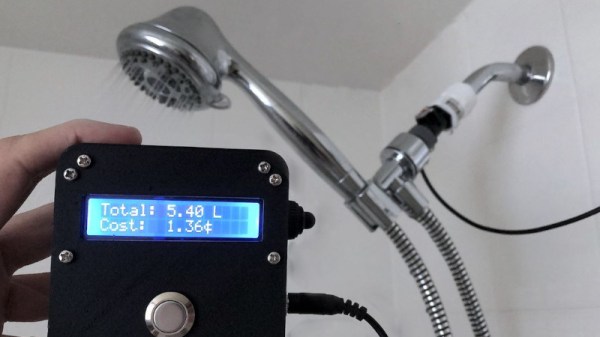
There’s nothing quite as relaxing as a long, hot shower. This has the tendency of making the bather absent minded as to the amount of water being used, which can lead to excessive bills. [LiamOSM] built a device to monitor this instead, and calculate the cost, to boot. 

The device consists of an Arduino hooked up to a cheap flow meter sourced from Banggood. The sensor consists of a paddle wheel that sits in the water flow, fitted with a magnet. A hall effect sensor picks up pulses as the magnet spins, and counting these allows the flow rate to be measured. An HD44780 LCD screen is used to display the readings, controlled over I2C.

To avoid issues in the bathroom environment, the enclosure was designed to be waterproof. The LCD is mounted behind a clear plastic window sourced from vegetable packaging, and the button chosen was specially selected for its sealing grommets. We’d love to see a proper submersion test, but for the most part, it appears to be doing a good job in the bathroom.

If you’re interested in monitoring your water use as a household, you might find it possible to piggy back on the municipal meter.