Toy Train Joins The Internet Of Things

[Zoltan] was developing a workshop on Matter for DEF CON, and wanted to whip up a fun IoT project to go with it. His idea was simple—take a simple toy train, and put it on the Internet of Things.

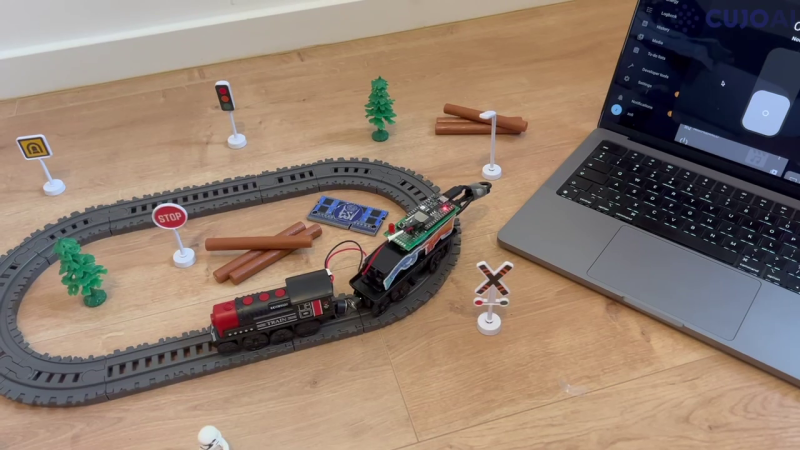
Speed and low cost were the goals here, with a budget of around $40 and a timeline of one week. The train set sourced for the build was a 43 piece set with a locomotive, one carriage, and a simple oval track, retailing for $25. The toy train got a new brain in the form of an ESP32-C3 DevKitM-1, with the goal of commanding the device over Wi-Fi for ease of use. The microcontroller was set up to control the train’s brushed DC motor with an IRL540 MOSFET. A USB battery bank was initially employed to power the rig, which sat neatly on the train’s solitary carriage. This was later swapped out for a CR123A battery, which did the job for the train’s short duration in service.

Code for the project was simple enough. The ESP32 simply listens for commands via Matter protocol, and turns the train on and off as instructed. [Zoltan] demos the simple interoperability of the Matter protocol by switching the train on and off with Google Home voice commands, and it works perfectly well.

Toy trains aren’t something we typically see included in smart homes, but maybe they should be. If you’re cooking up your own oddball IoT hacks, be sure to let us know on the tipsline!
A Smart LED Dice Box Thanks To The Internet Of Things

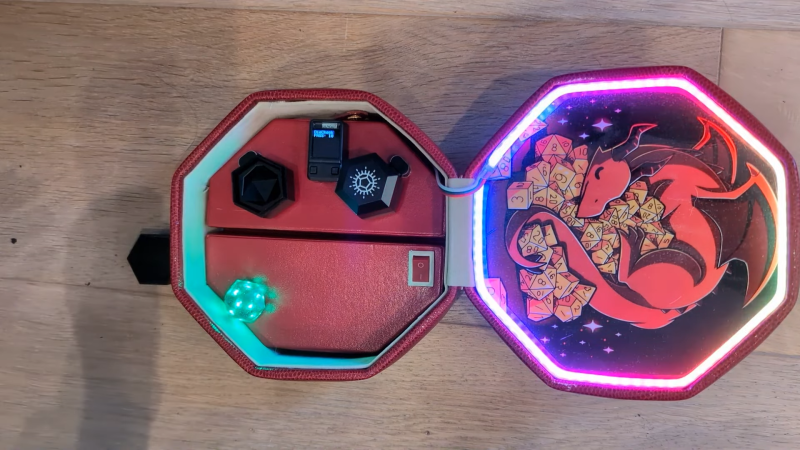
If there’s one thing humans love, it’s dancing with chance. To that end, [Jonathan] whipped up a fun dice box, connecting it to the Internet of Things for additional functionality.

Expect dice roll stat tracking to become a big thing in the D&D community.

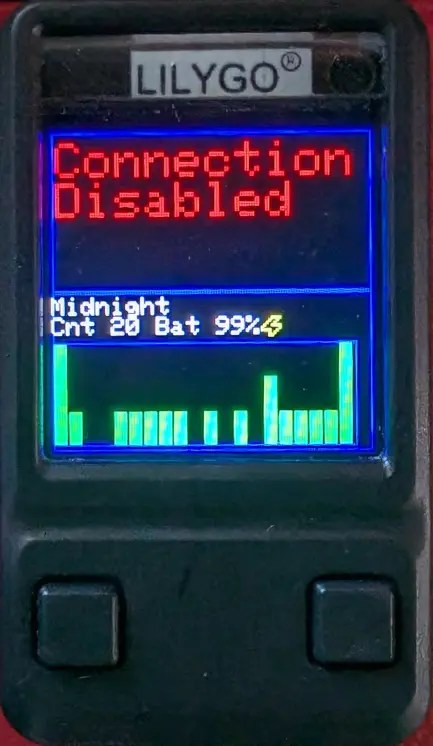
The build is based around Pixels Dice. They’re a smart type of IoT dice that contains Bluetooth connectivity and internal LEDs. The dice are literally capable of detecting their own rolls and reporting them wirelessly. Thus, the dice connects to the dice box, and the dice box can literally log the rolls and even graph them over time.

The project was built in a nice octagonal box [Jonathan] picked up from a thrift store. It was fitted with a hidden battery and ESP32 to communicate with the dice and run the show. The box also contains integrated wireless chargers to recharge the dice as needed, and a screen for displaying status information.

The dice and dice box can do all kinds of neat things, like responding with mood lighting and animations to your rolls—for better or worse. There are some fun modes you can play with—you can even set the lights to sparkle if you pass a given skill check in your tabletop RPG of choice!

If you play a lot of tabletop games, and you love dice and statistics, this is a project well worth looking into. Imagine logging every roll so you can see how hot you are on a given night. Or, heck—whether it was the dice’s fault you lost your favorite player character in that foreboding dungeon.

We see a few dice hacks now and then, but not nearly enough. This project has us questioning where smart dice have been all our life! Video after the break.
Continue reading “A Smart LED Dice Box Thanks To The Internet Of Things”

Your Guide To Using Amazon’s Sidewalk Network For The Internet Of Things

As the Internet of Things became a mainstream reality, it raised an interesting point about connectivity. We quickly learned it wasn’t ideal to have every light bulb, toaster, and kettle buzzing away on our main WiFi networks. Nor was it practical to sign up for a cellular data plan for every tracker tag or remote sensor we wanted to use.

To solve this issue, various tech companies have developed their own low-power mesh networking solutions. Amazon’s Sidewalk network is one of the widest spread in the US. Now, it’s opening it up for wider use beyond its own products, and you can get in on the action.

Continue reading “Your Guide To Using Amazon’s Sidewalk Network For The Internet Of Things”

Heater Joins The Internet Of Things With ESP32 Board

The wood-burning heater [g3gg0] has at home works perfectly, except for one flaw: the pellet reservoir needs to be manually refilled every few days. Humans being notoriously unreliable creatures, this critical task is sometimes overlooked, which naturally leads to literally chilling results.

With automatic fill systems expensive and difficult to install, [g3gg0] wanted to find some kind of way for the heater to notify its caretakers about any potential fault conditions. Not just the fact that it was out of fuel (though that would naturally be the most common alert), but any other issue which would potentially keep the heater from doing it’s job. In short, the heater was going to get a one-way ticket to the Internet of Things.

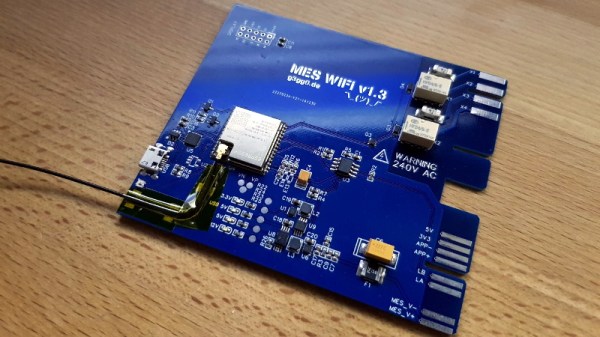
As it turns out, this task was not quite as difficult as you might expect. The Windhager heater already had upgrade bays where the user could insert additional modules and sensors, as well as a rudimentary data bus over RS-485. All [g3gg0] had to do was tap into this bus, decode what the packets contained, and use the information to generate alerts over the network. The ESP32 was more than up to the task, it just needed a custom PCB and 3D printed enclosure that would allow it to slot into the heater like an official expansion module.

When an interesting message flashes across the bus, the ESP32 captures it and relays the appropriate message to an MQTT broker. From there, the automation possibilities are nearly endless. In this case, the heater’s status information is being visualized with tools like Grafana, and important alerts are sent out to mobile devices with PushingBox. With a setup like this, the Windhager will never go hungry again.

Continue reading “Heater Joins The Internet Of Things With ESP32 Board”

Cat Litter Tray Joins The Internet Of Things

Keeping a cat as a pet can be rewarding, but it’s always important to consider how to handle the mess – and we’re not just talking about the tea cups pushed off tables here. To handle just this task, [Igor] decided to hook his cat litter box up to the internet of things.

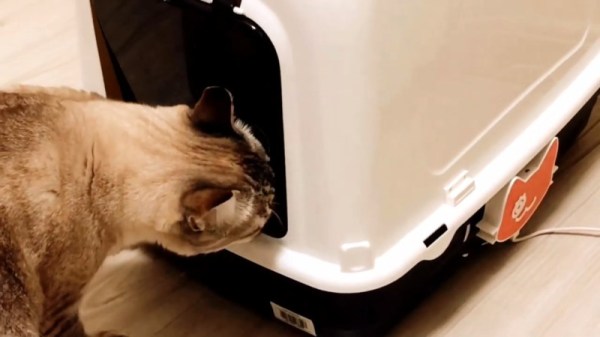
Monitoring the litter box brings several useful advantages. Load cells enable the weight of the litter tray to be monitored, allowing sand levels and the weight of the cats to be checked at regular intervals. Additionally, a door sensor keeps a record of comings and goings, giving an idea of how frequently the box has been used, and whether or not it may be time for cleaning. It’s all powered by an ESP32, hooked up to the Thingspeak platform. This allows for easy graphing and analysis of the data collected from the system. The electronics is then neatly installed in an attractive two-tone 3D printed enclosure with a pleasing cat motif.

It’s a great example of using some cheap off-the-shelf parts to ease the regular tasks of daily life. Building your own gear can be beneficial too, especially when Big Litter implements DRM on their hardware.

Dry Your Boots With The Internet Of Things

If you live somewhere cold, where the rain, snow and slush don’t abate for weeks at a time, you’ve probably dealt with wet boots. On top of the obvious discomfort, this can lead to problems with mold and cause blisters during extended wear. For this reason, boot dryers exist. [mark] had a MaxxDry model that had a timer, but it wasn’t quite working the way he desired. Naturally, it was begging to be hooked up to the Internet of Things.

The brains of the dryer is an ESP32, a solid choice for such a project. With WiFi on board, connecting the device to the internet is a snap. Relays are used to control the fan and heater inside the boot dryer, while MQTT helps make the device controllable remotely. It can be manually switched on and off, or controlled to always switch on at a certain time of the day.

It’s a simple project that shows how easily a device can be Internet controlled with modern hardware. For the price of a cheap devboard and a couple of relays, [mark] now has a more functional dryer, and toasty feet to boot.

We don’t see a lot of boot hacks here, but this magnet-equipped footwear is quite impressive.

Python And The Internet Of Things Hack Chat

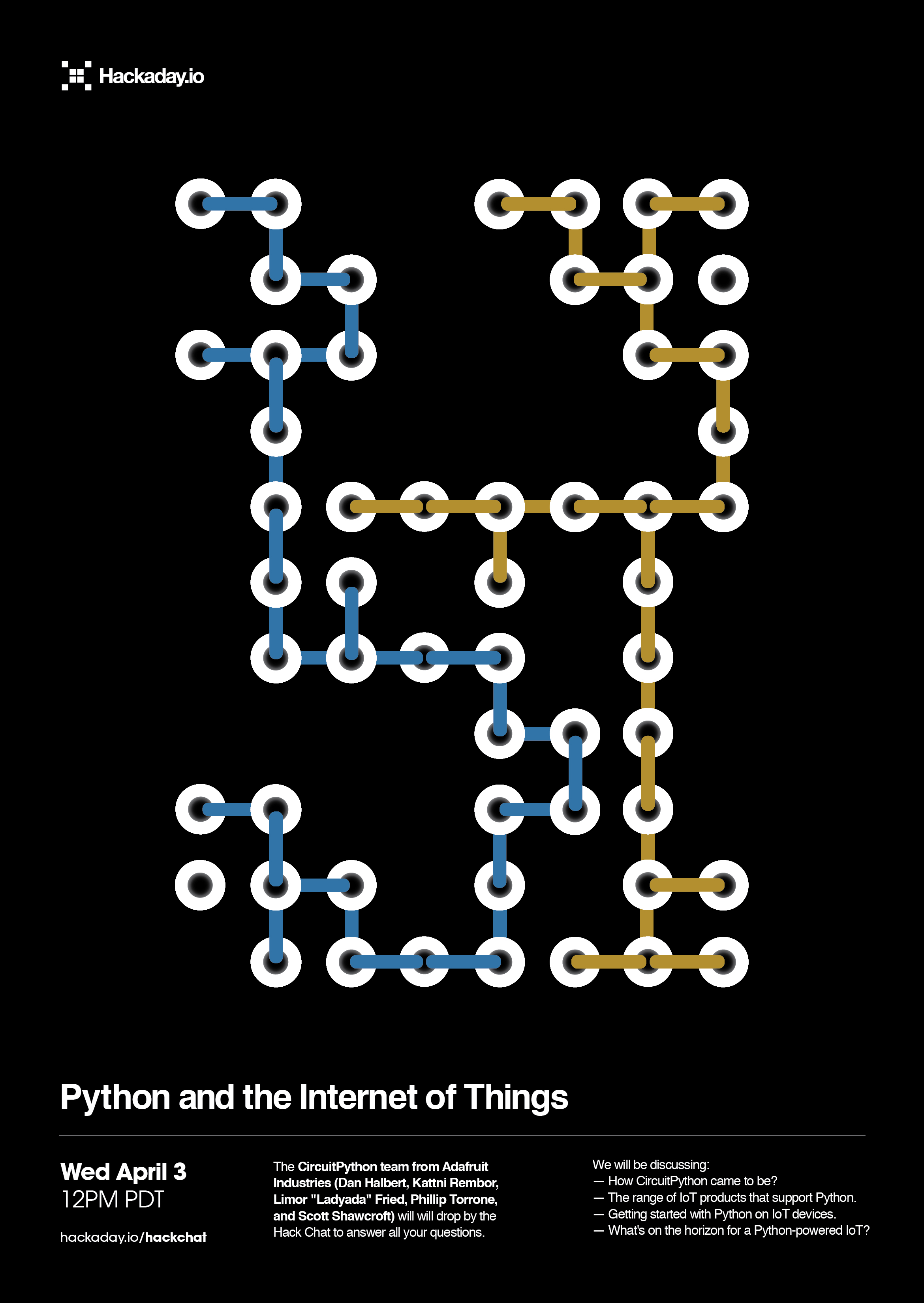
Join us Wednesday at noon Pacific time for the Python and the Internet of Things Hack Chat!

Opinions differ about what the most-used programming language in right now is, but it’s hard to deny both the popularity and versatility of Python. In the nearly 30 years since it was invented it has grown from niche language to full-blown development environment that seems to be everywhere these days. That includes our beloved microcontrollers now with MicroPython, and Adafruit’s CircuitPython, greatly lowering the bar for entry-level hackers and simplifying and speeding development for old hands and providing a path to a Python-powered Internet of Things.

The CircuitPython team from Adafruit Industries – Dan Halbert​, Kattni Rembor​, Limor “Ladyada” Fried​, Phillip Torrone​, and Scott Shawcroft – will drop by the Hack Chat to answer all your questions about Python and the IoT. Join us as we discuss:

  • How CircuitPython came to be;
  • The range of IoT products that support Python;
  • Getting started with Python on IoT devices; and
  • What’s on the horizon for a Python-powered IoT?

And as extra enticement, we’ll be giving away five free one-year passes to ​Adafruit.io​! We’ll draw five names at random from the list of Hack Chat attendees. Stop by for a chance to win. And, the Adafruit team will be streaming video live during the Hack Chat as well.

You are, of course, encouraged to add your own questions to the discussion. You can do that by leaving a comment on the Python and the Internet of Things Hack Chat and we’ll put that in the queue for the Hack Chat discussion.

join-hack-chatOur Hack Chats are live community events on the Hackaday.io Hack Chat group messaging. This week we’ll be sitting down on Wednesday, April 3, at noon, Pacific time. If time zones have got you down, we have a handy time zone converter.

Click that speech bubble to the right, and you’ll be taken directly to the Hack Chat group on Hackaday.io. You don’t have to wait until Wednesday; join whenever you want and you can see what the community is talking about.

Want a quick peek at what’s possible with CircuitPython? Check out this PyPortal event countdown timer that just happens to be counting down the hours till the next Hack Chat.