Cheetah 3d printer mobo

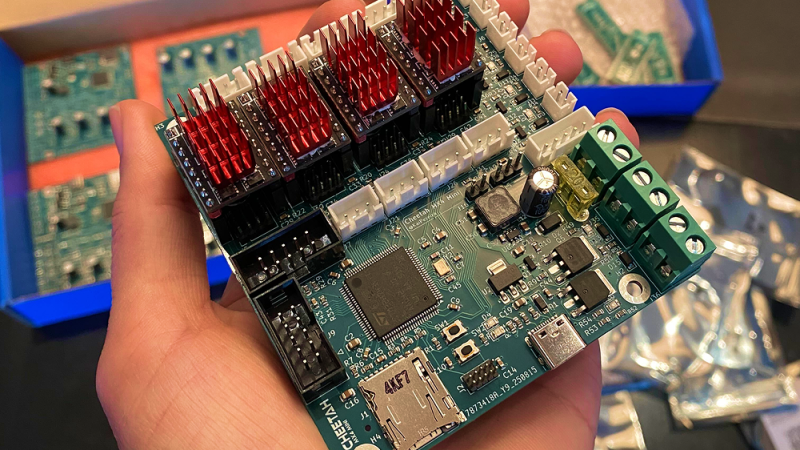
Cheetah MX4 Mini: A Pint-Sized 3D Printer Controller

There’s a seemingly unending list of modifications or upgrades you can make to a 3D printer. Most revolve around the mechanical side of things, many are simple prints or small add-ons. This upgrade is no small task: this 17-year-old hacker [Kai] took on designing and building his own 3D printer control motherboard, the Cheetah MX4 Mini.

He started the build by picking out the MCU to control everything. For that, he settled on the STM32H743, a fast chip with tons of support for all the protocols he could ask for, even as he was still nailing down the exact features to implement. For stepper drivers, [Kai] went with four TMC stepstick slots for silent motor control. There are provisions for sensorless homing and endstops, support for parallel and serial displays, and both USB-C and microSD card slots for receiving G-code. It can drive up to three fans as well as two high-amperage loads, such as for the heated bed.

All these features are packed into a board roughly the size of a drink coaster. Thanks to the STM32H743, the Cheetah MX4 Mini supports both Marlin and Klipper firmware, a smart choice that lets [Kai] leverage the massive amount of work that’s already gone into those projects.

One of the things that stood out about this project is the lengths to which [Kai] went to document what he did. Check out the day-by-day breakdown of the 86 hours that went into this build; reading through it is a fantastic learning aid for others. Thanks [JohnU] for sending in this tip! It’s great to see such an ambitious project not only taken on and accomplished, but documented along the way for others to learn from. This is a fantastic addition to the other 3D printer controllers we’ve seen.
STM32 Draws On Scope

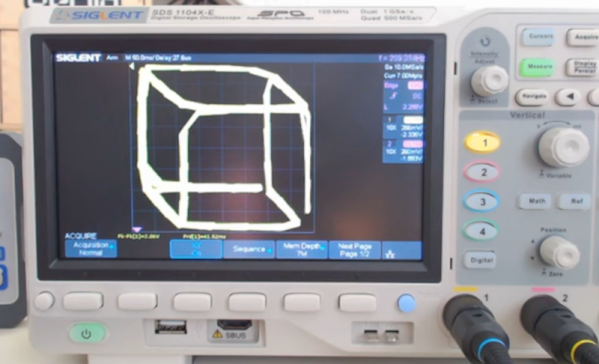
Drawing on an oscilloscope’s XY mode isn’t a new idea. However, if you’ve ever wanted to give it a go, you’d be hard-pressed to find more information than the nearly hour-and-a-half video about the topic from [Low Byte Productions]. You can check out the video below.

If you prefer to jump straight into the code, there’s a GitHub page. While the code is specific to the STM32, you can apply the ideas to anything.

Continue reading “STM32 Draws On Scope”

EasyThreed K9: The Value In A €72 AliExpress FDM 3D Printer

The hot end of the EasyThreed K9 is actually pretty nifty. (Credit: [Thomas Sanladerer])
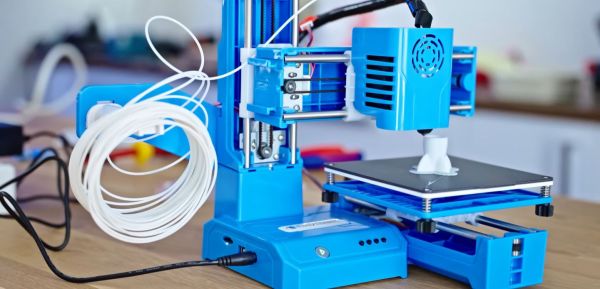
Recently, [Thomas Sanladerer] bought an EasyThreed K9 off AliExpress for a mere €72, netting him an FDM printer with a 10 x 10 x 10 cm build volume. The build plate is unheated, with optional upgrade, and there is no display to interact with the device: just a big multi-function ‘play’ button and five smaller buttons that direct the print head to preset locations above the build plate to allow for build plate leveling using the knobs on each corner. There’s also a ‘home’ button on the back for homing the print head, which pretty much completes the user interface. As the printer comes in a rather small box, the first step is to assemble the parts into something resembling a 3D printer.

What follows is both a mixture of wonder and horror, as the plastic build quality is everything but convincing, while at the same time, the self-contained nature of each of the three axes of the cantilevered design makes for very easy assembly. The print head has a nifty flip-up cover for easy access to the hot end, which makes the best of the anemic 24-watt power supply for the entire printer. A cooling fan with an air duct even provides part cooling, making this print head a contender for the ‘cheap but not terrible’ category. You can check out his full video review below.

Continue reading “EasyThreed K9: The Value In A €72 AliExpress FDM 3D Printer”

3D Mouse With 3D Printed Flexures And PCB Coils

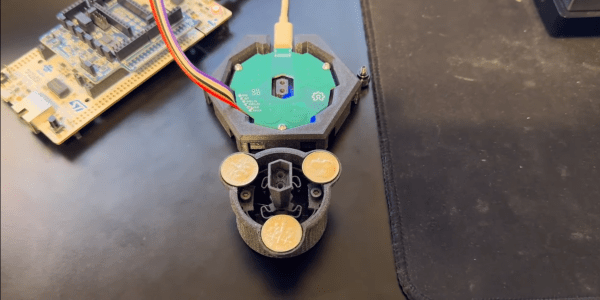
3D mice with six degrees of freedom (6DOF) motion are highly valued by professional CAD users. However, the entry-level versions typically cost upwards of $150 and are produced by a single manufacturer. [Colton Baldridge] has created the OS3M Mouse — an open source alternative using PCB coils and 3D printed flexures.

The primary challenges in creating a 6DOF input device, similar to the 3Dconnexion Space Mouse, lie in developing a mechanical coupling that enables full range motion, and electronics capable of precisely and consistently measuring this motion. After several iterations of printed flexure combinations and trip down the finite element analysis (FEA) rabbit hole, [Colton] had a working single-piece mechanical solution.

To measure the knob’s movement accurately, [Colton] employs inductive sensing. Inductance to Digital Converters (LDCs) assess the inductive alterations across three pairs of PCB coils, each having an opposing metal disk mounted on the knob. This setup allows [Colton] to use a Stewart platform‘s kinematic model calculate the  knob’s relative position. The calculation are done on an STM32 which also acts USB HID send the position data to a computer. For the demo [Colton] created a simple C++ app to translate the position data to Solidworks API calls.

Continue reading “3D Mouse With 3D Printed Flexures And PCB Coils”

3D Printed Tool Lets You Measure Component Reels Easily

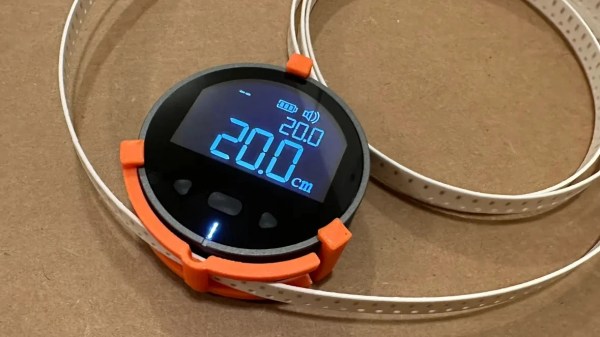
Component reels are a highly-0ptimized packaging format. They deliver components to pick and place machines for effective high-speed assembly. As more of us get into working with SMD components, we’re exposed to them as well. [MG] wanted a way to easily measure tape from component reels, which is difficult because they’re often curled up. Thus, they whipped up a nifty little tool for the job.

The device consists of a 3D printed bracket which is designed to fit on a cheap electronic tape measure from Amazon. The bracket holds an 8mm wide component tape against the measuring wheel. As the component tape is fed through the device, it turns the wheel, and the measurement appears on the screen. No more must you try and flatten out a tape and measure it section by section. Instead, you just feed it in, yank it through, and you’re done!

[MG] notes that the tape measure itself runs on an STM32 microcontroller. As an extra-credit assignment, they suggest that the device could be reprogrammed to display component count instead of distance if that’s more suitable for your application. If you happen to make that mod, be sure to notify us on the tipline!

Open World 3D Game Runs On The RP2040 Microcontroller

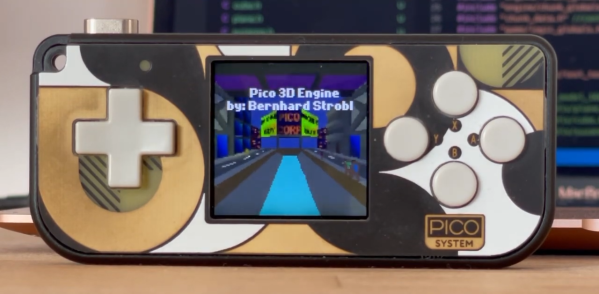
The Raspberry Pi RP2040 is versatile and cheap, but it’s by no means known as the most powerful microcontroller on the world. Regardless, it is capable of great things, as demonstrated by [Bernhard Strobl], who built a 3D open world game engine that runs on that very platform.

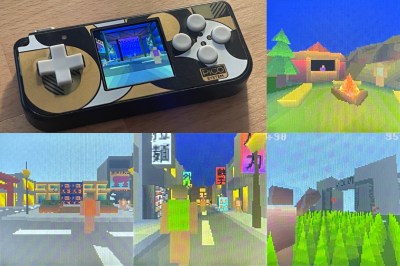
The graphics are simple, but with a compelling low-poly style.

The game engine itself is built to run on the Pimoroni PicoSystem, which is essentially a handheld gaming platform built around the RP2040 chip. The engine takes advantage of the multi-core nature of the RP2040, using the second core as a dedicated rasterizer to keep frames pumping out.

The basic game [Bernhard] built in the engine features 50 NPC characters and 50 further zombies, all running at the same time. Specs are impressive, with the engine’s included game simulating a “world” of 120 x 120 meters in size. As a maximum limit, the engine can handle a 2.56 x 2.56 km world, thanks to the use of 8-bit integers for directional data. However, limited storage space would make it difficult to achieve such a large world in practice.

We don’t get to see much of the gameplay in the YouTube video, but the quality of the graphics is impressive for such a cheap microcontroller. It seems within the bounds of possibility that an actual open-world game could be practical on the PicoSystem if only enough storage were available. Video after the break.

Continue reading “Open World 3D Game Runs On The RP2040 Microcontroller”

Hackaday Podcast 170: Poop Shooting Laser, Positron Is A 3D Printer On Its Head, DIY Pulsar Capture, GPS’s Achilles Heel

Join Hackaday Editor-in-Chief Elliot Williams and Managing Editor Tom Nardi for a recap of all the best tips, hacks, and stories of the past week. We start things off with an update on Hackaday’s current slate of contests, followed by an exploration of the cutting edge in 3D printing and printables. Next up we’ll look at two achievements in detection, as commercial off-the-shelf hardware is pushed into service by unusually dedicated hackers to identify both dog poop and deep space pulsars (but not at the same time). We’ll also talk about fancy Samsung cables, homebrew soundcards, the surprising vulnerability of GPS, and the development of ratholes in your cat food.

Direct Download link

Check out the links below if you want to follow along, and as always, tell us what you think about this episode in the comments!

Continue reading “Hackaday Podcast 170: Poop Shooting Laser, Positron Is A 3D Printer On Its Head, DIY Pulsar Capture, GPS’s Achilles Heel”