Best-Ever Brainstem Map Created By Indian Scientists

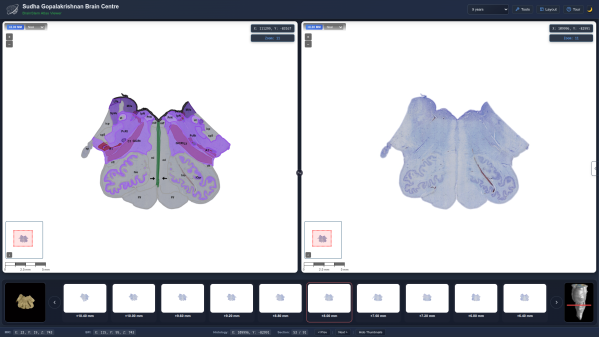
The elusive brainstem is a small, yet critical part of our brain: the slightest damage to it could prove fatal. But how it works is not fully understood today. Indian Scientists at SGBC (Sudha Gopalakrishnan Brain Centre) work to change that by producing the most detailed map of it ever seen.

Instead of more costly methods, this map was created with a high-resolution microscope. Starting with three samples, (45W fetus, 9Y and 54Y) the brain stems were imaged using MRI and BFI (Block Face Imaging), then sliced into 20/40µm pieces, imaged, annotated using in-house software and added to the dataset. From a combination of these images, MRI and BFI scans, they created a 3D model of the brainstem that you can explore in your browser.

The new research gives vital data needed for neurological research, and could help advance research on a wide range neurological diseases from Parkinson’s to Alzheimer’s.
You can find the paper here, which has not yet been peer reviewed at time of writing.

Via BBC.
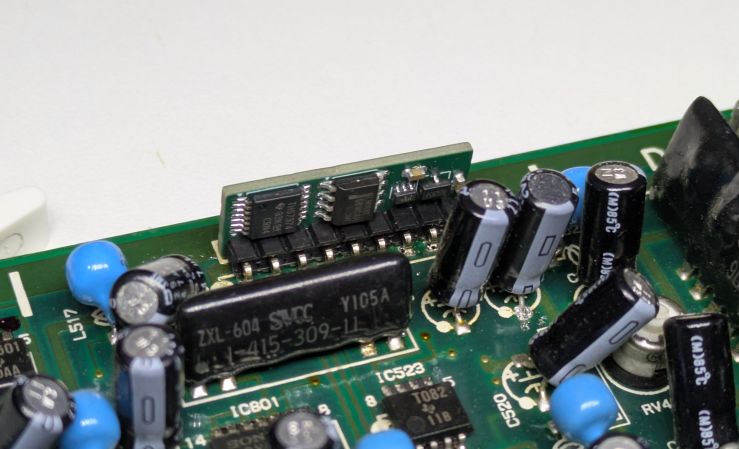
Rebuilding An Obsolete IC To Save A Betacam SP Tapedeck

Betacam is not the Betamax you may have had at home– it was a professional format that lived on into the 21st century, in the “SP” form. In many places, it would have been the last tape format in use. So it is perhaps understandable that [ldursw] decided to recreate an obsolete and unobtainable IC to save a Sony broadcast-grade editing Video Tape Recorder (VTR). Still mad, perhaps, but in a way we very much appreciate.

The Sony BVW-75 VTR had an odd flaw where the output lacked colour, unless paused with dynamic tracking off. Then colour would appear, but only in odd stripes. Clearly the chroma circuit was at fault. Some sluthing found that a sync separator IC– that separates the sync pulses that keep everything moving together, if the name didn’t give it away– wasn’t behaving correctly. More sluthing found that the chip in question was no longer available. Luckily, the concept of a sync separator hasn’t quite given up the ghost, and another part was available. It just didn’t fit, used a different voltage, and had an inverted output. No biggie! [ldursw] added a voltage regulator, an inverter, and a video amplifier chip, then after breadboard testing put them on a PCB with pins that match the original IC’s form-factor, making it a plug-in replacement.

That’s a GitHub link at the start of this article, by the way, so he’s open sourced the solution for anyone who needs a Toshiba TA7357P video sync separator. We don’t know who else needs this, but we’re willing to bet that whoever does, really needs it. On behalf of whoever that might be, we offer sincere thanks to [ldursw] for the hack, and for submitting it to our tips line.

This reminds us a little bit of a tape deck repair we featured previously, reviving another Sony format– D-1 tapes–to archive old media.

Fixing A JMicron-Based M.2 USB Enclosure That Stopped Working

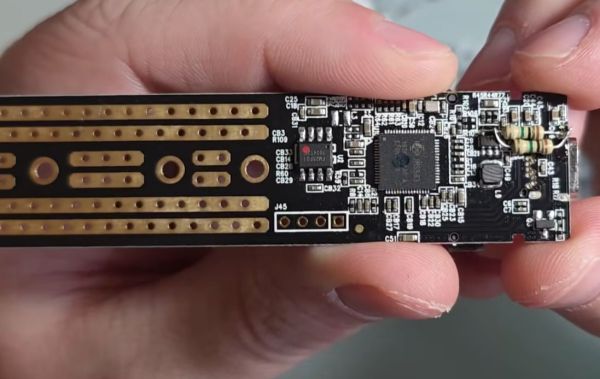
As useful as USB-to-M.2 SSD adapters are, sometimes you come across a bit of a dud. A case in point is the Orico-branded TCM2-C3 that features both an attractive clear case and in its earlier revisions a JMicron controller-based circuit that apparently degrades over time, causing erratic boot behavior. After implementing a fix a few years ago, [Mark Furneaux] can happily report that the thus fixed enclosures are still working.

These faulty board revisions feature the JMicron JMS583 controller IC, which has a 1.0V core voltage input pin. Apparently to save power, Orico designed the board to target the minimum ~-0.95V core voltage per the datasheet. Apparently due to component drift or degradation, this lower core voltage is after a while often not enough any more to start the controller, which thus translates into an unresponsive USB device and presumably some panic about lost data.

Although [Mark] doesn’t describe the fix in detail, it entails bumping up this core voltage to something closer to the nominal 1.0V, which restores functionality at the cost of presumably a measurable amount of extra heat production by said controller.

Later versions of the Orico TCM2-C3 enclosure switched from this JMicron controller to a Realtek one, which so far appears to be noticeably more reliable. Although Orico kept the same model name, the transparent enclosure makes it at least a snap to see which revision you are dealing with.

Continue reading “Fixing A JMicron-Based M.2 USB Enclosure That Stopped Working”

The newly surgerized internals

Pizza Eye Surgery Saves Hemispherical Projector

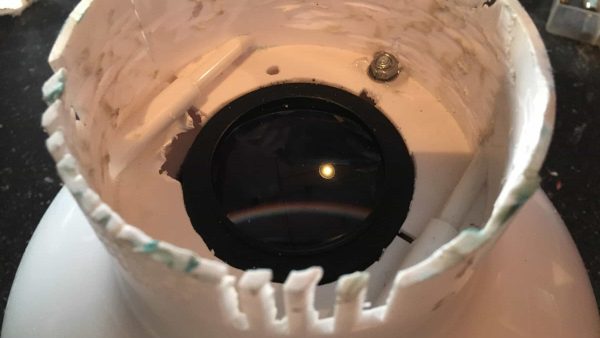
If you ever make it to DNA Pizza in San Francisco, you may feel as though you’re being watched. The Eye of the Pizza is Upon You. Or, it was, until the out-of-production and now very expensive spherical projector gave up the ghost during a power outage. It’s back, though! Thanks to proprietor [Jamie Zawinski] and some cheap, absolutely-not-supposed-to-be-in-there replacement parts.

The saga started long ago, back in 2017, when [Jamie] got ahold of a Gekkin WorldEye hemispherical projector. It looks like those were meant for the educational market, to show planets and the like, but [Jamie] instead put a big eye on it, thanks in part to work by [PaintYourDragon]. It looked great, as you can see from the demo video embedded below. There it sat, staring down patrons for nine long years, until the power company did what is known in the business as “an oopsie” and turned the WorldEye into an expensive paperweight.

Not to be deterred, [Jamie] got the cheapest projector he could find and an equally-bargain-bin fisheye lens originally meant for macro photography, and mashed them into the Gekkin case without a care for such fripperies as focal length. A little surgery later, and as [Jamie] puts it, “The Eye of Pizza is, Once Again, Upon You”. In spite of the projector being 16:9, thus not quite projecting across the whole surface of the dome and the image fuzzing a touch at the edges, the result works far better than it should for the amount of engineering that went into it. [Jamie] expects further improvements can come from tweaking the image on the software side, but it looks like the current iteration is good enough for pizza parlor decor.

We’ve featured another of [Jamie]’s hacks before, when he built a Linux payphone. Weirdly enough, this isn’t the first time the WorldEye has received a projector transplant around here.

Continue reading “Pizza Eye Surgery Saves Hemispherical Projector”

Wrangling Datacenter GPUs Into A Desktop

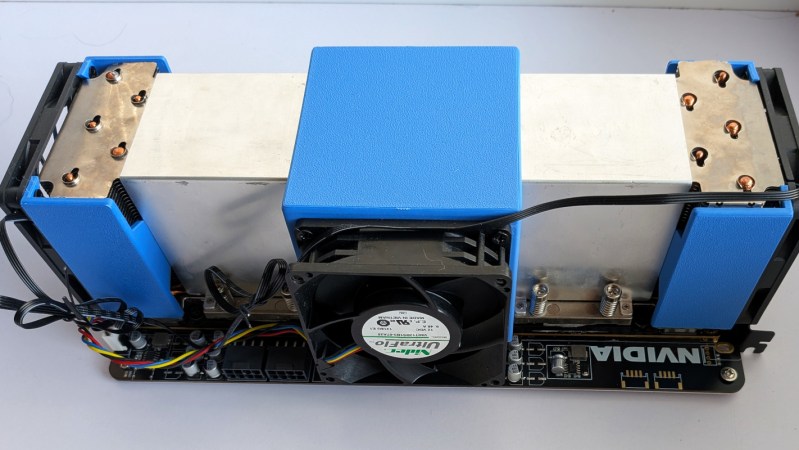
As we’ve seen many times before, there’s usually some way wrangle a bit more life out of what would otherwise be considered old and obsolete technology. Perhaps one thing that has been passed over by the masses a bit to early is older datacenter GPUs, which is understandable in one sense because of the rate NVIDIA is pumping out new ones, but these cards have plenty of useful life left in them for the average person, as [Andrew] demonstrates.

The cards [Andrew] is using are Tesla V100s of 2017 vintage. Despite being older hardware they have high-speed memory which allows them to run modern LLMs locally, competitively with online models. In this test, Gemma 4 26B and Qwen3 35B are run, with Gemma being a bit faster because it fits entirely in GPU memory and Qwen3 being a bit more capable but more hungry for resources. [Andrew] built a PCI card that can host two V100s, allowing these larger models to fit completely in memory.

Even though these don’t perform at the same level as the latest top-tier online models, they’re surprisingly capable and also have the benefit of running completely locally. This might be concerning for those looking at the global economy being propped up by companies that essentially have no moat for motivated users, especially as more and more datacenter hardware becomes available on the secondhand market. While this build by [Andrew] goes into detail on getting the software stack up and running, we recently featured another build using the same GPUs that focuses a bit more on hardware for those looking to get started with local hosting.

RC Telemetry Board Lets Virtual Crewmember Help You Race Better

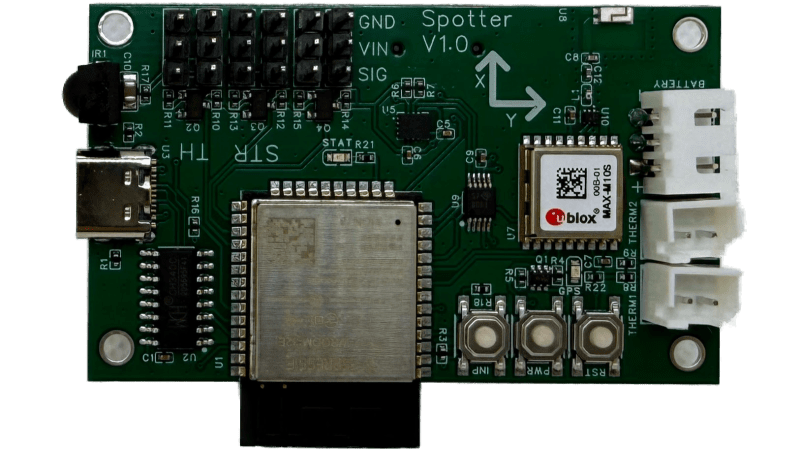
Logging and telemetry in remote controlled racing is a great thing, and not only does [jwachlin]’s Open RC Spotter do a fantastic job of that, it has quite a few clever tricks up its sleeve that make it extra special.

Open RC Spotter is an ESP32-based hardware platform for high performance RC car racing that reads from various sensors (including IMU, GPS, temperature, battery, and IR receiver for IR lap beacons) to create a filtered stream of readings that include position, velocity, lap time, battery voltage, and more.

Got RC car telemetry? Feed it to a virtual race engineer for real-time voice feedback.

This data gets logged to an SD card, but can also be broadcast wirelessly via ESP-NOW to a receiver that can in turn send it over serial USB, or do whatever else one wishes. There’s also a neat feature that fires up a temporary WiFi access point on demand so log files can be downloaded with a web browser, no need to hook up a cable.

So far, so cool. But there’s still another nifty feature. Open RC Spotter supports the Crew Chief telemetry protocol. Crew Chief is a piece of free Windows software that serves as a companion application for sim racing. It acts as a virtual race crew member, providing spoken information based on live telemetry read from supported racing sims.

Since Open RC Spotter supports the same telemetry format, one can use the virtual race engineer with RC car racing by simply feeding Open RC Spotter‘s serial data to the Crew Chief application. The RC telemetry data isn’t as rich as what comes from the racing sim APIs, but it’s more than enough to be useful.

People come up with all kinds of neat ideas when it comes to RC racing, and most of them depend on having access to good data. For example, a load cell in the steering mechanism can provides the data for force-feedback steering. We’ve even seen LiDAR and a depth camera used to automatically compute optimal racing lines.

A Capable KVM Built With The ESP32

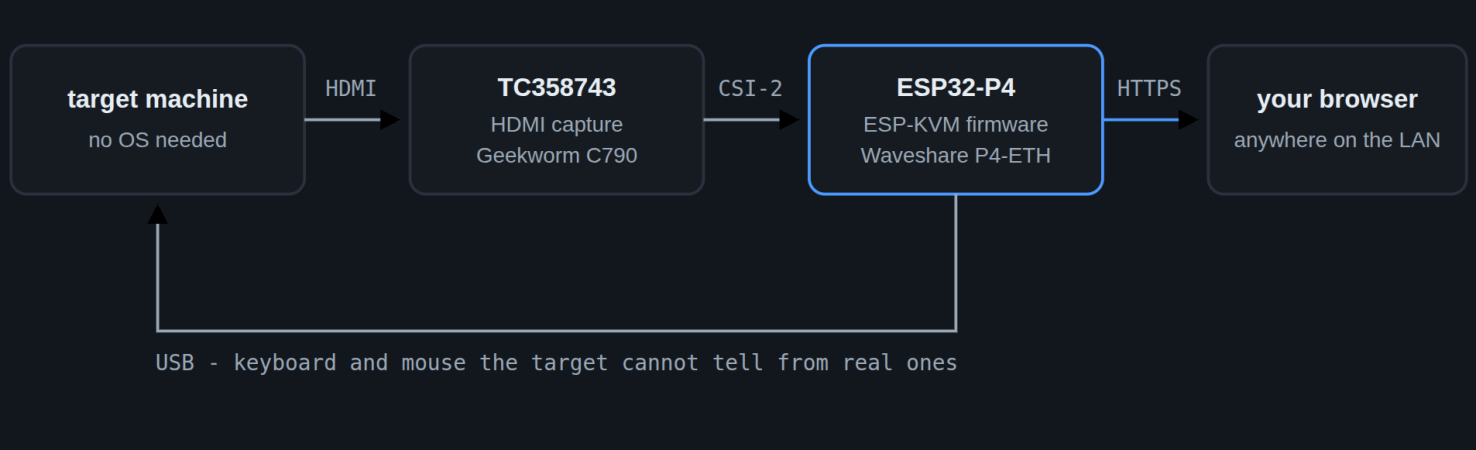
[Evgenij Spitsyn] spotted a KVM build on these very pages some time ago. That inspired their own build, leveraging the versatility of the ESP32-P4 microcontroller.

The concept is straightforward. Named the ESPKVM, the device is designed to hook up to a computer’s HDMI and USB ports. It captures the video output, while presenting itself as a standard keyboard and mouse device. In this way, it allows remote control of the machine over IP. It achieves this feat with the aid of the Toshiba TC358743 HDMI-to-CSI bridge, which is essentially the video capture hardware of the build.

The video output of the machine is streamed in MJPEG or H.264 format. The device is capable of serving up storage from a micro SD card or the onboard flash, as well as handling things like power/reset control and wake-on-LAN. All in all, it’s a very complete package, and full of useful features. Just don’t use it over the public internet yet — [Evgenij] notes it hasn’t been reviewed for potential security holes yet, even though it has some basic authentication features baked in.

If you’ve got an ESP32-P4 ready to go with a TC358743 HDMI bridge, you can actually head over to the ESPKVM website and flash the code right in your browser to get going. Meanwhile, if you found this build interesting, you might like to scope out the one that inspired it. If you’re cooking up similar utility hacks, be sure to notify the Hackaday tipsline.