Death To All Coca Cola Cans With This Miniature Arduino Powered Cannon

[MJKZZ] sends in this entertaining little tutorial on building a small automated cannon out of a syringe.

He starts the build off by modifying an arc lighter, the fancy kind one might use to light a fire on a windy day, so that it can be controlled by a micro-controller. The arc is moved to the needle end of the syringe with a careful application of wires and hot glue. When the syringe is filled with a bit of alcohol and the original plunger is pressed back in a small spark will send it flying back out in a very satisfying fashion.

Of course it wouldn’t be a proper hack without an Arduino added on for no reason other than the joy of doing so. [MKJZZ] adds an ultrasonic sensor into the mix which, when triggered appropriately by an invading object fires the arc lighter using a reed relay.

He demonstrates the build by eliminating an intruding coke can on his work bench. You can see it in the video after the break. All in all a very fun hack.

Continue reading “Death To All Coca Cola Cans With This Miniature Arduino Powered Cannon”
The Barn Find IBM 360 Comes Home

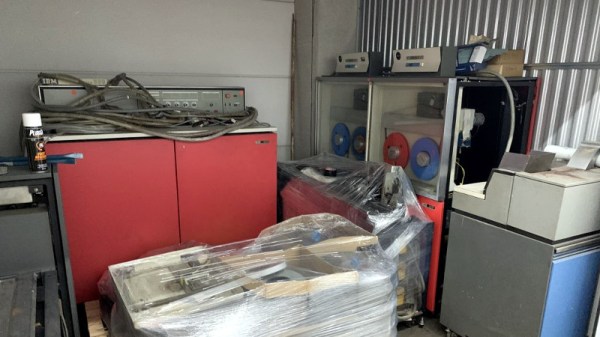
It’s a story that may be familiar to many of us, that of bidding on an item in an online auction and discovering once we go to pick it up that we’ve bought a bit more than we’d bargained for. We told you earlier in the year about the trio of Brits who bought an IBM System/360 mainframe computer from the mid 1960s off of a seller in Germany, only to find in the long-abandoned machine room that they’d bought not just one but two 360s, and a System/370 to boot. Their van was nowhere near big enough for all three machines plus a mountain of cabling, documentation, and period storage media, so they moved it to a hastily-rented storage unit and returned home to work out what on earth to do next.

Now we’ve received an email from the trio with some good news; not only have they managed to bring their hoard of vintage big iron computing back home, but also they’ve found a home for it in the rather unusual surroundings of a former top-secret UK Government signals intelligence station. With the help of a friendly specialist IT relocation company they unleashed it from their temporary storage and into the truck for the UK. It’s a tale of careful packing and plenty of wrapped pallets, as we begin to glimpse the true extent of the collection as you can see in the video below the break, because not only have they secured all the hardware but they also have a huge quantity of punched cards and disk packs. The prospect of a software archaeology peek into how a 1960s mainframe was used by its original customer is a particularly interesting one, as it’s likely those media contain an ossified snapshot of its inner workings.

We’re hoping to follow this project as it evolves, and see (we hope) a room full of abandoned junk transformed into a facsimile of a typical 1960s business computing setup. If you’d like to catch up, read our original coverage of the find.

Continue reading “The Barn Find IBM 360 Comes Home”

Using Glow-in-the-Dark Fish Gut Bacteria To Make Art

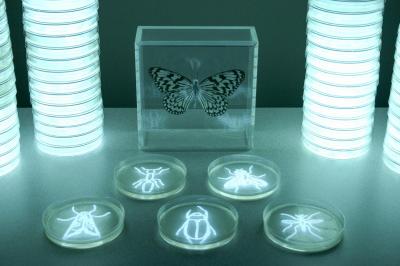
In New Orleans, a Loyola University professor has been creating original art out of glow-in-the-dark fish gut bacteria, enough to fill 1000 Petri dishes. Her first major foray into art was biomorphic abstractions, inspired by Impressionist painters, with her current work reflecting much of the abstraction of the earlier style.

The bacteria comes from the Pacific Rock Fish and glows a vibrant electric-blue. It is typically kept in a freezer and has a texture and color similar to water when it’s being used. The luminescence only lasts for 24 hours, presenting timing challenges when preparing artwork for a photoshoot, as artist [Hunter Cole] often does. With a Q-tip, [Cole] paints roses, lilies, and insects onto the Petri dishes and arranges them for surreal photography shoots. In addition to painting shapes in agar, she uses a light painting technique by filling clear water bottles with the bacteria for long-exposure shots.

[Cole] is planning on presenting her work at an art exhibit in New Orleans, along with showcasing a performance piece featuring models clad in chandelier-like costumes glowing with bioluminescent bacteria in petri dishes.

File Systems For Tiny Devices

Sometimes you build a computer and use it every day. Sometimes you build a different type of computer and it sits alone on a mountaintop for years. The design considerations for these two setups are remarkably different, right down to the type of file system used. For small computers like [Jo] is using, and for the amount of time they sit alone in remote locations, he decided to build his own file system for them.

Known as JesFs ([Jo]’s embedded serial File system), the file system is for SPI Flash and intended for use in scientific data logging. It can be used on the chip-scale processors found in many development boards, and is robust enough to use in applications where remoteness is a concern. It has a small RAM footprint, is completely open source, includes wear leveling, and has a number of security features built-in as well.

Some of the benefits of using a file system on such a tiny chip aren’t immediately obvious unless you’re doing a lot of data logging, but it does allow you to change virtually any aspect of the firmware much more easily if everything is accessible as a file, and not something you would have to change by reflashing the whole chip, for example. There are also a number of traps that you can easily fall into when working with file systems for tiny devices.

ESP32 Audio Sampling With Interrupts And IRAM

Interrupting while someone is talking is rude for humans, but smart for computers. [Ivan Voras] shows how to use interrupts to service the ESP32 analog to digital converters when sampling sound. Interestingly, he uses the Arduino IDE mixed with native ESP-IDF APIs to get the best performance.

Like most complex interrupt-driven software, [Ivan’s] code uses a two-stage interrupt strategy. When a timer expires, an interrupt occurs. The handler needs to complete quickly so it does nothing but set a flag. Another routine blocks on the flag and then does the actual work required.

Because the interrupt service routine needs to be fast, it has to be in RAM. [Ivan] uses the IRAM_ATTR attribute to make this work and explains what’s going on when you use it.

…the CPU cores can only execute instructions (and access data) from the embedded RAM, not from the flash storage where the program code and data are normally stored. To get around this, a part of the total 520 KiB of RAM is dedicated as IRAM, a 128 KiB cache used to transparently load code from flash storage.The ESP32 uses separate buses for code and data (“Harvard architecture”) so they are very much handled separately, and that extends to memory properties: IRAM is special, and can only be accessed at 32-bit address boundaries.

This is very important because some ESP-IDF calls — including adc1_get_raw — do not use this attribute and will, therefore, crash if they get pushed out to flash memory. At the end, he muses between the benefit of using an OS with the ESP32 or going bare metal.

If you want to know more about the Arduino on ESP32, we covered that. We also dug deeper into the chip a few times.

Learn Water Purification Techniques With This STEM Learning Kit

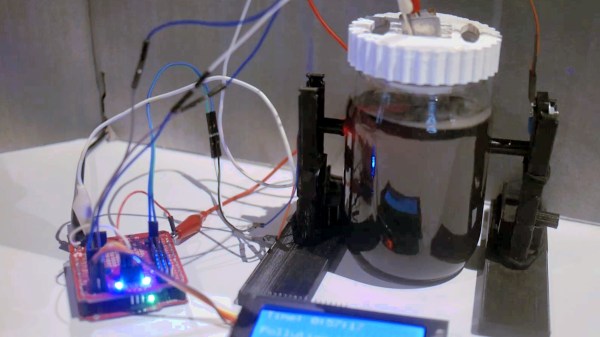
We see a lot of great STEM education projects. These projects have a way of turning into something much larger. How many commercial devices and machines are built on Raspberry Pi’s and Arduinos? [Ryan Beltrán] is using common materials to teach people how to clean water. This particular kit demonstrates a water purification process called electro-coagulation.

When current is passed through two electrodes suspended in water it changes the surface charge on the suspended solids. This causes the solids, metals, and oils to clump together which makes them considerably easier to treat and clean.

The kit consists of a jar, electrodes, some 3D printed parts, and a pre-flashed Arduino. There’s also salts and filters to finalize the purification process. Students can start the experiment right away and if they’re inspired they’ll have all the tools to try more advanced techniques.

Often STEM kits lean heavily to robotics or computer science, but there are so many vast and interesting fields out there with problems that need to be solved.

Beer Keg Becomes High-Performance Pizza Oven

Pizza varies all around the world, with several cities having put their own mark on the Italian dish. To make an authentic pie in the Neapolitan style requires extremely high temperatures in order to cook the pizza through in just a couple of minutes. Armed with a beer keg and some ingenuity, [AndrewW1977] got down to work, building a rig that could get the job done.

The build starts by cutting the keg in half. A series of zigzag steel pieces are welded inside, in order to give the refractory cement more surface area to stick to. With the cement poured and set, a handle was welded to the keg for ease of use, as well as a thermometer to monitor internal temperatures.

Initial attempts to cook using the rig used a wood-fired rocket stove design. This had the drawback of taking up to 45 minutes to reach the appropriate temperature, so the build then switched to using God’s Gas, clean burning propane, as a fuel source. With a jet-style burner installed in the base, the oven was ready to start turning out pizzas.

The idea of cooking a hot, fresh pizza in just a couple of minutes has us salivating at the possibilities. We’ve seen other high-speed pizza ovens, too. Video after the break.

Continue reading “Beer Keg Becomes High-Performance Pizza Oven”