NFC Enabled Business Card

[Sjaak] is back at it again with the cool PCB business cards, this time alleviating the burden to physically type his contact information into your phone. But NFC isn’t the only cool thing on this PCB – as always, his aesthetics don’t disappoint.

When we see [Sjaak’s] card, the future seems to be the now – not only do we have business cards that can take our pulse, we have business cards that actively help facilitate the exchange of contact information. I know what you’re thinking. “Business cards made of paper do that already.” That’s true if you read them. You have to physically remember you have the card (aka not put it through the wash), and, if you’re like most folks, you’ll ultimately enter the information into your cell phone’s contact list. Why not skip the whole reading thing? You know, just zap your contact information into the contact list of people automatically?

Maybe this is exactly what [Sjaak] thought when he built his NFC enabled business card. Maybe not. Regardless, [Sjaak’s] card is beautiful – both in implementation and aesthetics. Powered by “a nice little NFC EEPROM from NXP”, (the NT3H1101) the business card even has an energy harvesting mode. Moreover, one can interact with the card via four buttons and an LED. The LED informs the user what mode the card is currently in, and the buttons choose which URL is sent to users via NFC. To add icing to the cake, the back of the PCB is decked out via [Sjaak’s] custom full-color decal process we covered back in August.

As great as it looks, the card still needs some improvement. “I still need to tackle the sharp and protruding components on the front, which will ruin your wallet.” But, in our eyes, the card is surely on its way to greatness, and we look forward to seeing its final form. However, if you’re anything like us, you might want to see some other rad PCB business cards while you wait. If that’s the case, we recommend this logic based finite machine and this card made by a hackaday author.

Alas, Poor Yorick! He Hath Not Amazon Prime

If you are looking around for a Halloween project, you might consider The Yorick Project from [ViennaMike]. As you can see in the video below, it marries a Raspberry Pi acting as an Amazon Alexa with an animatronic skull.

This isn’t the most technically demanding project, but it has a lot of potential for further hacking. The project includes a USB microphone, a servo controller, and an audio servo driver board. It looks like the audio servo board is controlling the jaw movement and based on the video, we wondered if you might do better running it completely in software.

Continue reading “Alas, Poor Yorick! He Hath Not Amazon Prime”

LoRa Is The Network

We’ve become used to seeing LoRa appearing in projects on these pages, doing its job as a low-bandwidth wireless data link with a significant range. Usually these LoRa projects take the form of a client that talks to a central Internet connected node, allowing a remote wireless-connected device to connect through that node to the Internet.

It’s interesting then to see a modest application from [Mark C], a chat application designed to use a set of LoRa nodes as a peer-to-peer network. In effect LoRa becomes the network, instead of simply being a tool to access it. He optimistically describes peer-to-peer LoRa networks as the new FidoNet in his tip email to us, which might be a bold statement, but we can certainly see some parallel. It’s important to note that the application is merely a demonstrable proof-of-concept as it stands, however we’d agree that it has some potential.

The hardware used for the project is the Heltec ESP32-based LoRa board, which comes with a handy OLED screen on which the messages appear. As it stands a PC connection is required to provide text input via serial, however it’s not impossible to imagine other more stand-alone interfaces. If it interests you the code can be downloaded from the GitHub repository, so maybe this can become the seed for wider peer-to-peer LoRa networks.

There have been no shortage of LoRa projects featured here over the years. Recent ones include a handy local LoRa packet sniffer, and news of an extreme distance record from a LoRa node on a balloon.

FPGA Design From Top To Bottom

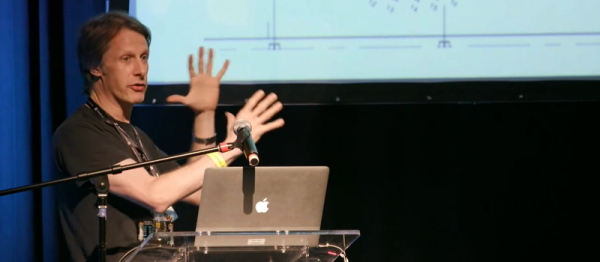
[Roland Lutz] gave a talk about FPGA design using the free tools for Lattice devices at the MetaRheinMainChaosDays conference this year. You can see the video below. It’s a great introduction to FPGAs that covers both the lowest-level detail and some higher level insight. If you’re getting started with these FPGAs, this video is a must-see.

[Roland] starts with the obligatory introductory material. He then jumps into an actual example before zooming back out to look at the internal details of the Lattice FPGA. For instance, this FPGA supports multiple bitstreams, so you can switch between different “programs” on the fly.

Continue reading “FPGA Design From Top To Bottom”

Listen To The Netherworld With Artificial Intelligence

It’s that time of year again, and with Halloween arguably being the hacker’s perfect holiday, we’re starting to see a tick up in projects with a spooky theme. Most seem to do with making some otherwise tame Halloween decorations scarily awesome, but this is different — using artificial intelligence to search for ghosts.

It seems like [Matt Reed]’s “DeepWhisper” project is meant to be taken as light-hearted fun for the spooky season, but there may be a touch of seriousness to his efforts to listen in on ghostly conversations. The principle behind this is electronic voice phenomena (EVP), whereby the metabolically and/or dimensionally challenged are purported to influence electronic systems, resulting in heavily processed audio clips that seem to have a whispered endearment from the departed or a threat from a malevolent spirit. DeepWhisper takes this a step further by using a Raspberry Pi to feed audio into the Google Cloud Speech API for analysis. If anything is whispered in one of the 110 or so languages Google knows, it’ll get displayed on a screen. [Matt] plans to set DeepWhisper up in the aptly-named Butchertown section of Nashville and live-stream the results next week.

It’ll be interesting to see what Google’s neural network makes out of the random noise it will probably only ever hear. And [Matt] is planning on releasing his code for all to see, so there may be some valuable cloud techniques to learn from DeepWhisper. But in the unlikely event that he does discover ghosts, it’s nice to know you can have the tools and the talent to bust ’em.

Continue reading “Listen To The Netherworld With Artificial Intelligence”

DIY Laptop Aims For Complete Hardware Freedom

Open source software has unquestionably gone from fringe idealism to mainstream, even if the average person doesn’t really know it. From their web browser to their smartphone operating system, more people are running open source software today than at any other time in the history of computing, and the numbers are only getting bigger. While we can debate how well some companies are handling their responsibilities to the open source community, overall this is probably a lot closer to an open source utopia that many of us ever believed we’d get.

For argument’s sake, let’s say the software is settled. What’s next? Well, if we’ve got all the open source software we could ever ask for, naturally we now need to run it on open source hardware. Just like our software, we want to see how it works, we want to modify it, and to fix it ourselves if we want. These goals are precisely what [Lukas Hartmann] had in mind when he started work on Reform, the latest entry in the world of fully open source laptops.

A plate of fresh keycaps

Like the Novena that came before it, the Reform leverages the four-core ARM Cortex-A9 NXP i.MX6 SoC to deliver tablet-level performance, though [Lukas] mentions the design may migrated to the upgraded six-core version of the chip in the future which should give it a little more punch. The SoC is paired with the Vivante GC2000 GPU which can be used under Linux without any binary blobs. Most hardware is connected to the system via the USB 2.0 bus, though networking is provided by a ThinkPenguin mini PCI-e wireless adapter, and on-board SATA handles the 128 GB SSD.

While the internals are relatively run-of-the-mill these days, the work that [Lukas] has done on the case and input devices is definitely very impressive. He partnered with industrial designer [Ana Dantas] to get the look and feel of the system down, and built almost everything out of 3D printed parts. Even the keyboard caps and the trackball were manufactured in house on a Formlabs Form 2. Rather than using an off-the-shelf USB HID solution, [Lukas] is using Teensy LC boards to interface the custom input hardware with the OS.

[Lukas] is still working on how and when the Reform will be made available to the public. After some refinements, the team hopes to make both kits and individual parts available, and of course put all the files up so you can build your own if you’ve got the equipment. A mockup Amazon listing for the Reform has been posted to get the public’s feedback on the look and features of the machine, and [Lukas] asks that anyone with comments and suggestions send him an email.

Between the Reform, Novena, and the Olimex, competition in the realm of DIY laptops is frankly staggering. Now we just need more people working on open hardware smartphones.

Thanks to [Adrian] for the tip.

Hackaday Prize Entry: Thingspeak IoT Heart Rate Monitor

[Naman Chauhan]’s 2017 Hackaday Prize entry consists of a heartbeat detection and monitoring system that centers around everyone’s favorite WiFi board, the ESP8266. The monitor is hooked up to the patient’s finger, keeping track of his or her vitals and publishing the data on the cloud.

By using Thingspeak to manage the data, [Naman] leverages the platform’s data visualization and analytical features. Also, by making the data accessible on the cloud, he offers an intriguing opportunity to help friends and relatives to monitor the data. If you think about it, if you had a loved one in the hospital, wouldn’t having all of his or her chart available on your phone be great?