When we hear about the Internet of Things, we’re thinking it’s a portable device with a sensor of some kind, a radio module, and the ability to push data up to the Internet. There’s nothing that says a device that puts data on the Internet has to be portable, though, as [Jeff] from ReelyActive showed us at HOPE X last weekend.
[Jeff]’s startup is working on a device that turns every space into a smart space. It does this with radio modules connected to a computer that listen to Bluetooth and the 868, 915 and 2400MHz bands. These modules turn every place into a smart space, identifying who just walked into a room, and who is at a specific location. Think of it as the invisible foundation for any truly smart house.
The radio modules themselves are daisychained with Cat5 cable, able to be plugged into a hub or existing Ethernet drops. The software that makes the whole thing work can run on just about anything; if you want a Raspi to turn on the lights when you enter a room, or turn off a thermostat when you leave a building, that’s just a few lines of code and a relay.
The software is open source, and [Jeff] and his team are looking at making the hardware open. It’s a great idea, and something that would be a good entry for The Hackaday Prize, but ReelyActive is located in Montréal, and like Syria and North Korea, we’re not allowed to run a contest in Quebec.


 Simple machines are wonderful in their own right and serve as the cornerstones of many technological advances. This is certainly true for the humble lever and the role it plays in manual transmissions as evidenced in this week’s Retrotechtacular installment,
 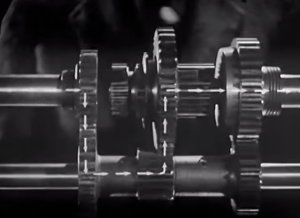 Next, we are shown how engine power is transferred to the rear wheels: it travels from a gear on the engine shaft to a gear on the drive shaft through gears on the countershaft. At low speeds, we let the smallest gear on the countershaft turn the largest gear on the drive shaft. When the engine is turning 90 RPM, the rear wheel turns at 30 RPM. At high speeds using high gears, the power goes directly from the engine shaft to the drive shaft and the RPM on both is equal. The film goes on to explain how the gearbox handles reverse, and the vast improvements to transmission life made possible through synchromesh gearing.