Weather-O-Matic Displays Digital Weather On An Analog Face

SANYO DIGITAL CAMERA

This clean-looking readout uses analog dials to display the weather. [Nuno Martins] calls it the Weather-O-Matic and after the jump he explains what went into the project.

The hardware is about as simple as it gets. Each hand has a servo motor attached to it. An MSP430 gets the weather via a serial connection to a computer (data is scraped by a Python script) and sets the dials accordingly. The microcontroller also takes user input in the form of a single button on the side of the frame. The words on the left side of the dial are Portuguese for Today, Tomorrow, and After (meaning the day after tomorrow). Pressing the button multiple times will scroll through these three words, followed by the forecast temperature high and low for that day being displayed.

The nice thing about this is that the servo motors will stay in place if you cut the power to them. We bet if he wanted to make this a permanent fixture in his house he could get it to run well on batteries by using the sleep function of the microcontroller and adding an RF transceiver to communicate with the server.

Continue reading “Weather-O-Matic Displays Digital Weather On An Analog Face”

3D Printer Used To Make Custom Blade Server Type Mounting System

3d-printed-blade-server-mounts

We usually have no problem hacking together electronics into something useful. But finding an enclosure that makes sense for the build can be a real drag. In this case [Vincent Sanders] already had a working ARM build farm that leveraged the power of multiple ARM boards. But it was lying in a heap in the corner of the room and if it ever needed service or expansion it was going to be about as fun as having a cavity drilled. But no longer. He took inspiration from how a blade server rack works and 3D printed his own modular rail system for the hardware.

Each group of boards is now held securely in its own slot. The collection seen above mounts in a server rack which has its own power supply. This image is part way through the retrofit which explains why there’s a bunch of random pieces lying around yet. Instead of printing continuous rail [Vincent] uses a threaded rod to span the larger frame, securing small chunks of rail where needed by tightening nuts on either side of them. The white and red trays are prints he ordered from Shapeways designed to secure the eurocard form factor parts.

[Thanks Thomas]

Fabricating A Mechanical Wristwatch At Home

diy-mechanical-wristwatch

Our mouth is still agape after digging through [Tom’s] watchmaking blog. This gentleman spent several years designing and machining his own mechanical wristwatch. A dozen years ago or so [Tom] answered an ad for an apprentice watchmaker. He worked on watches and came across a book that detailed how timepieces are made. He was told that no-one does it like that anymore, which only fed his curiosity. What he came up with is, to his knowledge, the first timepiece every made in Australia.

It’s no secret that we have a thing for clocks. But we feature digital timepieces almost exclusively. We’ve love mechanical watches too but don’t see them as hobby projects very frequently. After looking at what goes into the mechanism it’s not hard to see why.

[Tom] was faced with a variety of challenges along the way. One of the biggest was having to come up with tools that would let him perform the precise milling work necessary to achieve success. You’ll want to read through his movement design and manufacture posts. He laid out the plan in CAD, but ended up using some hacked together milling tools to get the job done.

[Thanks Amit]

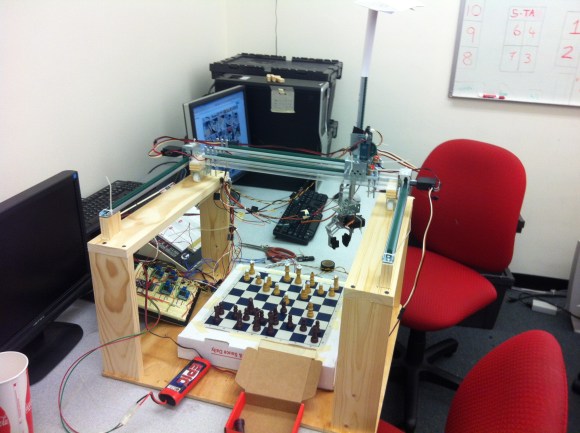
DVD Laser Diode Used To Build A Laser Engraver

[Johannes] has been reading Hackaday for years but this is the first project he’s tipped us off about. It’s a laser engraver built from a DVD burner diode (translated). It turned out so well we wonder what other projects he’s forgotten to tip us off about?

This is the second CNC machine he’s seen through from start to finish. It improves upon the knowledge he acquired when building his CNC mill. The frame is built from pine but also uses bits of plywood and MDF. It can move on the X and Y axes, using drawer sliders as bearings. The pair of blue stepper motors drive the threaded rods which move the platform and the laser mount. Just above the laser he included a small DC fan to keep it from burning up. The control circuitry is made up of an Arduino Nano and a stepper motor driver board. Catch a glimpse of the engraver cutting out some stencil material after the break.

There must be something about Spring that brings out the urge to work with laser diodes. We just saw a similar 1W cutter last week.

Continue reading “DVD Laser Diode Used To Build A Laser Engraver”

Tracking Ships Using Software-defined Radio (SDR)

tracking-ships-using-sdr

When we first started hearing about software-defined radio hacks (which often use USB dongles that ring it at under $20) we didn’t fully grasp the scope of that flexibility. But now we’ve seen several real-life examples that drive the concept home. For instance, did you know that SDR can be used to track ships? Ships large and small are required by may countries to use an Automatic Identification System (AIS) transponder. The protocol was originally developed to prevent collisions on large ships, but when the cost of the hardware became affordable the system was also brought to smaller vessels.

[Carl] wrote in to share his project (which is linked above). Just like the police scanner project from April this makes use of RTL-SDR in the form of a TV tuner dongle. He uses the SDRSharp software along with a Yagi-UDA. The captured data is then decoded and plotted on a map using ShipPlotter.

The First 3d Printed Gun Has Been Fired, And I Don’t Care.

3d-printed-gunSeveral people have sent us this story. I’ve seen it everywhere. A lot of people are upset, on several sides.  A gun has been 3d printed that can actually fire a round.

First, we have people scared that this will bring undetectable guns to people who wouldn’t have had access before. Then we have the gun fans that are reacting to the others with shouts of freedom and liberty and stuff.  The 3d printing community has had mixed reactions, but many are concerned that this will harm 3d printing in general.

I simply don’t care.

Continue reading “The First 3d Printed Gun Has Been Fired, And I Don’t Care.”

Update: Grow Controller Rebuilt To Last

new-grow-controller

[The Cheap Vegetable Gardener] assembled his first grow controller about three and a half years ago. He’s been very happy with it and knows that he’ll be using it for years, maybe even decades to come. He just finished overhauling the grow controller design to help make sure he doesn’t burn down his garage one day. You have to admit, without knowing anything about the project this rendition does look safer than his original offering.

Pictured above is the weather-proof enclosure he used to house four mains-rated solid state relays. This box is isolated from the control hardware, providing heavy-duty utility plugs to interface with the heater, lights, fan, and water pump.  He mounted the Arduino board which controls the relays to the outside of the box, using the Ethernet wire to switch the SSRs. It uses a manufactured shield he designed which will help ease the pain of fixing the system if parts ever go bad.

Later on in the build he shows the grow light and heaters used in his operation. The heaters simply screw into light sockets; something we’ve never come across before.