Your Own Head-mounted Display For Under Two Bills

CIMG1078

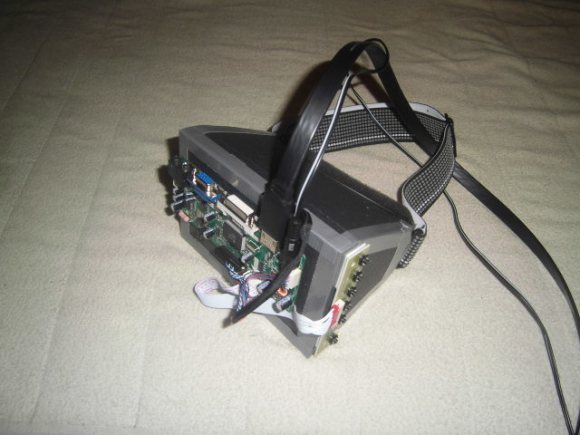
[D S] wanted his own head-mounted display. What you see here is just his mockup, but somewhere along the way he realized it’s closer to a finished build than just being a stating point. Not only does it work well for gaming, it came in at under $200 all in. You think your girlfriend makes fun of you now for wearing that big microphone headset while playing? Just wait until she gets a load of these!

We’ve embedded an image gallery after the break as well as the description he sent us with his email. The display itself is a 7″ LCD module from eBay that boasts a hair better than 720P resolution: 1280×800. He’s using a pair of ski goggles to strap the display to his noggin. The enclosure is made out of foam board which should help keep the weight down. Inside there’s a Fresnel lens but after reading his description of how he measured the focal length we’re still not 100% clear on how he figured out where to mount it.

Though it may be missing the 3d of the rift,a quick mod could fix that and he’ll be well on his way through the journey to building his own Holodeck.

Continue reading “Your Own Head-mounted Display For Under Two Bills”
3D Scanner Made In A Day

diy-3d-scanner

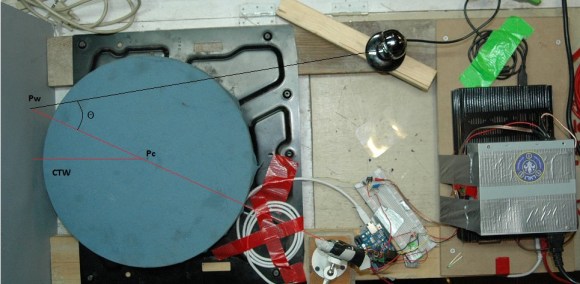
The LVL1 Hackerspace held a hackathon back in June and this is one of the projects that was created in that 24-hour period. It’s a 3D scanner made from leftover parts. The image gives you an idea of the math used in the image processing. It shows the angular relations between the laser diode, the subject being scanned, and the webcam doing the scanning.

The webcam is of rather low quality and one way to quickly improve the output would be to replace it with a better one. But because the rules said they had to use only materials from the parts bin it worked out just fine. The other issue that came into play was the there were no LCD monitors available for use in the project. Because of that they decided to make the device controllable over the network. On the right you can see a power supply taped to the top of a car computer. It connects to the laser (pulled out of a barcode scanner which produces a line of red light) and the turntable. A Python script does all of the image processing, assembling each slice of the scan into both an animated GIF and an OBJ file.

[Thanks Nathan]

Weightless, The Hopefully-not-vaporware Internet Of Things Chip

Weightless

Imagine a single chip able to interface with your Ethernet, USB, and serial devices, turn those connections into wireless radio signals with miles of range, able operate off a single AA battery, and costs less than $2. That’s the promise of the Weightless special interest group that wants to put several hopefully not vaporware radio chips in the hands of everyone on the planet.

Long-range wireless networks are a tricky thing; for home networks, Bluetooth and WiFi reign supreme. Venturing into the outdoors, or really any place more than a few hundred feet from a WiFi repeater is a challenge, though. If you’re trying to send data to a fleet of automobiles, track an endangered animal, or make a smart power grid, your only real option is a cell phone tower with very high costs in hardware and battery life.

Weightless hopes to change that with a small radio chip that includes a MAC, PHY, and all the components necessary to turn just about any digital connection into a wireless link between devices. The radio will operate in the spectrum left behind by UHF TV (470 – 790MHz), and the folks working on already have some reference designs etched into silicon.Don’t expect this to replace WiFi, cellular, or Bluetooth, though: according to the getting to know Weighless book, the designers are aiming for a data rate of only a few kB/s.

Still, it’s a great use of now unused spectrum, and would fill a huge gap in what is readily possible with homebrew Internet of Things things.

Tip ‘o the hat to [Mark] for sending this one in.

Hacking A Coffee Machine For A Better Brew

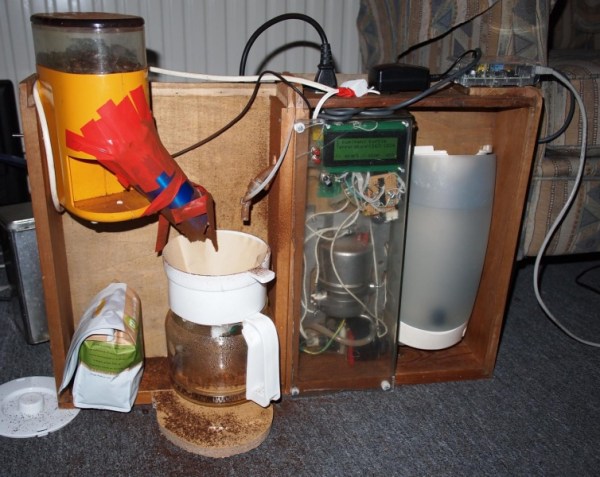
Senseo coffee makers are automated brewers that use coffee pods. [Ronald] had one, but wasn’t satisfied with the quality of the coffee it produced. His solution was to hack it apart and build his own automatic coffee machine with the innards.

The coffee brewing part of the system is controlled by an ATmega8. This reads the temperature using the NTC sensor from the original machine and actuates the various parts of the Senseo machine, and the added grinder. The timing was all done by trial and error, optimizing for the best cup of coffee.

Keeping with the trend of adding Raspberry Pis to everything, [Ronald] connected one to this build for remote control. He runs a very hacked version of LCD2USB which deals with communicating with the RPi. An Apache web server hosts a PHP script to provide a user interface, which runs a C program to tell the system to start brewing.

Unfortunately, [Ronald] didn’t give us a link to his web interface, so we can’t remotely brew him coffee. However he did provide all of the source for the project in his write up.

555-timer Charges Lead Acid Batteries

555-timer-charges-lead-acid-batteries

[Kenneth Finnegan] took the focus of a great design and redirected it to solve his own problem. What results is this lead acid battery charger based on the 555 timer. It’s not a top-of-the-line, all the bells and whistles type of charger. But it gets the job done with a readily available IC and no need to code for a microcontroller.

The original idea came from a solar battery charger entered in the 555 timer contest. The main difference in application between that and [Kenneth’s] application is the source. A solar array or wind turbine is limited on how much juice it can produce. But mains power can push a shocking (har-har) amount of current if you’re not paying attention. Herein lies the alterations to the circuit design. To control this he’s using a Laptop power supply as an intermediary and only implementing the constant current portion of the tradition 3-stage lead acid charging profile (those stages are explained in his write up).

He did a talk on the charger at his local radio club. You can see the 90-minute video after the break.

Continue reading “555-timer Charges Lead Acid Batteries”

Toroid Winding Cheat

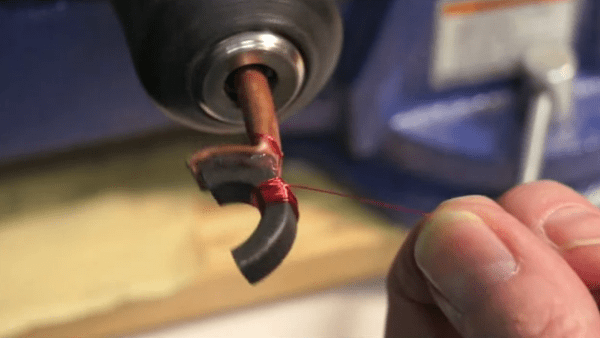
When you need a toroid the easiest source is often to wind it yourself. The problem being that placing a few hundred windings around a ferrite ring is a real drag, especially if you have to make several of them. This cheat developed by [Jim W.] will save a lot of time. He cuts the ring in half for the winding and reassembles it afterward.

Here you can see that he has half of the core mounted in a drill chuck. To get to this point he scored the ferrite before clamping half in a vice and whacking the extruding half with a block of wood and a hammer. He hasn’t found a perfect solution for scoring the material (a utility knife or a triangular file both work but have drawbacks). Leave a comment if you’ve got any bright ideas.

Once the core is in two pieces he used some copper pipe with one end flattened and bent to the shape of the ring segment. With it hot glued in place he takes it for a spin (shown in the clip after the break). Once the windings are done a bit of super glue recombines the halves. This sort of thing is great for monitoring power use.

Continue reading “Toroid Winding Cheat”

Hackaday Links: Valentine’s Day, 2013

It’s not too late to hack your own Valentine’s day gifts. Here’s four projects to get you headed in the right direction.

Heart-shaped box

links-hear-giftbox

[Ian] built what he calls the Valentine’s gift bomb. It’s a cigar box with this LED heart on the top. A servo motor latches the lid from the inside and won’t open until the thing goes off on the big day. (sorry, no link to this one as he just sent us the pictures found after the break).

A Blinky Bouquet

links-led-flowers

[Ryan] shows us how to make a felt bouquet and then light things up with some LEDs.

Pictures in a bottle

links-valentines-bulb

Reuse that old incandescent bulb by adding LEDs and heart-shaped pictures inside the glass enclosure.

Robot love

links-valentines-robot

This cocoa container turned robot cat calls, raises its eyebrows, and blinks the LEDs eyes when she presses the button on top.

Continue reading “Hackaday Links: Valentine’s Day, 2013”