Ankle Bracelet Lets You Become Emperor Palpatine

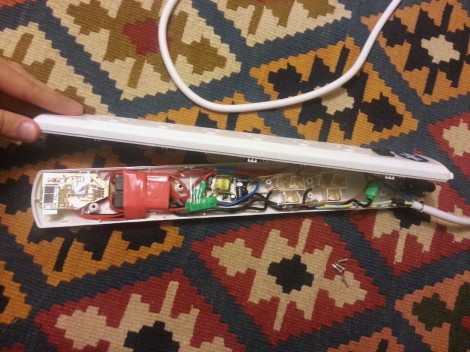
Want to shoot lighting bolts from your hands to punish your enemies? You can (almost) do just that with this static electricity generator hack. Above you can see the charge jumping off of this guy’s knuckle and surging through the LED. But that’s not the only trick you can pull off when wearing just a bit of hardware around your ankle. The video after the break shows sand grains jumping around as a charged hand is waved over them.

The trick is done by powering a negative ion generator from a 9V battery. This can’t be done directly, since the ion generator is looking for an AC power source. But conversion is as easy as scrapping an inverter which is designed to plug into a car cigarette lighter. Everything is shoehorned into a glasses case, which can then be strapped on to your ankle. Why this fascination with the ankle area? One part of the answer is that this provides an easy way to interface the ion generator output with your skin. The other part of the answer is that you need to make sure the system is grounded (but you’re not) and the build includes a ring that goes around your shoe to achieve this.

Check out the demo and full build instructions in the video after the break.

Continue reading “Ankle Bracelet Lets You Become Emperor Palpatine”

Robotic Rock-paper-scissors Never Lets You Win

So robots kick our butts at tic-tac-toe, chess, Jeopardy, and now they’re the dominant species at rock-paper-scissors too. This robot arm will outmatch your at the game every single time. It’s not just fast enough to keep up, but it figures out what you’re planning to do and reacts according. All of this happens way to fast for you to catch it in the act.

Researchers at the University of Tokyo came up with the idea of combining high-speed vision with a high-speed hand. Apparently one millisecond is all it takes to analyze what move you’ve chosen. The time it takes for the hand to form the conquering position is only marginally longer than that. As you can see in the clip after the break, it already knows the protocol of 1-2-3 shoot and doesn’t need any operator intervention to start a new game, or repeatedly school you on trying to compete with a machine.

We’ve been beaten at the game by a machine before. This is just first time that the human player doesn’t need to wear special equipment and the machine has moved from a virtual hand to a physical one.

Continue reading “Robotic Rock-paper-scissors Never Lets You Win”

Baking Better Bread With Steam

It’s not often we see a build that turns you into a better cook without any electronics whatsoever. [Chris]’s method of baking better bread with steam is one of those builds, and we’re more than willing to test it out on our own.

If you’ve ever tried to bake bread at home, you’ll quickly notice the crust is much thicker and harder than a loaf available at a bakery. The thickness of the crust can be controlled, however, with a careful application of steam. To make a better crust, [Chris] used a pressure cooker fitted with a valve to inject steam into an oven through his oven’s exhaust. Not only does this gelatinate the starches in the bread crust, but it keeps this gelatin from hardening too quickly.

The end result is a thin, golden brown crust that makes for the perfect loaf of bread. Of course, the proper application of steam does take a little bit of practice. If someone is up to the task of Arduinofying this hack with a few solenoid valves, PID sensors, and a high-temperature humidity sensor, send it in and we’ll put it up.

Getting Started With Software Defined Radio

In the last few months, software defined radio has seen an explosion in popularity thanks to a small USB TV tuner dongle able to receive anything broadcast between 64 and 1700 MHz. It’s a very neat project that opens the door to a whole bunch of radio experimentations, but getting started in the SDR world can be a bit daunting. To help everyone out, [MS3FGX] is writing a getting started guide so everyone can get into the world of software defined radio.

After getting one of the TV tuners supported by the RTL-SDR project (by far the most commonly used is this one from Dealextreme), the next thing you’ll need is a decent antenna. [MS3FGX] has had some success with this Radio Shack antenna, but it’s very easy to make your own.

The most popular software package to use with the RTL TV dongle is GNU Radio, and [MS3FGX] goes over the ins and outs of setting this up along with a brief aside for the Gqrx receiver.

After your hardware and software is set up, the only thing left to do is tuning into a few of your favorite stations. The range of frequencies the RTL covers includes AM and FM radio, along with GSM and GPS signals. Of course there’s a whole lot more you can do with this project like listening in on your car’s keyless entry fob, pagers, and wireless weather stations.

An Etsy For Electronics

A few months ago we caught wind of Tindie, a site that gives builders, tinkerers, makers, and hackers a place to sell their projects. Well, Tindie has gone live and it looks to be cooler than we expected.

Already there are some pretty awesome projects available on Tindie such as a truly awesome MIDI keyboard, an Arduino synthesizer, and even a robot that plays Angry Birds.

In addition to giving makers a place to sell their wares, Tindie also offers a place to post want ads. If you have an idea for a project but don’t have the skills or tools to pull it off, Tindie is just the place for you. Any builder is free to make a bid for jobs that include a sonic screwdriver TV-b-gone or a Pip boy

Hopefully, Tindie will pick up some steam and fill the role of a much geekier Etsy. For now, though, we eagerly await the eventual Tindie/regretsy mashup showcasing perpetual motion machines and alien overlord detectors.

Quick Look At The Soldercore Dev Board

It seems like hacker-friendly ARM development boards are just exploding into the market right now. Here’s one we haven’t looked at yet. The SolderCore is made by Rowley Associates and is packed with features which help to explain the $80 price tag. [CharlieX] just ordered one and posted a bit about his first day with the device.

First off, it’s obviously the Arduino form factor. We think that’s a nice touch in a development board, but we still wish the Arduino folks hadn’t offset that one header way back when. That chip at the center packs quite a wallop; an 80 MHz ARM Cortex-M3 (from TI) with 512 kb of Flash memory and 96 kb of RAM. The in-built Ethernet jack is hard to miss, but right below it in this picture you can also see the USB On-the-Go connector. There’s a microSD card slot and both 3V and 5V regulators. [CharlieX] does a little hacking on the networking features offered, then takes a look at firmware upgrading. For that you’ll need an SD card formatted to FAT 16.

Chiptune Player Uses Preprocessed .MOD Files

[Kayvon] just finished building this chiptune player based on a PIC microcontroller. The hardware really couldn’t be any simpler. He chose to use a PIC18F2685 just because it’s big enough to store the music files directly and it let him get away with not using an external EEPROM for that purpose. The output pins feed a Digital to Analog Convert (DAC) chip, which in turn outputs analog audio to an LM386 OpAmp. The white trimpot sandwiched between the chips controls the volume.

The real work on this project went into coding a program which translates .MOD files into something the PIC will be able to play. Because of the memory limits of the chip it is unable to directly use all of the instrument samples from these files. [Kayvon] wrote a program with a nice GUI that lets him load in his music and page through each instrument to fine-tune how they are being re-encoded. The audio track from the video after the break doesn’t do the project justice, but you will get a nice look at the hardware and software.

Continue reading “Chiptune Player Uses Preprocessed .MOD Files”