Control Your House By Moving Your Arms Like You’re Directing Traffic

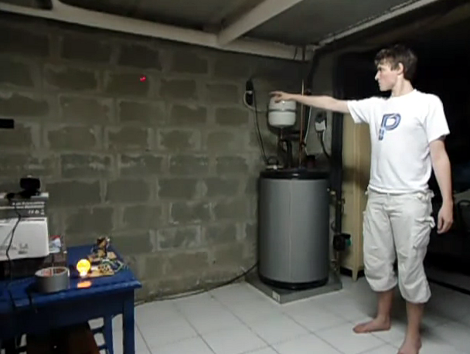
This home automation project lets you flap your arms to turn things on and off. [Toon] and [Jiang] have been working on the concept as part of their Master’s thesis at University. It uses a 3D camera with some custom software to pick up your gestures. What we really like is the laser pointer which provides feedback. You can see a red dot on the wall which followers where ever he points. Each controllable device has a special area to which the dot will snap when the user is pointing close to it. By raising his other arm the selected object can be turned on or off.

Take a look at the two videos after the break to get a good overview of the concept. We’d love to see some type of laser projector used instead of just a single dot. This way you could have a pop-up menu system. Imagine getting a virtual remote control on the wall for skipping to the next audio track, adjusting the volume, or changing the TV channel.

Continue reading “Control Your House By Moving Your Arms Like You’re Directing Traffic”

The ShockerDrone; A Shocking Mod For The AR Drone


You’ve all seen taser like devices built from disposable cameras. We have seen them mounted to rubber gloves, finger tips, even potato gun ammo! We had not yet seen them on a quadcopter. This was quickly remedied once we had one to play with. Meet the shockerDrone, a Parrot AR Drone with built in shocker attachment.

Continue reading “The ShockerDrone; A Shocking Mod For The AR Drone”

There’s Trouble Brewin’ On The ‘ol Kickstarter Site

This Kickstarter campaign, the AmbioLight, brings RGB LED strips to the masses. The only problem is that some of the backers discovered this RGB LED strip is already on the market. Internet denizens are now frothing at the mouth, complaining the designers of the AmbioLight, “haven’t designed anything,” and are, “just reselling parts which [AmbioLight] put together at a higher cost than other products on the market.”

A few backers of the AmbioLight have found what they think to be the original product, an RGB LED strip produced by ELCO Lighting. Comparing the picture of the ‘ballast’ on the AmbioLight Kickstarter to the ELCO controller raises even more suspicions about how involved the AmbioLight team was involved in the design of their product.

Even if the AmbioLight is simply a repackaging of an already existing product, that doesn’t make it against the rules of Kickstarter. I’ve even contributed to Kickstarter campaigns just to get a difficult-to-source component. Still, given the vitriol of the AmbioLight’s comments page, Kickstarter contributors don’t seem to appreciate taking an already available product and reselling it as your own.

What say you, Hackaday reader? Is it right for the AmbioLight team to do this?

EDIT: Kickstarter suspended the funding of AmbioLight a few hours after this was posted.

Measuring The Speed Of Sound With Science And Statistics

Despite what you may have heard elsewhere, science isn’t just reading [Neil deGrasse Tyson]’s Twitter account or an epistemology predicated on the non-existence of god. No, science requires much more work watching Cosmos, as evidenced by [Ast]’s adventures in analyzing data to measure the speed of sound with a microcontroller.

After [Ast] built a time to digital converter – basically an oversized stopwatch with microsecond resolution – he needed a project to show off what his TDC could do. The speed of sound seemed like a reasonable thing to measure, so [Ast] connected a pair of microphones and amplifiers to his gigantic stopwatch. After separating the microphones by a measured distance; [Ast] clapped his hands, recorded the time of flight for the sound between the two microphones, and repeated the test.

When the testing was finished, [Ast] had a set of data that recorded the time it took the sound of a hand clap to travel between each microphone. A simple linear regression (with some unit conversions), showed the speed of sound to be 345 +/- 25 meters per second, a 7% margin of error.

A 7% margin of error isn’t great, so [Ast] decided to bring out Numpy to analyze the data. In the first analysis, each data point was treated with equal weight, meaning an outlier in the data will create huge errors. By calculating the standard deviation of each distance measurement the error is reduced and the speed of sound becomes 331 +/- 14 m/s.

This result was better, but there were still a few extraneous data points. [Ast] chalked these up to echos and room vibrations and after careful consideration, threw these data points out. The final result? 343 +/- 9 meters per second, or an error of 2.6%.

A lot of work for something you can just look up on Wikipedia? Yeah, but that’s not science, is it?

Turning A Webcam Into A Spectrometer

If you want to find out what something is made out of, you’ll probably be using a spectrometer. These devices allow scientists to determine what something is made of by shining light through an object and recording what colors are absorbed. Professional spectrometers cost many thousands of dollars, but you can build your own using a simple USB web cam, an old DVD-R, and a VHS cassette case.

In this tutorial of Public Labs’ DIY video spectrometer, [Jeffery] takes us through the process of building a spectrometer. After cutting a small bit of plastic from a DVD-R and mounting it on the lens of a web cam, [Jeff] puts the webcam in a VHS case and shines a light through a small slit. The result is a rainbow pattern captured by the webcam, and by putting different translucent materials in front of the light source, the spectrum slightly changes.

Of course a DIY spectrometer is nearly useless without a library of materials and their associated spectra. [Jeffery] is working on this as well with a wiki-style app called Spectral Workbench.

There’s a video tutorial for making your own DIY spectrometer available after the break. It seems like an easy build, if you can find the requisite VHS cassette case in your basement and/or attic.

Continue reading “Turning A Webcam Into A Spectrometer”

Making A Spray Booth From An Old Dishwasher

For several years, [Randy]’s spray paint booth was a simple cardboard box. Sure, it kept the overspray contained to a small area, but there was a lot of room for improvement. Luckily, after replacing his dishwasher he had the makings of an excellent spray paint booth that can be put together in a few hours.

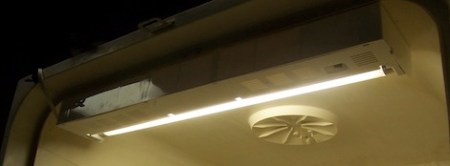
The build began by tearing apart the old dishwasher and getting rid of just about everything; the door, plumbing, and electrical were all discarded leaving [Randy] with a plastic husk. After installing a small fluorescent light, plugging the drain hole, and making a simple lazy Suzan, [Randy] had a proper spray booth on his hands.

[Randy] opted not to put in a ventilation system; he was, after all, working with non-toxic vapors. If you’re planning on gutting a dishwasher for use with some nasty chemicals, it might be a good idea to use the drain hole as a ventilation port.

Becoming Gallagher In Your Mind

The folks at the Louisville hackerspace LVL1 created the handiest and the dandiest kitchen tool you’ve ever seen. It’s not a slicer, it’s not a dicer, or a chopper or a hopper; it’s… a Star Wars Force Trainer that blows up watermelons.

The project is called Mind Over Melon and was created by [Chris] and [Brad] at LVL1 for the CONNECT at Bernheim festival this past weekend. The idea behind the build is allowing people to explode a watermelon with their mind using a Star Wars Force Trainer EEG toy.

The build features the Force Trainer attached to an XBee module, wirelessly connected to the ground zero of watermelon destruction. When the operator of the device concentrates very hard, a series of LEDs light up and a solenoid dumps a shot of compressed CO2 into a watermelon.

[Brad] tells us instructions to build your own mental Sledge-O-Matic will be available on the LVL1 wiki shortly, but until then enjoy this video of the Mind Over Melon being featured on WHAS11 news.