Hacking A VS200 Food Sealer

This food sealer just wasn’t cutting it for [Tinkering Engineer], so he decided to do something about it. The issue with this sealer was that it didn’t have a mode where it could simply seal bags without pulling a vacuum on it. Going through the whole process takes a reported 40 seconds in order to evacuate the air and then seal the bag. Without pulling a vacuum, the sealing process took only 9.

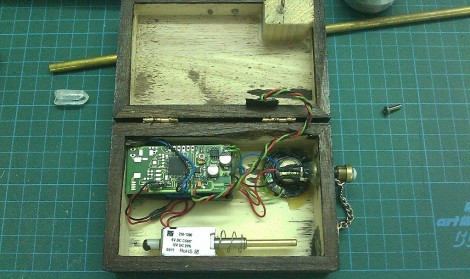
After taking everything apart and looking around, a PIC microcontroller, and vacuum switch were found as well as other assorted electronics. Although the first thought was to replace the onboard PIC with an Arduino, a much simpler solution was arrived at. Two switches were added, one to disable the vacuum pump and the other to manually turn on the heater. This would allow the machine to function as originally intended or simply let bags be sealed without the vacuum function.

This hack may not be the most advanced one that we’ve ever seen, but it’s a good reminder that some projects can be done very simply if you’re willing to look around!

Build A Kinect Bot For 500 Bones

[Eric] sent in his tutorial on building a Kinect based robot for $500, a low-cost solution to a wife that thinks her husband spends too much on robots.

For the base of his build, [Eric] used an iRobot Create, a derivative of the Roomba that is built exclusive for some hardware hackery. For command and control of the robot, an EEE netbook takes data from the Kinect and sends it to the iRobot over a serial connection.

The build itself is remarkably simple: two pieces of angle aluminum were attached to the iRobot, and a plastic milk crate was installed with zip ties. The Kinect sits on top of the plastic crate and the netbook comfortably fits inside.

A few weeks ago, [Eric] posted a summary of the history and open-source software for the Kinect that covers the development of the Libfreenect driver. [Eric] used this same driver for his robot. Currently, the robot is configured for two modes. The first mode has the robot travel to the furthest point from itself. The second mode instructs the robot to follow the closest thing to itself – walk in front of the robot and it becomes an ankle biter.

There is a limitation of the Kinect that [Eric] is trying to work around. Objects closer than 19 inches to the Kinect appear to be very far away. This caused a lot of wall bumping, but he plans on adding a few ultrasonic sensors to fill the gap in the sensor data. Not bad for a very inexpensive autonomous robot.

Big Head Costume Would Make Max Headroom Jealous

big-head-halloween

[Dan Rosenfeld] does a lot of thinking in his spare time, and one thing he returns to pretty often is videoconferencing. He’s often wondered why it hasn’t caught on enough to become a ubiquitous piece of technology, and his examination of the topic in regards to eye contact and spatial awareness inspired him to create a very unique Halloween costume.

His “Big Head” costume consists of a front-mounted 24” LCD panel that displays the wearer’s face in real time. Inside the large headpiece [Dan] installed a microphone, another LCD screen, a half silvered mirror, and a video camera – not to mention all of the power-related goodies required to keep it running. While the main LCD displays his face, the internal monitor is fed by an externally mounted camera that shows him everything going on outside the box. This image is reflected off the half silvered mirror, allowing him to gaze directly at the camera, while also seeing what’s going on in front of him.

As you can see in the video below, the effect is pretty cool, and devoid of the ‘disconnected’ look most people have when talking to others via a camera and computer screen.

Continue reading “Big Head Costume Would Make Max Headroom Jealous”

Single-column Rubens’ Tube

Here’s a fiery project which [Patrick] calls his Pyro Jam Can. It’s the simplest Rubens’ Tube build that we can think of. For the uninformed, a Rubens’ tube uses flammable gas to reveal wave forms passing through the supply vessel. In the past we’ve seen projects with multiple columns, which very clearly show a standing wave. But this version lacks the resolution for that, so the wave is seen as a modulated flame height.

You can see the propane feed tube coming into the can from the right. This keeps the gas flowing steadily, but a diaphram on the bottom of the can made of a latex balloon allows for modulations in flame height by pushing the gas through the aperture a bit faster than it is flowing. A speaker in the base bounces sound waves off of the diaphragm for the effect seen in the video clip after the break.

We wonder if the can will ever heat up enough to melt the balloon on the other end?

Continue reading “Single-column Rubens’ Tube”

Talking Digital Calipers Make Engineering More Accessible

talking-digital-calipers

The team over at NerdKits recently put together a device aimed to help make the process of measuring things more accessible to those with disabilities. [Terry Garrett] is a Mechanical Engineering student, and as anyone who is in the field knows, it’s a discipline which requires taking tons of measurements. Since [Terry] cannot see he was often asking classmates to assist in measuring items during labs, but when he got a job at a nearby design studio, he knew he would have to find a way to take those measurements on his own.

Enter NerdKits.

[Humberto] wrote in to share how he and his team built a set of talking digital calipers to assist [Terry] in his daily tasks. They based the design off a previous project they worked on, getting digital readout data from a set of calipers. The DRO information is fed into an ATmega382p, which pieces together pre-recorded sound bites to announce the size of the object being measured.

As you can see in the video below, the system looks to work very well, and [Terry] is quite pleased with his new talking tool. We love seeing these sorts of hacks, because they truly make a difference in people’s lives – excellent job!

Continue reading “Talking Digital Calipers Make Engineering More Accessible”

Kitchen Hacks: What Would You Cook If You Had A Sous-Vide This Large?

We’ve seen no shortage of temperature controlled immersion cooking devices, called Sous-Vide, around here. But this one probably has the capacity of all of them combined! Flickr user [RogueGormet] isn’t writing about the build, but his Large Form Water Oven build photo set speaks for itself.

We’d wager that the donor vessel is a 16-gallon chest cooler. He cut the lid into two sections, sealing off the insulated cavity with High Density Polyethylene (the stuff those white cutting boards are made out of). This gives him a place to mount the heating element, with a box for the PID controller riding on top. A submersible pump keeps the liquid moving to help regulate the cooking temperature throughout.

What do you put in one of these? Right off the top of our heads we’d think he had something like a pig roast planned. But it could just as easily be a Turkey, or other large hunk of meat. What would you use it for?

If you don’t need quite as much capacity you might make some alterations to your slow cooker for your own immersion cooking.

Counterfeit Electronics In Military Weapons

Boeng and the US military found some systems on new P-8 Posiedons to be defective. The culprit: counterfeit electronics. These are scrap parts from 80s-90s electronics that have been re-branded and sold to the government as new.  Many of the parts have been linked to dealers in China, but the Chinese government feels no need to pursue this(according to the article).

There is an amendment to a defense operation bill in the works that requires all parts from china to undergo rigorous inspection and testing before installation.  Regardless of your stance on military action or military spending or whatever political aspect you want to connect this with, we can all agree that dangerous things designed to destroy stuff and kill people should not have defective electrics, right?

[via Adafruit]