Music-synced Christmas Light Suit

Ah, the end of the 4th financial quarter – the magical time of increased sales, being at work the entire time the sun is up, and holiday parties. For [Andy] at National Instruments, though, things don’t seem too bad. He built a neat Christmas light suit to entertain everyone with his brilliant persona.

[Andy] always loves great Christmas light displays (he even blogs about them), so he figured a wearable light display synchronized with music would be very doable. The build is controlled with LabVIEW to convert .WAV files to power levels and frequency bands. This info is then piped into the Arduino that controls the lights.

[Andy] actually made two light suits, one for him and one for his friend [Richard]. Both guys have two light-up Christmas staffs to wield light mage powers on their coworkers. The lighsuits are controlled by Arduino/Xbee setups – one each for each suit and staff. The result is phenomenal, and should really get everyone in the holiday spirit.

Pee-light Gives Guidance For Nocturnal Tinkles

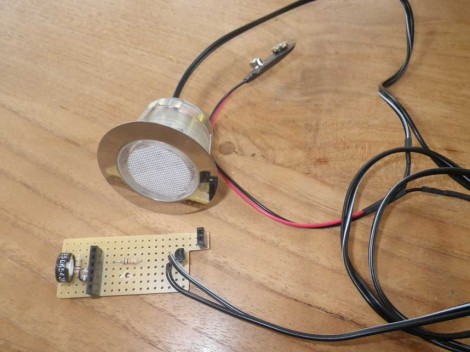
This light is a rather dim LED module whose purpose is to give you a very small bit of illumination when using the restroom at night. If you rely on it instead of using the overhead lighting in the bathroom, you’ll be able to find your way back to bed with your night-vision undisturbed.

[Fred] built the project as a way to learn more about using MSP430 microcontrollers. The protoboard seen above has a pair of female pin headers designed to accept an MSP430-PIR board, which uses the low-power microcontroller to monitor a PIR motion sensor. The chip can be reprogrammed and [Fred] did just that, using the USB dongle side of the eZ430-F2013 dev stick. Now when the sensor detects motion the chip first checks the light-dependent resistor on the protoboard to see if it’s dark in the bathroom. If so, it switches on the LED and sets a timer to shut if off again.

The system runs on a 9V battery, which is a bit under-powered for the 12V-spec’ed LED module. But [Fred] says the light it produces is just the right intensity.

[Thanks Jeremy]

Naughty Duck Will Be The End Of Secret Santa At Your Place Of Work

Aw, isn’t he cute? Looks are deceiving, because if you get him started, this duck says some vulgar things. [Gigavolt] found the little guy abandoned at the Goodwill store and decided it might have some hacking potential. Boy was he right. The stock toy can already sing a tune while flapping its beak and wings. After spending some time in [Gigavolt’s] lair, this duck is going to be on the naughty list. The best part is that this is going to end up in the hands of someone else thanks to a Secret Santa exchange.

The build article linked above is safe for you to read at work, but the video embedded after the break most certainly is not. [Gigavolt] got to work replacing the integrated circuit inside with his own PIC 16F628 microcontroller. He uses a new audio track, which is played back by a SOMO-14D audio player board. The two use different input voltage levels which is something of a bother, but it’s a standby power drain that has been vexing [Gigavolt] he rolled his own board using the DorkbotPDX order and can’t figure out why the current consumption is so high. Take a look at the cursing duck, then see if you can’t troubleshoot his electrical issues.

Continue reading “Naughty Duck Will Be The End Of Secret Santa At Your Place Of Work”

Dilemmabox Brings Tactile Upvoting

Here’s a fun art installation which you might run into downtown. It’s called the Dilemmabox and lets you pull a rope to up or down vote a question. [Christoffer Lorang Dahl] realized that touchscreens are wiping out a lot of really fun user interfaces of yore. He incorporated the two hanging rope inputs as an homage to doorbell ropes.

The built process works much like a laptop-to-digital photo frame conversion. The first step is to liberate the LCD screen from the laptop body. Both are housed in a wooden box, with a window cut out to show the screen. The mechanically clever part is the rope pulls. They’re both just pressing a key on the keyboard in a roundabout sort of way. [Christoffer] attached a smooth hemispherical piece to two keys. The ropes are connected to wooden levers which are held in place by springs. They rub on the hemispheres just enough when passing by to register a keypress.

The photo above was taken during the Dilemmabox’s brief appearance at a shopping plaza in Oslo.

Android Legs Stability Testing

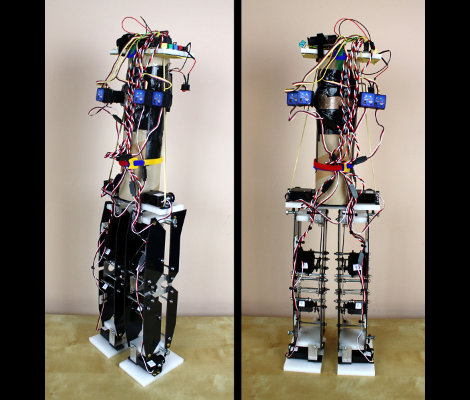
This is [James’] latest android build, a set of legs that use gyroscopes for balance.

He started off by planning the build with some LEGO pieces to get an idea of how each foot and leg joint would fit together. This let him achieve one of his goals. From the start he wanted to create a robot that would remain stable, and not build up enough momentum to tip itself over if there is a problem. With the dimensions established he cut out parts from 2mm sheets of HIP plastic using a hobby knife. They work in conjunction with a frame made from aluminum and HDPE. The whole thing houses eight servos responsible for movement, but he found an interesting way to use them for balance as well.

[James] came across some gyroscopic sensors which are made for use with RC helicopters. They connect in-line with a servo motor and offset it based on the gyro data. He’s using four of them with this bot, playing the hip and ankle servos against each other for balance. What results is a set of legs that look like their jonesin’ for a fix. See for yourself in the clip after the break.

Continue reading “Android Legs Stability Testing”

Troubleshooting Household Light Timers

timer-repair

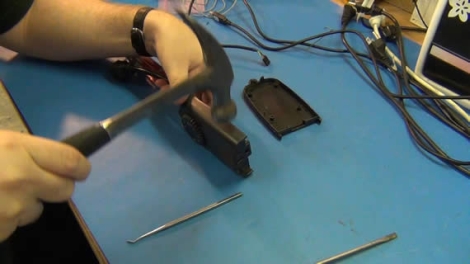
When [Todd Harrison’s] Christmas lights stayed on well past the pre-defined shut off time, he knew there was something wrong with the timer. He took the device into his workshop and spent some time diagnosing and repairing the device, a process he recorded for all to see.

After busting the screw-less timer open with a hammer, he inspected the PCB for any apparent signs of damage. After seeing what looked like a damaged transistor, he desoldered it from the board for testing. After the transistor passed his tests with flying colors, [Todd] assumed that the fault had to be in the relay which the transistor was responsible for switching.

Sure enough, the relay had shorted out, and upon cutting it open he found that the contact points were fused together. He separated and sanded the contacts down, enabling him to get the timer working – at least for the time being.

Part of [Todd’s] goal with this video was to show off different methods of desoldering, including a manual solder sucker (my favorite), desoldering braid, and a purpose built desoldering iron. If you’re in the market for some desoldering tools, but don’t know what to buy, [Todd] is more than happy to offer his advice.

Continue reading to see a video of [Todd’s] troubleshooting process.

Continue reading “Troubleshooting Household Light Timers”

Simple IR Sensor Simplifies Laptop Audio Control

tiny-ir-tv-remote-receiver

[Owen] has a fairly big project in the works, where he’ll need to use infrared light to send data wirelessly between two nodes. The only problem with his grand plan is that he has never built anything of the sort. As a learning exercise, he decided to try his hand at building a wireless control interface for his laptop, which he uses to play music while doing homework.

His laptop usually sits across the room from [Owen], where it is connected to a speaker and amplifier. He hates getting up repeatedly to change songs, so he figured he might as well build an IR receiver to control Winamp that responds to commands from his TV’s remote control. Using his Open Bench logic sniffer and an IR receiver from an old VCR, he deciphered his remote’s encoding system. He then programmed an ATtiny13 to decode messages received by the IR sensor, sending them to his laptop via USB.

He packaged things inside a tiny mint tin, which he hangs from a desk lamp while in use. Now he can easily perform just about any action in Winamp with a few button presses on his remote. [Owen] says that he’s incredibly happy with the results, and now that he has a firm grasp of IR signaling concepts, we can’t wait to see what he builds next.