Occupy Rigs Up Human-power After Generators Are Confiscated

Looks like New York’s fire brigade confiscated all of the gas (or bio-diesel) generators from Occupy Wall Street protesters in Zuccotti Park. Apparently the Fire Chief cites the generators as a fire hazard. This seems a dubious claim. One of the shots in the video after the break clearly shows fire extinguishers close at hand, but we’re no experts on fire code. We’d bet the concern is having combustibles around if the scene turns violent… or just wanting to pressure the group with the loss of a heat source.

Instead of going without, the movement received help from a neighboring protest group in Boston. Bicycle power replaces the missing generators as volunteers pedal to produce electricity. Students from MIT plied their skills to help design multiple charging stations that can be used by the community. It won’t be enough to provide heat for the ongoing occupiers, but it does let them charge their electronic devices which helps ensure that current information is still flowing out of this epicenter of activity.

Does anyone have any ideas for hacking up a heat source that won’t ruffle the feathers of local officials? If so, leave a comment. And if you’ve already got a post written up on the topic don’t be afraid to send in a tip about it. Continue reading “Occupy Rigs Up Human-power After Generators Are Confiscated”


Here’s Your Flying Car

We’ve seen quadrocopters galore over the past few years. We’ve never seen one big enough to lift a person until now.

[Thomas], [Stephan], and [Alexander] of e-volo have been working on a gigantic, human-lifting multicopter for a few years now. A few days ago, their prototype took to the air carrying a fully human pilot. There aren’t a whole lot of details on their build, but from what we can tell the flight was powered entirely by batteries.

The test vehicle looks to be a study in minimalism. The landing gear looks to be a repurposed yoga ball, and the chassis is just four pieces of aluminum tube welded into a cross. The the power plant for the prototype is four brushless motors in each quadrant of the vehicle. That’s right – there are 16 motors spinning around the pilot.

This isn’t the first time we’ve seen a build based on Doctor Robotniks designs. Earlier this year, some guy in China built a very nice deathtrap an octocopter. The e-volo team definitely has the leg up in safety considerations – they have actual design and engineering studies

The good news is the e-volo team wants to improve their prototype and sell it to the masses. The bad news for Americans is the FAA hasn’t taken too kindly to electric flying machines. The team is working on a hybrid drive version, and as long as the weight is kept down, we can always get an ultralight cert.

Check out the video of some 16-blade hovering action after the break.

[youtube=http://www.youtube.com/watch?&v=L75ESD9PBOw&w=470]

Urine Territory Marking, Now For Humans!

Although Dogs and other animals love to mark their territory with urine, this technique has been generally ignored by human beings. Despair no more, fellow homo sapiens, we have now developed the ability to check-in on foursquare through your information stream. This device is descriptively called “Mark your Territory.”

Although this is not currently available to buy in stores (although apparently $10,000 will get you one built), [Instructables] user [blorgggggg] has furnished directions on building your own. The system is powered by an Arduino and an Android phone. The urine tags have both a pointed end for sticking in grass and the like, and a sticky back to be used in a “more urban settings.”

The video after the break gives quite a bit of background trying to justify such a system in terms of communicating in the physical world, animals, et cetera, but it’s doubtful that this excuse will get you out of a public urination charge.  You’ve been warned.

[youtube http://www.youtube.com/watch?v=rRdfeb7vDWg&w=470&h=315%5D

Annoy Your Sound Guy Even More

“I can’t hear myself in the mix,” “yeah, man, I’ll be there at 8,” and “dude, we need like four more mics.” Each and every one of these words is documented in actuarial tables and doesn’t bode well for your sound tech’s risk of a stroke. Luckily, there’s an even better way to kill your sound guy and this time, it’s actually pretty clever.

[@dop3j0e] at the Stuttgart hackerspace Shackspace came up with the Noiseplug. It’s a very small build that could almost fit into a quarter-inch jack. It’s all SMD with a tiny (unknown) ATtiny9 microcontroller powered by a watch battery.

The music coming out of the Noiseplug is really interesting. All the code on the microcontroller is a one-liner written in C. Similar ‘algorithmic chiptune’ programs can be run on any PC: check out these three examples.

These potential entries to the International Obfuscated C Code Contest throw chars into an 8-bit PCM stream. Piping the output of these programs to /dev/audio would generate an actual song – written entirely in one line of C.

Of course, [@dop3j0e] could have made his Noiseplug a little less annoying, but sound techs are underappreciated for a reason, right?

Check out the Noiseplug in action after the break along with a few one-liner C songs.

Continue reading “Annoy Your Sound Guy Even More”

Simple Earphone Repair Saves A Big Chunk Of Cash

shure_earphone_repair

[Spode] has been rocking out with a pair of Shure E4C earphones for about six years now, and he has no intentions of buying another set any time soon. The earphones cost him £200, so when the right channel started acting up, he decided to fix them rather than toss them in the trash bin.

His first attempt was successful, but just barely so. He ended up damaging the earphone case pretty badly, and in time the same problem reappeared. Undeterred, he opted to fix them once again, but this time around he did things differently.

Upon disassembling them, he found that his repair job had become frayed over time. [Spode] desoldered both drivers from the wires and cut them back a bit to expose some nice clean (and structurally sound) cable. He spent a little more time carefully soldering things back together to mitigate the chances of having to repair them again before replacing both earphone shells with a bit of black Sugru.

Having saved himself £200, [Spode] is quite happy with the repair. We probably would have tied an underwriter’s knot in each cable before soldering them to the drivers in the name of strain relief, though the Sugru should help with that.

Say Hello To Our Little Friend, The BeagleBone

Small and more powerful… what more can you want? This is the newest BeagleBoard offering, called the BeagleBone. It’s packed with some pretty intriguing features, but let’s take a tour of the hardware first.

Like its predecessors, the BeagleBone sports an ARM processor. This time around it’s a TI AM3358 ARM Cortex-A8. It will ship with a 2 GB microSD card and has an Ethernet port and USB connection. The dual pin headers on either side of the board are designed to receive ‘Capes’ for expansion. Currently a DVI cape is in the works, with HDMI and others to follow.

Linux is running on board and one of the best features we see in the video after the break is the browser-based programming interface. When connected to a network, the BeagleBone serves HTML5 web pages. One of these is an IDE that lets you write and execute code directly from your browser.

Now, can we finally have our open-hardware set top box (hopefully running XBMC)?? At an MSRP of $89 this should be able to give AppleTV 2 a run for its money as an easy way to get your television some network connectivity. Continue reading “Say Hello To Our Little Friend, The BeagleBone”

The Rube-Goldberg Of Car Audio

[Anthony Pray] had his car stereo stolen. When thinking about replacing it he realized the he and his wife never used it for anything other than an Auxiliary connection to play songs from their cellphones. So instead of buying a head unit he pulled an unused home audio amplifier out of a dark corner of his house and wired it to the car speakers. Problem solved, except that the under-dash installation meant the only volume control is on the phone playing the audio. He decided to build a wireless audio controller that would let him send commands to the phone without quite as much distraction from the road.

The device you see above is his creation. What a beauty. But seriously, it’s so random and hacked together how can you not love it? And, it works!

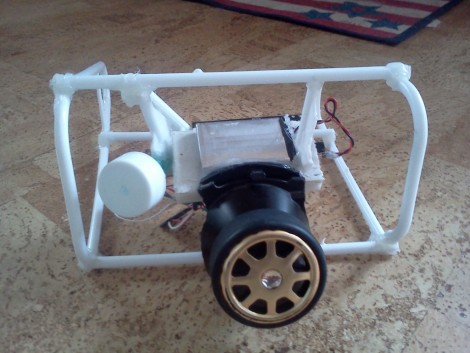
The frame is made from plastic coat hangers, and the wheel is an old RC control knob. There’s even a play/pause feature built from the clicking properties of a retractable ball-point pen. A Cypress PSoC board reads the knob and pen positions, then pushes commands via a Bluetooth module in order to control the phone. He recorded a testing video (after the break) which gives you a better look at the functionality of this setup. Continue reading “The Rube-Goldberg Of Car Audio”