Adding Sound And Light To Your Radio Controlled Vehicles

[Nicholas] wanted to add some flair to his RC car. In addition to the headlights that you see above, there’s brake lights, and a horn that plays “Dixie” like the General Lee in the Dukes of Hazard. All of this is triggered by the wireless controller, but he figured out a way to monitor the servo signals in order to add the additional features.

The hack is driven by a Propeller chip. [Nicholas] patches into the servo lines by adding a servo-in and servo-out header to his prototyping shield. With that in place he’s able to tap into the voltage and ground pins to power the microcontroller. By attaching a 4k7 resistor to the control line, he can listen in on the servo signals using the Propeller.

This RC car has a throttle servo. So when the throttle is opened all the way up the Propeller chip flashes some white LEDs in the headlights, and uses an LM386 audio amplifier to play a tune. When the throttle is pulled all the way back the brake lights are activated. Don’t miss the test footage of this which is embedded after the break.

Continue reading “Adding Sound And Light To Your Radio Controlled Vehicles” →

For The Trade Show Booth That Has Everything, A Blimp!

Trade shows are all about attracting attention and getting people to learn about your product, so what could be better than a custom-built RC blimp? Sure, you could just buy one, but what’s the fun in that? After several design iterations, [Tretton37] came up with a blimp known as the [LeetZeppelin] controlled by an Arduino, an XBee module, as well as a Wiimote controller connected to a computer.

The hack itself is a great example of repurposing off-the-shelf materials into something more interesting and unique. In addition to the components listed above, hobby servos were modded to allow for thrust motor control in conjunction with Legos for the gearing and “pillow-block bearings.” A list of the “important” parts used in this hack is furnished on their site as well as a video of it in action, which is also after the break.

As for the results of this hack as a trade-show attention grabber, Fredrik Leijon had this to say: “We think that all the gazing at the sky and half opened mouths proves that it was a huge success!”

[youtube http://www.youtube.com/watch?v=geMrAmBJsls&w=470&h=315%5D

Fabbing A Guitar Tremolo Stompbox

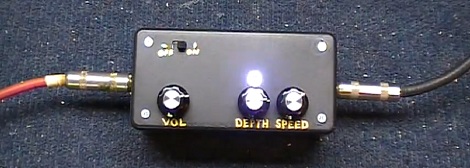
There’s a lot of builders around whose first foray in electron manipulation was building effects pedals for guitars. It looks like [Dino] might be getting back to his roots with his tremolo effects box how-to.

Last week, [Dino] found an old 5-watt tube amp in someone’s trash and decided to bring it back to a functional state. With his new trem effect, it looks like [Dino] might be getting the band back together.

Apart from tiny boost circuits, a tremolo is generally the simplest effect pedal you can make. All you’ll need to do is vary the amplitude of the guitar’s signal at regular intervals. After that, it’s only a matter of pretending you’re playing through a rotating Leslie speaker.

To get his trem working, [Dino] set up a 555 circuit to flash a LED at regular intervals. This LED is encased in heat-shrink tubing along with a photocell. This setup controls an LM386 amplifier. The build is really simple, but from the video after the break we can tell it sounds great.

Continue reading “Fabbing A Guitar Tremolo Stompbox” →

juke-footwell-lighting

DIY Car Lighting Illuminates Areas The Designers Overlooked

[Dave] just can’t seem to get enough of modifying his new car. Where he lives, it’s typically dark on his ride home from work and he finds himself dropping things on the floor of his car all too often. Nissan decided not to include lighting in the Juke’s foot well or glove box, so [Dave] decided that he needed to rectify the situation.

As you might have noticed by his previous tinkering, [Dave] is a big fan of LEDs and ATTiny microcontrollers. He added some Lego-supported LEDs to the driver and passenger side foot wells, installing an additional light in the glove box while he was at it.

The Juke had a couple of usable blank spots on the dashboard, so [Dave] installed a pair of capacitive touch sensors and a small switch into one of the open slots. When touched, the top-most capacitive pin pair ramps up the foot well lights, while the lower pair turns on the LEDs in the glove box. The switch at the bottom is used to toggle on a light in the back seat which he installed a while back.

It’s a simple addition, but it makes all the difference when he is hunting around on the floor in the dark. We are a bit surprised by how many amenities are missing from the Juke, but tweaking them to his liking seems to keep [Dave] happily occupied.

Continue reading to see a short demo video of his interior lights in action.

Continue reading “DIY Car Lighting Illuminates Areas The Designers Overlooked” →

New Siri Hack Controls Your Car

siri-viper-smartstart

Siri can make appointments, tell you the weather, but now she can start your car as well!

After we showed you how Siri could be hacked to use a custom proxy and execute custom commands, we knew it wouldn’t be long before additional hacks would start rolling in. [Brandon Fiquett] thought it would be great if Siri could remotely control his car, so he built this functionality into Siri using [Pete’s] proxy software.

The hack relies on the Viper remote start system he had installed in his car, along with a few modules loaded into his proxy server. His proxy server tweaks allow Siri to interpret a preset list of commands such as “Vehicle Start” and “Vehicle Arm/Disarm”, relaying the commands to the Viper SmartStart module.

We imagine that the back-end functionality is not unlike the existing SmartStart iOS app, but it looks like [Brandon] beat Viper to the game since Siri has not been made available to 3rd party developers as of yet.

Check out the video below to see Siri in action, then be sure to swing by his web site for additional videos as well as the code that makes this possible.

Continue reading “New Siri Hack Controls Your Car” →

ANT+ Networks Using An MSP430 Chip And Android Phone

[Jbremnant] wanted to try his hand with ANT+ wireless networks. This protocol is designed for light-weight and low-power consumer electronics, like heart rate chest straps and bicycle computers (Garmin brand devices for example). There are already libraries out there for Arduino, but [Jbremnant] found that most of them were written as slave-only code. He set out to use an MSP430 to drive a fully functioning ANT network including a computer and an Android phone.

The TI Launchpad is used as the master node in the network. [Jbremnant] chose the smaller of the two MSP430 processors that came with the dev platform. After starting down this road he realized that chip didn’t have a hardware UART needed to communicate with the SparkFun ANT board (based on the nRF24AP1 radio chip). Rolling with the punches, he used a software UART he had previously worked with. Now he’s able to transmit test data from the Launchpad. It is picked up by both a USB dongle on his computer and the Android phone seen above. Check out his demo video after the break.

Continue reading “ANT+ Networks Using An MSP430 Chip And Android Phone” →

LED Sconces Spice Up Dorm Room Parties

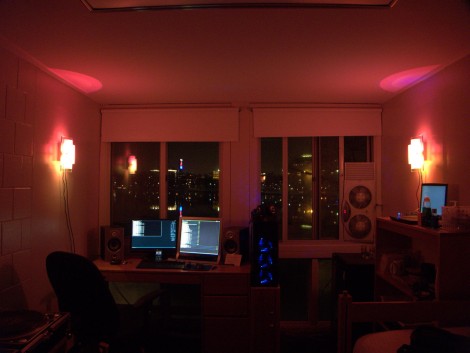
This dorm room is ready to entertain, thanks in part to the LED wall sconces that [Joseph] hacked together. Inside each fixture you’ll find three 3-Watt LED modules. For proper heat dissipation he mounted them on sheet metal which he cut out, including some fingers for additional surface area. The shape for the heat sink was chosen to fit behind the diffuser of the sconce, which is an incandescent light fixture with the socket removed.

[Joseph] designed his own control boards for the base station and LED modules. They communicate with each other via RS485, which lets him run CAT-5 cable to each, but the lights do require external power as well. The controller itself is a USB dongle which takes the serial commands from a computer and pushes them out over the RS485 protocol. In the video after the break you can get a good look at the hardware and the overall performance of the system.

Continue reading “LED Sconces Spice Up Dorm Room Parties” →