Boobie Board Powered Twitter Notifier

boobie_board_twitter_notifier

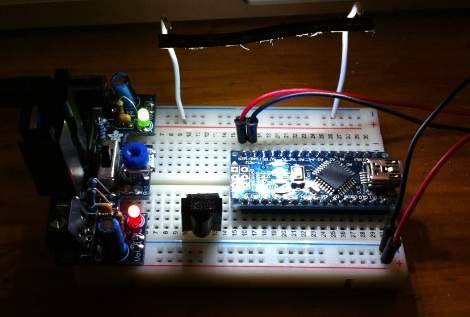
The team over at Archonix frequently challenge themselves to create a full working project in under 20 minutes. [Andrew Armstrong] put together a blog post detailing their most recent “Quickproject” – a simple Twitter notifier built using their Boobie Board.

They started by putting together a small notifier breakout module that could later be attached to their Boobie Board. The module is pretty simple and includes a trio of LEDs to alert you to activity across several online services, though only the Twitter notification module is currently complete. The notifier’s code was written in LUA, and primarily designed to interact with Linux desktops. They do not currently have a Windows compatible version of the code available, but they are more than happy to host it if someone desires to port their code over.

The notifier was put into an old candy tin with a plastic window, which is perfect fit for their project. All in all, the entire thing took them about 40 minutes, with half spent on hardware, half on code. The notifier does just what it was intended to do, but they have a healthy list of improvements that they would like to add, including the use of the other two notifier LEDs.

Livescribe Shuts Down Developer Program

[Kelly] sent in a tip saying that Livescribe, the company behind a remarkable smartpen able to record handwriting, was shuttering the developer program by taking down their dev forums and removing the SDK, taking away the ability to write custom apps. [Kelly] posted about this on her blog.

Livescribe has a thriving community around it and the pens themselves have had some incredible hacks, like Zork played on an Echo smartpen.

Livescribe’s official reason for shutting down the development program is to concentrate on, “cloud access, storage and services.” While we’re still wondering why Livescribe would sideline the developers that give a platform more functionality, it’s astonishing that a company would take down the SDK and delete the dev forums of their own product.

Although the largest Livescribe development and hacking forum has been shut down, we fully expect an independent forum to pop up within the week. We’ll be sure to post a link to that forum when we get word of it. If you know where the new forum is, be sure to send it into the tip line.

Electro-active Polymers

What’s that you say? You’ve got rigid materials that change their shape when exposed to electric current? Sign us up for some! Although the fabrication process looks a bit daunting, we love the results of working with electro-active polymers. These are sheets of plastic that can flex by contracting in one direction when the juice is turned on. It has an effect very similar to muscle wire but distributed over a larger area.

From what we saw in the video after the break it looks like this is not the most resilient of materials. Several of the test shots have broken panes, but we’re sure that will improve with time. It looks like there is some info out there about fabricating your own EAP but the processes seem no easier than what’s going on at the research level. We might stick to building our own air muscles until EAP is easier to source for projects.

Continue reading “Electro-active Polymers”

CNC-PBDU (pancake Batter Dispenser Unit)

Flapjacks taste infinitely better when they’re machine-made. Well, that’s true for [Mexican Viking] who built an automatic pancake maker to the delight of his family.

Obviously, the building material of choice is Lego. The machine consists of a base with two linear gears on either side. A gantry is held high above this base, travelling upon geared towers to either side. The writing nozzle, fashioned out of ketchup bottles, can move back and forth along this gantry for a full range of motion along the X and Y axes. Lego pneumatic pumps supply pressurized air which forces the batter out of the bottle reservoir. This dispensing system is extremely clever and worth reading a bit more about. But if you just want us to make with the good stuff, you can see it grilling up pancakes in the video after the break.

The only thing missing is automatic flipping.

Continue reading “CNC-PBDU (pancake Batter Dispenser Unit)”

Importing PCB Layout Into Google Sketchup

If you’ve been spending hours with the digital calipers while designing enclosures for your circuit boards there may be a better way. [Phil] tipped us off about a new software package that will let you import PCB layout files into Google Sketchup. This way you can start working on the enclosure in CAD before you’ve populated your first board. Of course this adds to the pain of realizing there’s an error in your layout, but what are you going to do?

The free software was developed by RS Components, a European component distributor. It takes IDF files, which can be exported from most PCB design software, and converts them to a format compatible with Sketchup, Google’s 3D design software. For those who enjoy a very dry demonstration video you won’t want to skip seeing what we’ve embedded after the jump.

We’re kind of surprised that this hasn’t already been done. If it has, leave a link in the comments.

Continue reading “Importing PCB Layout Into Google Sketchup”

External Text Display For Nexus One

Nexus One External Display

[follower] prototyped a 2-line external display for his Nexus One using an Arduino with a USB Host Shield, and the Android Open Accessory Protocol. There are two basic software pieces at work: an Arduino sketch that handles displaying data sent from the phone, and a lightweight android app to detect the presence of the external screen and send data to it. As shown here, it diplays the time and the beginning of the most recently received SMS message.

This project coalesced from several other things [follower] had been working on with regards to USB accessories, background services, interfacing with the Arduino and handling SMS messages, so it’s modular and open-source.  If you’re interested in mashing up microcontroller projects and your android phone, there’s plenty of stuff in this project to help you get off the ground.

As hacks go, this is very much a “because you can” sort of deal that’s designed to tie a bunch of cool things together. You’re unlikely to catch us carrying an LCD and breadboard around in our pockets any time soon, but it paves the way for some potentially fun phone accessories.