Camera Software Learns To Pick You Out Of A Crowd

tld_object_tracking

While the Kinect is great at tracking gross body movements and discerning what part of a person’s skeleton is moving in front of the camera, the device most definitely has its shortfalls. For instance, facial recognition is quite limited, and we’re guessing that it couldn’t easily track an individual’s eye throughout the room.

No, for tracking like that, you would need something far more robust. Under the guidance of [Krystian Mikolajczyk and Jiri Matas], PhD student [Zdenek Kalal] has been working on a piece of software called TLD, which has some pretty amazing capabilities. The software uses almost any computer-connected camera to simultaneously Track an object, Learn its appearance, and Detect the object whenever it appears in the video stream. The software is so effective as you can see in the video below, that it has been dubbed “Predator”.

Once he has chosen an object within the camera’s field of vision, the software monitors that object, learning more and more about how it looks under different conditions. The software’s learning abilities allow it to pick out individual facial features, follow moving objects in video, and can recognize an individual’s face amid a collection of others.

While the software can currently only track one object at a time, we imagine that with some additional development and computing horsepower, this technology will become even more amazing.

Continue reading “Camera Software Learns To Pick You Out Of A Crowd”
Internet-controlled Robotic Arm

internet_robotic_arm

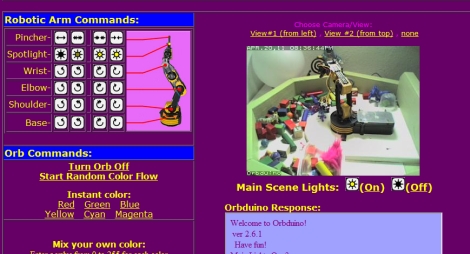
[Trav] was pondering virtual reality and decided it was no longer all that it was cracked up to be, so he created an experience in what he calls “Remote Reality”. While we have seen many installations over the years that allow people to remotely interact with objects across the globe, his Orbduino project consists of more than simply toggling lights on and off (though he’ll let you do that too).

In his house, he has set up a robotic playground of sorts that allows anyone who visits a chance to play around with the robotic arm he has installed there. The arm is situated in a pen filled with random objects which can be stacked and moved around. He also promises to show you something fun, provided you can guide the arm to pick up an object and hold it against the target positioned outside the pen.

He didn’t forget the obligatory remote light controls either. You can turn the overhead lights on and off, as well as control a multi-colored orb situated in the corner of the room. Most of the project’s interface is done with an Arduino Mega, which handles the robot arm interface, as well as messing with the light installations.

If you have some free time, swing by his site and give the robotic arm a try. It’s a fun little time waster that you will likely enjoy.  Just make sure to take it easy on his web server!

Easter Egg Hacking

ateam_easter_egg

Spring is upon us and Instructables user [Mischka] decided it was a good idea to combine two flavors we never considered putting together: The Easter Bunny and the A-Team.

He decided to build the egg as an Easter gift for his brother, who is a huge fan of the A-Team. He found a slightly larger than normal plastic egg, and proceeded to paint the shell white, adding a printed picture of Mr. T once the paint had dried.

The guts of the egg are made up of a Picaxe 08M micro controller mounted on a Picaxe protoboard. Rather fond of buzzing, beeping audio, he decided to forgo a normal speaker and opted to use a piezo instead. To activate the music when the egg is shaken, a tilt switch was added to the board as well. He uploaded his software to the Picaxe, sealed up the egg, and called it a day.

We can imagine his brother will be pretty pleased with the creation – who wouldn’t be? We only wish that there was video of the egg in action.

Rube Goldberg Machine Puts Engineering Students In The Record Books

rube_goldberg

Rube Goldberg machines are always a fan favorite around here. They truly embody the concept of over-engineering, and are an entertaining departure from what we normally cover on Hackaday.

Back in February, engineering students from two on-campus professional associations at Purdue University teamed up to construct a world record-setting Rube Goldberg machine. Their entry in the Purdue Regional Rube Goldberg Machine Contest not only won them the regional title, but also potentially put them in the books as creating the most complex device of its nature.

Their contraption was dubbed “The Time Machine” and acts out events in our planet’s history. It starts with the big bang, moving through various other time periods, including the stone age, ancient Egypt, and the medieval era. It also makes several stops in more recent times, including World War II and the Cold War, before self-destructing at the Apocalypse.

All told, the machine incorporates 244 steps to water a plant, which is 14 more than the previous record holder. Continue reading to see a video that highlights some of the machine’s more interesting features, and be sure to check out these Rube Goldberg machines we’ve covered in the past.

[via BoingBoing]

Continue reading “Rube Goldberg Machine Puts Engineering Students In The Record Books”

Cotton Candy Just The Color You Like It

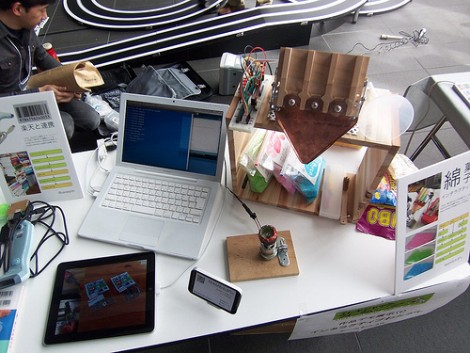
Hit the web to order up your custom-color cotton candy from this machine (translated). A computer monitors a web interface for an incoming order, then pushes commands to an mbed microcontroller which dispenses three different colors of sugar to whip up your custom shade of the cottony delight.

In addition to the sugar dispensing system, the candy maker itself is also a do-it-yourself design. It looks like the most difficult part of this project was getting this component right. They’ve got a collection of videos documenting the multiple attempts on the road to success. Once dispensed, the colored sugars make their way into a spinning metal cylinder where they’re heated by the flame from a butane candle lighter. Eventually the team manages to get cotton candy to form but we can’t help but feel like they’re trying to reinvent the wheel with this one.

[via Make]

DoJ And FBI Now Issuing Command To Botnet Malware

Looks like the FBI is starting to get pretty serious about fighting malware. Traditionally they have attacked the servers that activate and control botnets made up of infected computers. This time they’re going much further by taking control of and issuing commands to the botnets. In this instance it’s a nasty little bug called Coreflood, and they’ve been given permission to take the yet-unheard-of step by a federal judge.

An outside company called Internet Systems Consortium has been tapped to do the actual work. It will call upon the malware on infected computers and issue a command to shut it down. That falls short of fixing the problem as Coreflood will try to phone home again upon reboot. This gets back to the initial problem; we won’t ever be able to stop malware attacks as long as there are users who do not have the knowhow (or simply don’t care) to protect and disinfect their own computer systems.

How long do you think it will be before some black hat comes up with a countermeasure against this type of enforcement?

[via Gizmodo]

Amazing Quad Pick And Place System Tirelessly Sorts Your Legos

delta_robots

[Chris] is quite the devoted tinkerer. He recently wrote in to share what can only be described as a labor of love. His Quad Delta Robot system has been in the works for about six years now, split into periods of research, building, more research, and rebuilding until arriving at its current form.

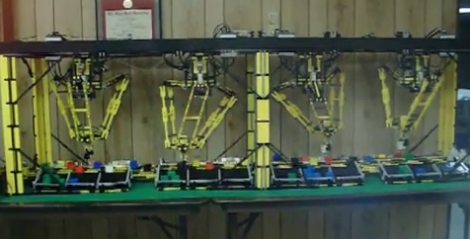
The system is made up of four Lego NXT robots which are tasked with sorting Lego cubes by color as they come down a pair of conveyer belts. The robots were built to mimic commercially available pick and place robots which can be found on assembly lines all over the world.

Each robot operates independently, receiving signals via a light sensor which tells the robot where the next brick is located, as well as what color it is. This data is sent by the main NXT unit, which uses a lights sensor to determine brick color and position, relaying the information to the other bots via flashing LEDs. All of the robots receive the same signal, but much like NIC cards ignore frames not destined for their MAC, the bots ignore messages that are not addressed to them.

The machine is truly amazing to watch – it’s clear that all of [Chris’] research and planning has paid off. You have to check out the video embedded below to truly appreciate all of the work that went into this system. Also, be sure to swing by his site for a far more in-depth look at how the machines work, it is definitely worth the time.

Continue reading “Amazing Quad Pick And Place System Tirelessly Sorts Your Legos”