Antenna Cannon For Amateur Radio

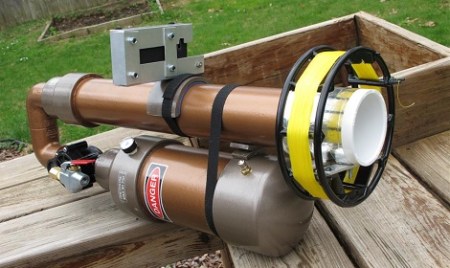
As an amateur radio enthusiast, [Andrew] sometimes has to set up impromptu antennas up to 160 meters in length. The easiest way to get these antennas off the ground is to drape them over trees, a feat normally accomplished by lofting fishing line into the air with a slingshot or bow and arrow. [Andrew] thought slings were so last century, so he came up with a spud gun inspired antenna launcher.

The launcher is built out of PVC and launches a foam filled tennis ball that can reel out 150 yards of Spectra line. In a moment of brilliance, [Andrew] decided to add an augmented reality HUD. The display is actually [Andrew]’s phone running an app called Geocam that provides him with a display of elevation and azimuth overlaid on the phone’s camera feed. The results of [Andrew]’s build are fairly impressive. The cannon was able to lob a tennis ball over a 110 foot tree at half the pressure rating of the PVC. The grouping was pretty tight as well, more than sufficient to run a line over a tree.

[Andrew]’s antenna cannon is an awesome piece of work and unlike most french fry cutters, it’s a useful tool. If you’re interested in seeing 160 meter antennas heaved over the tops of trees, amateur radio field day is next month week, June 25th and 26th.

Official Kinect SDK Released

Microsoft just released the beta of the Kinect for Windows SDK. Although, “Microsoft does not condone the modification of its products” it appears Microsoft have changed their tune and released APIs for C++, C# and Visual Basic seven months after the Kinect was officially hacked.

We’ve seen libraries being developed since the launch of Kinect, culminating in the OpenKinect project. The Microsoft release covers the same ground as the OpenKinect project, and will hopefully improve on attempts to get audio out of the Kinect.

We’ve seen Kinect hacks run the gamut from telepresence, to robotics, to 3D modeling, so the Kinect seems like a great tool in the builder’s arsenal. The Kinect is a wonderful tool, and even though most of the functionality has already been replicated by the open-source community, it’s nice to know there’s official support for all the great projects we’ve seen.

Tripod CNC Plotter

tripod printer machine

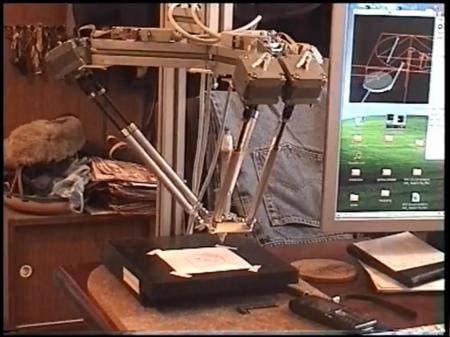
Although some may have heard of a machine like this, the CNC tripod remains an unknown machine to many in the engineering word.  This particular machine is set up as a plotter, drawing incredibly straight lines, shapes, and letters.

The machine appears to have 6 servo motors, 3 working as pairs.  This would simplify control and allows the pen to be held at a perpendicular angle to the paper.  Once could envision this being used with, instead of a pen, a spindle and mill.  Instead of the traditional movement of a CNC mill or router, this could be used to cut out complex shapes.

Additionally, if the servos were not driven in 3 tandem pairs, but were all controlled independently, it should be possible to twist the tool in a controlled angular direction.  This would add an extra axis of control to an already robust CNC setup.  It will be exciting to see how this technology develops in the future.  Until then, check out the video after the break: Continue reading “Tripod CNC Plotter” →

Beginner Concepts: Using A Low-pass Filter To Smooth PWM Output

Microcontrollers are digital devices at heart. They can do fancy things like convert analog signals into a digital value but going the other direction is a bit tougher. Pulse-Width Modulation is used to approximate an analog output but what you’re actually doing is turning the operating voltage on and off very quickly to achieve an average value somewhere in between. This is the method most commonly used to dim an LED. But generating a smooth voltage in this way takes just a few more parts.

[Scott Daniels] spent some time discussing the process of smoothing a PWM output by using a low pass filter. This is a compilation of digital and analog circuitry to produce a smoother signal than PWM can achieve on its own. As you can see above, the low pass filter is made up of one resistor and one capacitor. The theory is not hard to understand, and with [Scott’s] help you’ll become much more comfortable with choosing the component values for your own filters. His examples center around an Arduino using the analogWrite() function but the techniques can be applied universally.

Mouse And HDD Combo Show Off Your Data Gluttony

databot_mouse

So we know you’ve got a lot of porn on your computer, but just how much is a lot? This concept mouse and hard drive combo aims to show you just how much digital junk you have acquired through physical feedback.

The DataBot mouse looks like a typical run of the mill scroll mouse that you might get with a new computer. Inside however, the designers have added a small servo which alters the ease with which the ball moves. The more files you have stuffed into the folder you are moving around, the more the mouse resists, giving you a sense of the physical “weight” of your computer’s contents.

The DataBot hard drive gives you a sense of how full your computer is by growing and shrinking based on space usage. During file transmissions the hard drive blinks its LEDs to indicate how fast or slowly your files are moving. When the inevitable file access error occurs, the LEDs switch to a bright red hue and the drive shakes to indicate there is a problem afoot.

With the price of data storage decreasing by the day, it’s easy to get lost in a glut of information without realizing just how much data you have. This is definitely an interesting way to get a different look at your data consumption.

Check out the videos below to see the pair in action.

[via Dvice]

Continue reading “Mouse And HDD Combo Show Off Your Data Gluttony” →

Watch Out Segway, Here Comes Tilto

tilto_demo

While the Segway enjoyed a few years of fame before falling off the radar, [Marcelo Fornaso] is hoping his creation has quite a bit more staying power. Inspired by the Segway’s ability to balance itself, he started thinking about how the concept could be improved. He felt that one of the Segway’s shortcomings arose out of the fact that the base platform was rigid and required the user to lean back and forth outside the device’s frame in order to turn it. He thought that this made the riding experience uncomfortable as well as risked causing the rider to fall over.

His creation, the Tilto, aims to both improve on the turning ability of the Segway while eliminating the need for handlebars. Based on a tilting mountain board design he had been tossing around for a while, the Tilto uses accelerometers and gyros to keep its balance, much like the Segway. His goal was to keep the vehicle balanced while traveling forwards and backwards, but also allowing the device to tilt from side to side without tipping over. This design keeps the rider mostly upright, allowing the user to direct the vehicle by leaning much like you would on a bicycle.

As you can see in the video below, the Tilto works pretty well, even in its prototype form.

Finally, a people mover that lets us get our gangsta lean on!

Continue reading “Watch Out Segway, Here Comes Tilto” →

PVC Boombox Is Not A Potato Cannon

After [Luke] built a suitcase mini-ITX rig for LAN parties he was left with one problem: he didn’t have any speakers and he didn’t want to use headphones. Not wanting to do something boring like a USB-powered speaker setup, he built a PVC Boombox.

Built around 3 inch PVC pipe, the boombox houses an off the shelf 15 W amplifier, bluetooth receiver, and charge controller. [Luke] found a deal on a dozen 1400mAh lithium ion batteries and despite the standard, “if you don’t know what you’re doing, don’t use lithium” trope commonly given as advice, he forged ahead anyway. [Luke] picked up a power converter that charges the batteries and provides some protection. The batteries are charged though wall power with a transformer and a huge cap scrounged from an ATX power supply.

[Luke] is pretty pleased with his boombox. Not only does it put out some decent quality sound, the battery life should be tremendous. It’s not a ground-up build, but we think it’s a pretty nice project. [Luke] will be taking the ‘boomtube’ to the Detroit Maker Faire next month, so if you see him make sure to say hi.