Building A 555 Timer From Discrete Components

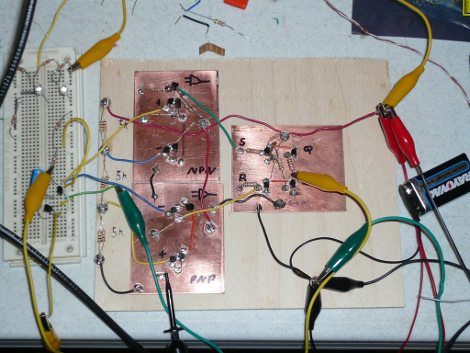
The 555 Design Contest shook a whole bunch of really creative circuits out of the trees, hence the 555-heavy content lately. While not technically part of the contest, [esalazar] wanted to know what made the 555 tick, literally! He started working on the project in a circuit simulator, then ultimately ended up building the three main logic blocks inside the familiar timer on pieces of copper-clad board. He’d built a 555 using discrete components.

While this isn’t 100% compatible with the classic 555 IC, it covers the basics pretty well, and [esalazar] gets extra-credit points for embracing the hacker spirit of seeing for himself how stuff works while documenting it well and citing his references.
Digital Wavetable Oscillator

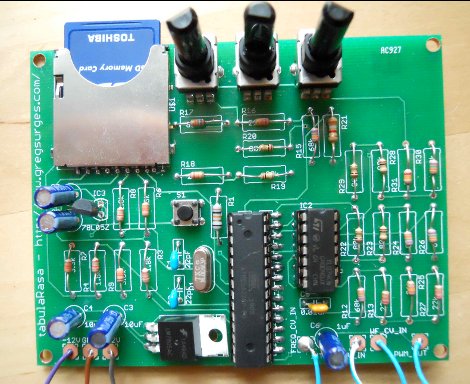
The tabulaRasa is a digital wave table oscillator, and features control of frequency, wave table selection, and interpolation. The device is split up into 2 parts. One is a pcb with a healthy amount of resistors, 3 potentiometers, ST TL074 JFET op amp, atmega328 and a SD socket.

The second part is software for your computer that allows you to edit or create your own waveforms. There are 3 different modes of control. Breakpoints, which allows you to set the waveform points and allows up to sixteen. Harmonic allows amplitude control over 16 harmonically-related sine waves, finally, the third mode lets you load in short sound clips.

Once you’re happy, save to a SD card and pop it into the board, and you’re ready to make some noise. The project page states at the end “tabulaRasa is in the last stages of development, and will be available soon.” so you cant get your hands on one just yet, but if you’re interested [Greg] has a kickstarter page setup where you can find out details on pricing.


Hear That? It’s A 555 Timer AM Radio

555_timer_am_radio

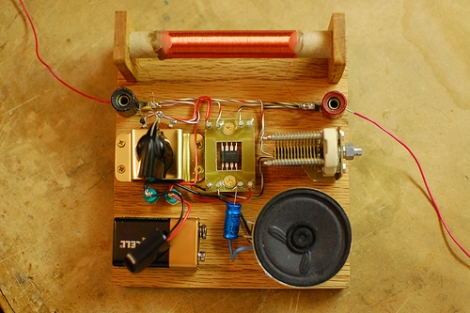
[Eric] recently built an AM radio based on a 555 timer, and posted a few pictures to the Hack-a-Day Flickr pool. He used the 555 timer as an AM demodulator and power amplifier in order to drive the speaker. A hand-wound inductor is used to tune the signal which is then superimposed over the ramp signal produced by the circuit he built. [Eric] points out that he chose a CMOS 555 timer because of its superior performance in this particular application since the timer is used in a bit of a nontraditional manner. He shared his circuit diagram as well as a great video walking through each part of his design, finishing off with a demonstration of the radio, which can be seen below.

This is yet another great project that will be entered in the 555 Design Contest – simple and elegant. We love seeing these, so keep them coming!

If you want to see more cool projects made by Hack-a-Day readers, be sure to check out our Flickr pool as well as the forums.

Continue reading “Hear That? It’s A 555 Timer AM Radio”

Video Projector From An Old Single-slide Unit

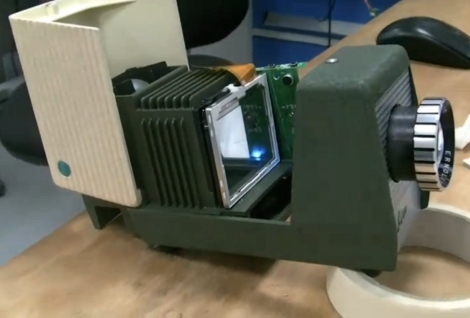
Here’s a video projector that [Matt] hacked together. He needed a small and inexpensive solution to use with his R2D2 build. As you can see in the video after the break, it has no problem playing back the Princess’ distress call. But even if R2D2 is not one of the droids you’re looking for, we think this can be useful in other ways. One use that pops into mind is for projector-based Halloween displays.

As with past projector hacks, all you really need to pull this off is a light source, an LCD screen on which you can playback video, and a lens to focus the light onto a screen. Usually the LCD is the most expensive part of the project and building an enclosure to the correct dimensions can be a bit difficult. [Matt’s] solution was to use an MP4 knockoff media player. The rest of the setup is a ’50s era slide projector. The screen from the media player is about the same size as a single film slide, so he removed the screen from the case and put it where the slides go.

Continue reading “Video Projector From An Old Single-slide Unit”

555 Two-fer – Baby Swing Upgrade And A Headphone Tube Amp

baby_swing_tube_amp

[Jason] sent in two 555 timer driven items that were worth sharing, both of which are entries in the 555 Design Contest.

The first item is a circuit that automatically resets an infant swing. [Jay], who built both items, has an infant swing for his daughter that spins a mobile and plays music. It’s great but it only works for 7 minutes and 15 seconds before a button push is required to trigger it again. He found this limitation to be annoying, and as I have owned the same swing, I can echo his frustrations. He probed the swing and found that a 5v pulse was required to reactivate the mobile, but it had to be sent after it turned off to have any effect. He put together a simple circuit that would do the button pushing for him, as you can see in the video below.

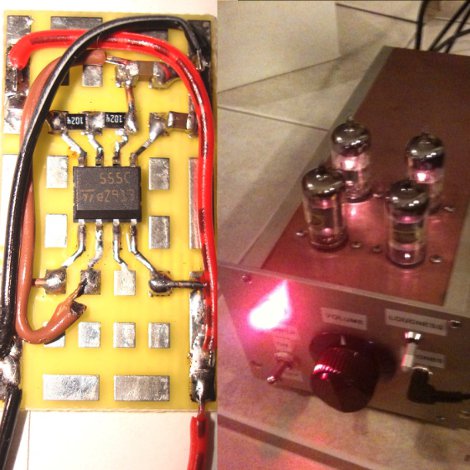
[Jay’s] other entry is a headphone tube amp using a quartet of 6DJ8 vacuum tubes. The 555 timer in the amp is used to drive a FET and the hand-wound transformer he built for the amp. You can see a video of the amp in action below as well.

The projects are lacking a thorough write-up, but he does provide schematics for both the swing reset switch and the tube amp for those looking to replicate either item.

Continue reading “555 Two-fer – Baby Swing Upgrade And A Headphone Tube Amp”

Debugging MSP430 Using Eclipse

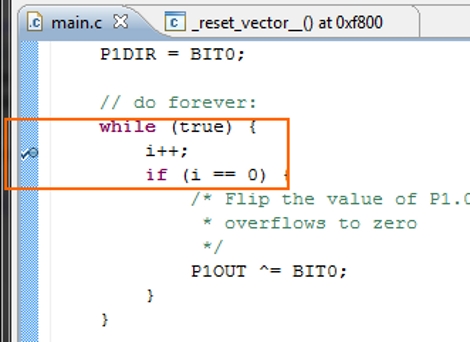
[Springuin] just posted a tutorial about debugging MSP430 projects using Eclipse. He read our feature about debugging under IAR, a proprietary IDE which TI offers as a code-limited freebie with the TI Launchpad. In that writeup we wondered if anyone would put together a tutorial using open source tools like DDD and GDB to make debugging easier for those that choose to use operating systems other than Windows. Even though he didn’t directly use those particular packages, this should work just as well.

Eclipse is a popular IDE for many different languages like C, C++, Java, and others. We’ve already seen it used to develop for the TI Evalbot on Linux systems. [Springuin] is using the Java-based IDE on a Windows system, and this is the first time we recall seeing directions on using an open-source alternative for programming with the TI Launchpad under Windows. That being said, the only real Windows specific parts are the steps necessary for communicating with the programmer. Since this method uses MSP-GCC and msp430-gdbproxy, it should be easy to do this under Linux as well. Use our tutorial to set up those tools if you haven’t already, then follow this one for a setting up and debugging in the Eclipse environment.

Der Wafflemeister 3000

der_wafflemeister3000

When people think about robots, a few different things come to mind. We like robots because they take care of tedious work. Robots are great for accomplishing tasks in hazardous environments too. When the [Chalmers Robotics Society] thinks about robots however, they think, “Breakfast!”

The CRS constructed a sweet automatic waffle cooking machine known as the Wafflemeister3000. It can produce up to 5 waffles at a time, cooking them to a nice golden brown in a little over 3 minutes. Think about that for a second – that’s about 90 waffles an hour!

This project isn’t exactly new, with the second iteration having been completed in 2007. However, since the third version features a 400% increase in production volume, we thought it was worth a mention.

Be sure to check out the video below of the Wafflemeister3000 doing its thing.

[via Neatorama]

Continue reading “Der Wafflemeister 3000”