Building Your Internet Radio Empire

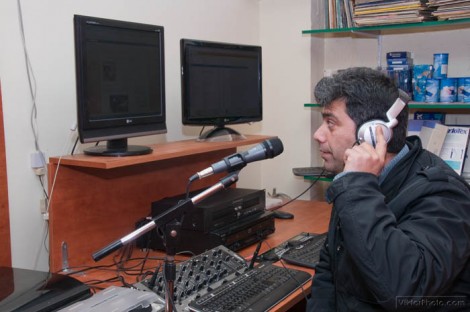
It all starts with one station in your home office but who knows where it can go from there? If you’ve got dreams of being an Internet radio jockey you can get some ideas about equipment startup from this setup that [Viktor’s] built for a friend.

He started out with a plan to have a station that offers twenty-four hour streaming but also supports live broadcast. Two computers are used in the setup. The first handles automated music broadcast and live mixing. This box has two sound cards, one is used for the automated music by feeding the output into a sound mixer that is a separate piece of hardware. The output of that mixer feeds back into the second sound card on the box. This secondary card outputs the final mix to the computer speakers.

The second computer is where a lot of the live broadcast work is done. Any steaming guest (using VOIP or Skype, etc.) come in through this box as well as jingles and sound effects used during the feed. Its sound card is also connected through the external mixer and joins the final feed headed into one of the sound cards on the primary computer.

In the end the Internet connection for the system isn’t beefy enough to reliably support a streaming station. For this a dedicated streaming service is used. It receives the live feed and then uses its increase bandwidth to propagate the signal to listeners anywhere in the world.

Want to listen to this radio station? Build your own streaming radio module, or outfit classic hardware to work with your computer.
Passcode Protected Laser Tripwire Alarm System

laser_tripwire

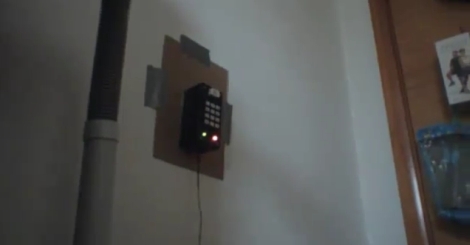
Sometimes security doesn’t need to be overly complex to be effective. Instructables user [1234itouch] recently built a simple laser tripwire alarm that can be mounted virtually anywhere, complete with a keypad for disarming the device.

He mounted a photo cell in a project box, along with an Arduino and a 12-button key pad. A laser pointer is aimed at the photo cell from across a gap, which results in a steady voltage being read by the Arduino. When the laser beam is broken, a drop in voltage is detected, and the alarm sounds until you enter the proper pre-configured passcode. Entering the passcode triggers a 15 second grace period during which the the alarm cannot be tripped again.

It might not be built with triple-thick steel doors and thermo-sensors, but it’s a simple device for simple needs. In its current form it could be pretty useful, and with a little reworking, there are a wide range of things it could be used for.

Continue reading to see a demo video of the tripwire alarm, and be sure to check out these other tripwire-based security systems.

Continue reading “Passcode Protected Laser Tripwire Alarm System” →

Bench-top Laser Engraver Does Some Cutting Too

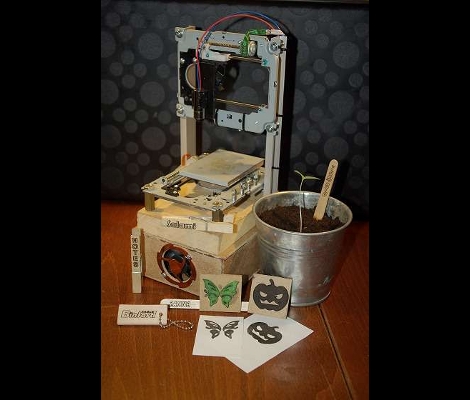
Grab that stack of old optical drives you have in the corner and get to work building this laser engraver. [Groover] is taking a no-nonsense approach to the build and we think it is just simple enough to be accessible to a very wide audience.

The physical assembly uses sleds from two optical drives. These are mounted some angle bracket. Since lasers cut at one specific focal length, there is not need for a Z axis (simplifying the build greatly). In fact, we think the hardest part of the assembly is retrieving the laser diode from a DVD-R drive and packaging it for use with this setup.

The electronics are a combination of a couple of consumer products. Two pre-fab motor drivers are used to command the stepper motors on the optical sleds. These receive their commands from an Arduino. A package called GRBL reads in G-code ([Groover] shows how to generate this from Inkscape) and in turn sends commands to the Arduino.

The results are quite remarkable. It can engrave wood with great resolution and contrast. The video after the break even shows it cutting out shapes from construction paper. Now we still want our own full-size laser cutter, but this project is much more fiscally possible for us.

Continue reading “Bench-top Laser Engraver Does Some Cutting Too” →

ASync-Firefly

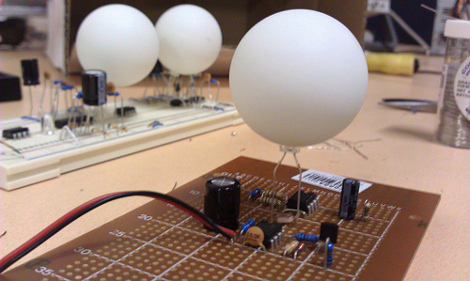
[dev_dsp] wanted to try his hand at creating a purely analog implementation of multiple synchronizing fireflies powered by a single battery and built from off-the shelf, through-hole components on inexpensive protoboard. In theory, even your local Radio Shack should still carry all of this stuff. He was obviously inspired by [alex]’s fireflies that we’ve covered in the past, but he wanted to see how far it could be taken without the use of a microprocessor.

In the end, [dev_dsp] relied on one crucial piece of digital ware, the ever-popular 555 timer IC, but he’s using analog discrete components to do the grunt work of adjusting the phase of each firefly by feeding a little extra current to the trigger capacitor whenever the flash of a nearby firefly is detected. After the jump, you’ll find schematics and a video demo of three ASync-Firefly modules in various stages of assembly playing with one another while [dev_dsp] discusses their operation.

Bounce Flash In Multiple Mediums

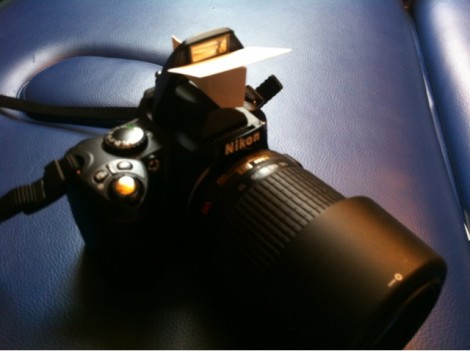
[Nigel’s] been trying out a series of designs and materials to make his own bounce flash. He set out on this mission because most of the images he used flash on ended up washed out with dark shadows. The flash add-on seen above seeks to curb the harshness of the direct light but shielding the subject.

What you see above is just a couple of pieces of paper. [Nigel] put together a template so that you can cut your own. Although the design is his favorite, he also put together a second generation that is built from hobby plastic with a piece of aluminum tape as the reflecting surface. The main link at the beginning of this feature leads to that version, but after the break we’ve included direct links to each article he published during his experimentation.

Continue reading “Bounce Flash In Multiple Mediums” →

Lol Shield Theatre Brings Online Video To The Pixelated Screen

lol_shield_theatre

[FallDeaf] bought a Lol Shield, and after making all sorts of blinky displays, he thought to himself, “What in the world can I use this thing for?”

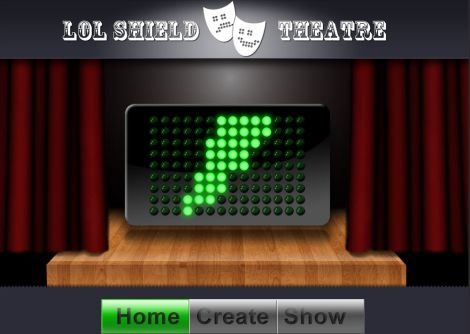
In a really slick fusion of hardware, software, and the power of the Internet, he has created what he calls, “Lol Shield Theatre”.

The idea goes something like this:

You visit his site, and create your own “movie” by drawing on his virtual Lol Shield. Add as many frames as you would like, set the frame rate, then submit your creation. From there, you can download an Arduino sketch that contains your entire animation so you can play it on your own Lol Shield. You can also visit his Lol Shield gallery, where you have the ability to watch, download, and vote on movie submissions from other visitors.

He has also provided the source code to drive your Lol Shield, as well as created an API through which you can stream the various animation feeds from his Lol Shield gallery directly to your Arduino via a USB cable.

Be sure to check out the video demo we have embedded below, and show off your pixel cinematography skills over in the theatre.

Continue reading “Lol Shield Theatre Brings Online Video To The Pixelated Screen” →

The Traveling Terabyte Project – Helping Those Who Protect Us

ttb_dogtags

Though some people differ on what exactly a “hacker” is, there is one thing that can be said for certain – this global community of tinkerers, experimenters, and hobbyists we belong to is one of big hearts. Through our various projects and tutorials, we lead by example – sharing knowledge and offering help whenever we can. You would be hard pressed to find something that could exemplify this more than the Traveling Terabyte Project.

Started in the summer of 2006 by [Deviant Ollam], the goal of the project was to provide informational content from DefCon 14 to those friends and acquaintances who were deployed overseas in the service of the U.S. Armed Forces and their associates. This was originally done by outfitting durable cases with large portable hard drives stuffed with movies, music, and publications in order help those stationed far from their friends and family enjoy their down time a little bit more.

The project has grown by leaps and bounds while the storage mediums have shrunk accordingly. The project has recently entered a new phase, where they are migrating over to flash drives instead of hard drives, which should help spread the distribution of media immensely.

The Traveling Terabyte Project did not approach us soliciting money or publicity in any way, so by no means should you feel obligated to support the project. Regardless of our individual political leanings and views on war, we believe that helping out people who are subject to extreme amounts of stress while stationed far away from their home, friends, and family is a noble cause.

[Thanks, RenderMan]