Temperature Sensing Mug Means Never Burning Your Mouth Again

temp_sensing_mug

Some people tend to get awfully attached to their favorite mug. Like an old friend, the mug holds a special place in their hearts, and there’s a weird sadness when it finally gives up the ghost. Through the winter months [Ben’s] girlfriend is never without hers, and when it broke, he decided to give her a new one with some added functionality.

He built her a temperature sensing mug that uses a rather novel way of determining how hot or cold the contents are. Instead of using a thermistor to determine the drink’s temperature, he opted to use a simple diode since it is well known that a diode’s forward voltage varies with temperature. After determining the diode’s voltage range using hot and cold beverages, he hooked it up to the ADC of a PIC12F615 micro controller. The temperature is displayed via 10 LEDs, which are driven through a pair of 8-bit shift registers and buffers since his PIC did not have enough pins to control them on its own.

He had some PCBs made, and after a handful of setbacks got everything put together. He says the mug works pretty well, though the display changes a bit more slowly than he would like. He also mentions that if he builds a second version, he will be sure to select a different PIC that has enough I/O pins to do the job, as well as use a thermistor instead of a simple diode for sensing the temperature.

Continue reading to see a brief demo video [Ben] put together.

Continue reading “Temperature Sensing Mug Means Never Burning Your Mouth Again” →
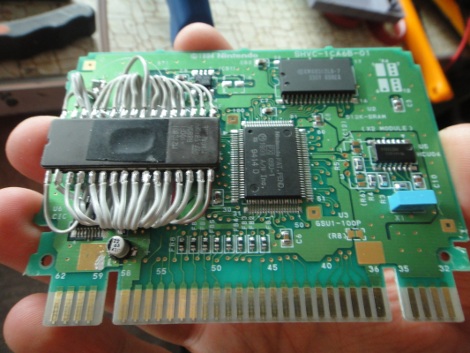
Play Unreleased Retro Games On The Real Thing

Star Fox, one of the greatest 3D space shooters ever developed, has a pretty decent fan base even after eighteen or so years. It had a sequel that was 99% complete, but it came very late in the Super Nintendo’s life and it was held off so that the next great Star Fox would be on the newest Nintendo console, the N64.

You could get the Japanese version, which aside from a couple debug routines, is complete, and you could play it on an emulator. While emulators are fine for most of us, anyone who has played a game on the real metal can quickly and easily pick out minor nuances.

Since playing Star Fox 2 on the real hardware is not a simple trip to the flea market, [Doug] went about ripping apart an old SNES cart and placing a eprom inside with the data from the game. Through that 8 page forum post you can see the project start, progress through different constructions, and result in 3 fully working carts, complete with custom labels.

Join us after the break for a quick video.

Continue reading “Play Unreleased Retro Games On The Real Thing” →

Controlling Weapons With Kinect

kinect_rocket_launcher

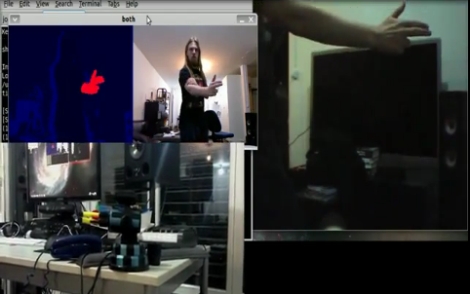
It was only a matter of time before someone would figure out how to weaponize their Kinect. Hacker [Jonas Wagner] was fiddling with his Kinect one day and thought that it would be cool to launch missiles simply by gesturing. Not having any real missiles on hand, he settled for controlling a USB-powered foam missile launcher instead.

He mounted a webcam to the top of his rocket launcher to record video of his victims, and with a bit of Python along with the libfreenect ilbrary he was well on his way to world cubicle dominance.  The Kinect waits for him to pull his hand out of its holster in dramatic fashion, monitoring his movements for tracking purposes. Once the launcher has been armed, the Kinect watches for [Jonas] to pull his hands out of frame before firing the rocket.

We doubt you’ll see this thing controlling weapons for DARPA any time soon, but it’s cool nonetheless. The launcher seems to move a touch slowly, but we’re guessing that with an uprated servo, things could be a bit snappier.

Continue reading for a quick video of the Kinect-powered rocket launcher in action.

[via KinectHacks]

Continue reading “Controlling Weapons With Kinect” →

Giant Scale Printer

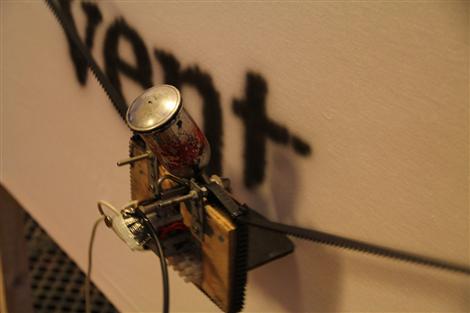
Giant Printer Print Head

This giant printer was originally constructed by [Komponent/LAB] in 2006 to print some large-format banners for a festival, but has recently been pulled out of storage and updated for the Venture Cup competition. The system received a few mechanical and software updates and was also mounted on tripods in order to make it fully portable.

Instead of using stepper motors and encoders to directly control the print head as in a typical printer, the entire print axis is turned vertically and the relative lengths of two belts are varied (along with the constant downward pull of gravity) to precisely control movement across the plane. The software uses HPGL plotter files and is able to scale them to fit the available printing area.

Although there are some issues with the print head wobbling due to the rapid accelerations, any printed imperfections appear to be difficult to notice from more than a few feet away. Precision could be further increased by tweaking the software to compensate for such unwanted movements.

Although we can imagine many different applications for such a printer such as architectural or street art, some fine tuning would definitely be required at very large scales and to compensate for wind, etc if done outdoors.

Here are some pictures of the build and there is a short video of it in action after the jump.

[via GeekPhysical]

Continue reading “Giant Scale Printer” →

Ball Bot Constructed From Power Tools And Pet Toys

ballbot

Hackaday forum member [machinelou] says he’s been fascinated with remote controlled hamster balls for quite some time. Inspired by a ball bot he saw on a BBC show, he finally picked up a 12″ plastic ball and got to work.

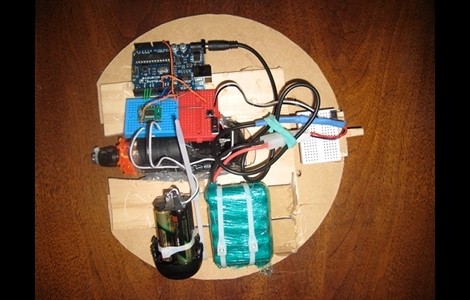
He used a small drill to provide the power required to roll the ball, and an Arduino is used as the brains of the device. This is his first major project outside of simple I/O and servo control, so he’s taking things slowly. While all this is a bit new to him, he already has things up and running to a degree as you can see in the video below. In its current state, the ball is programmed to roll forward and backwards for a few seconds before going back to sleep.

His future plans include adding a servo-controlled weight to allow him to steer the ball as well as using a pair of Zigbee modules in order to control the ball remotely.

It’s a neat little project, and definitely one that would be a fan favorite among kids. Stick around to see a quick video of his bot’s progress thus far.

Continue reading “Ball Bot Constructed From Power Tools And Pet Toys” →

Retrode Gets An Upgrade

We’ve been following the Retrode since it was an obscure video on YouTube that we swore was an elaborate hoax. Now, [Matthias] tell us it’s getting its third major upgrade, and it is really starting to resemble a commercial project. The video features the new prototype case for the Retrode II, which has been 3d printed. The fact that such advanced protyping facilities are availavble to the common hacker is just incredible.  The new Retrode II will have ports built in so SEGA and SNES controllers can be plugged in. Since its launch the community has been collaborating to build plug-in boards allowing people to play Virtual Boy, Atari 2600, GBx, Turbografix-16, Neo Geo Pocket, and even N-64 cartridges directly from the cartridge on their computers. Very Cool.

Continue reading “Retrode Gets An Upgrade” →

DIY MP3 Player Shows That No Hack Is Ever Obsolete

wacken_death_box

[Ole Wolf] wrote in to tell us about a project he has been working on for several years now. The Wacken Death Box serves as a reminder that once you start a DIY project, it’s probably a good idea to finish it in a reasonable amount of time, lest it risk becoming obsolete.

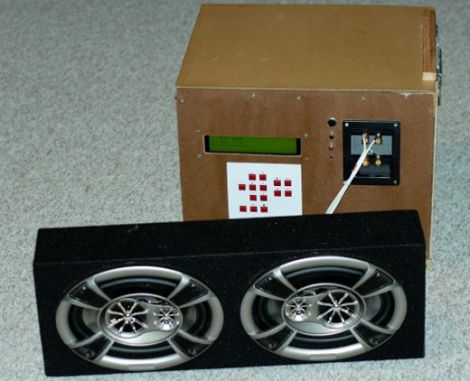
His Death Box is an MP3 player that he takes along on his annual trip to the Wacken Open Air Festival. His goal was to construct a portable amplified music player that could be powered from either a car battery or charger. A Via EPIA Mini-ITX computer serves as the brains of the device, blaring his tunes from a set of car loudspeakers via a two-channel 100W amp.

[Ole Wolf] used the music player for a few years, improving it as he went along. He does admit however, that with the continually dropping prices of MP3 players, he decided to bring a small portable unit along with him to the 2010 festival, leaving his box at home.

Given the fact that far smaller and more portable devices make his music box seem clunky and obsolete in comparison, you might ask why he even keeps it around. We think that every hack has its place, and while you won’t be strapping the Death Box on your back for your morning jog, it fits quite well in a variety of situations. This rugged music box would be an appropriate choice to use in your workshop, at the beach, or even on a construction job site – places where you might not want to use your comparatively fragile iDevice.