Beginner Concepts: Analog Circuits

We look at a lot of projects that have microcontrollers in them. That’s because microcontrollers do cool stuff, but there are still plenty of tricks you can pull off with analog circuits. [Osgeld’s] latest project explores this realm, controlling the discharge of capacitors through an LED. His setup uses just nine components and, if you’ve been collecting broken electronics from your friends and neighbors like a good hacker, you can scavenge all of these parts. Try it, you’ll like it!


Prototyping The Bulbdial Clock

Evil Mad Scientist posted a story about what went into developing the Bulbdial clock. We think the Bulbdial is one of the best pieces of kit out there for many reasons; using colored shadows for each hand is a brilliant idea, the design is clever and uses a low parts count, and the concentric rings that make it work also add to the aesthetic. But after seeing the original wood prototype it had crossed our minds that developing those circular PCBs isn’t the easiest thing to pull off. To save on board cost, the first run didn’t have the center routed out, but rather used almost-touching holes drilled during manufacture and finished by hand during assembly. They also go on to discuss the use of Charlieplexing to reduce part count and the search for a suitable diffuser for the clock face.

Gas Plasma Pinball Display

[Whoopjohn] decided to build a driver board for a display he pulled from a pinball machine. You’ve probably seen these used to scroll both score and messages using a total of sixteen 15-segment digits. We’d love to get our hands on one, and you might too but where? [Whoopjohn] notes that these were usually installed two-per machine and the driver boards were run close to their maximum ratings. That means that somewhere there’s a collection of broken machines with working displays. If you do plan to make this happen, you should be able to figure out the circuit based on this commented board layout (pdf).

Tube Preamp With A Dazzling Wood Case

It’s been a while since we’ve looked in on the world of vacuum tube audio equipment. [Bruce] just finished documenting a tube preamp he built. He actually made a couple of these with slightly different cases but they use the same circuit design. We found his discussion of common errors made when tying into ground quite interesting. It seems that many folks struggle with noise in their circuits because of ground loops. There’s some details about isolating the signal ground from a metal chassis, and also an admonition about not connecting the input or output jacks directly the chassis.
If you like this, don’t miss on of our favorite tube projects, [Bruce’s] Poddwatt.

Robotic Helicopter That Can Grasp A Payload

Like the Grand Theft Auto RC missions come to life, this helicopter can grasp objects for transport. They don’t have to be a special size or shape, and it can lift them even if they are not centered. This is thanks to a load-balancing hand (originally developed as a prosthesis) that relies on flexible joints and a tendon-like closing mechanism. As you can see in the video, the light-weight chopper has an on-board camera so that the operator can see what is being picked up. This little guy has no problem lifting objects that are over one kilogram while remaining stable in the air.

[Thanks Paul]

Airport Express Speaker Mashup

[Wei] salvaged the internals from an Airport Express that had a blown power supply. From there he built this streaming music box. The case is from an IKEA clock with the face removed. He added some decorative fabric around a grill to make an acoustically transparent front panel. Inside you’ll find the Airport guts connected to a USB charger (replaces the dead PSU) and a set of powered stereo speakers. This simple mashup looks good and frees up space in your junk-parts box.

Hydropower Generator

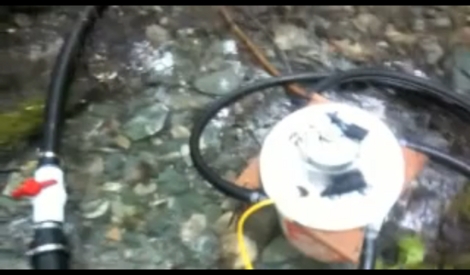
[Paul] wanted to have access to renewable energy at his cabin. It’s a relaxing place, nestled in a tall forest that shelters him from the sun and wind. This also means that solar and wind energy aren’t an option. But there is a stream running through the property so he decided to build his own version of a small water-powered generator.

He tapped into a reservoir about 200 feet upstream, split the flow into four smaller hoses, and channeled that into a five-gallon bucket. Inside the bucket you’ll find a Pelton wheel he built which turns a low-RPM generator. He manages to generate 56 VDC at 10 A with this setup, more than enough to charge a bank of batteries.

He does a great job of explaining his setup in the video after the break. If you’re looking for other ideas of how to cut down on your environmental impact check out this compost-powered water heater.

Continue reading “Hydropower Generator”