Three Pendulum Harmonograph

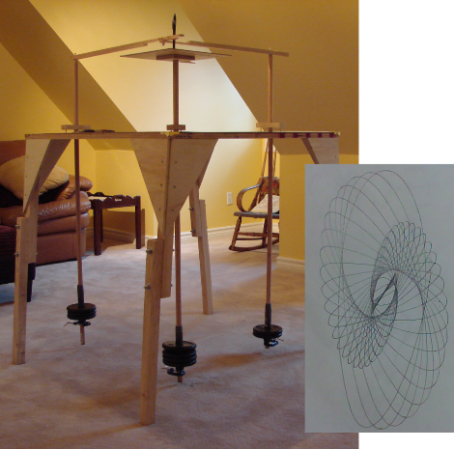
Just the other day we were thinking “You know what we need more of around here? Harmonographs!” And our requests were answered when [Paul] sent in his three pendulum harmonograph. For those unaware, it’s a mechanical device that draws Lissajous curves or “really cool circles” to quote some of our staff.

[Paul] includes all the plans necessary to make your own harmonograph and begin drawing today. If you can’t wait, there’s a video of the three pendulum harmonograph etching a masterpiece after the jump. Continue reading “Three Pendulum Harmonograph” →

Store Update: Remember This?

The Hack a Day store has a couple new items.  It was brought to our attention that we once held a T-shirt contest, and people really wanted access to that design. Well, now you can get it. The design on the shirt will be roughly 13″x10″ and located at the hem under the right arm. Please note that this is not identical to the previously made ones that you may have noticed at CES.  The design is also available as a large sticker.

We would love to see our stuff in the wild, so please upload your pictures to Flickr and put them in the Hack a Day pool.

Arduino Webserver

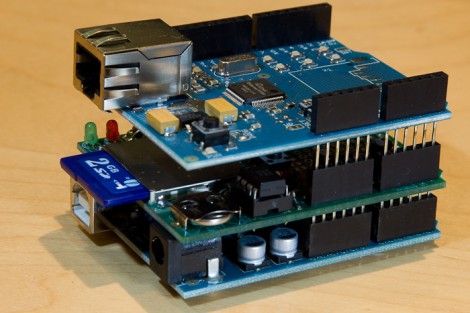
The Arduino platform should be perfect for throwing together a lightweight webserver because of the availability of quality shields that take care of the hardware for you. As [Ovidiu Predescu] found, there are a few hiccups along the way and he’s put together a guide that covers the workarounds. Specifically, using an Ethernet shield and data logging shield at the same time produces a bus conflict which he sidesteps by cutting the CS pin trace on the data logging board and moving it to a different pin. There is also a bug with one of the chips on the Ethernet shield that is fixed using a similar method. So if you’re not just going to etch your own webserver hardware maybe this is the next best thing.

Open Source Logic Analyzer Software

[Christian Weichel] has been hard at work developing LogicAnalyzer, an open source tool that may interest you. It is designed with SUMP Logic Analyzers in mind but a main goal is expandability. What this means is that it plays nicely with things like the Open Workbench Logic Sniffer or you can do a bit of fiddling to get it to work with your own designs. The program is based on Eclipse so you should be familiar with how it works and you can get it running easily on multiple platforms. Take a look at the wiki for a quick start.

Wasp Sucker Clears The Air

[Matthias Wandel] had something of a wasp problem so he built this trap to catch the pesky fliers. These look like Yellow jackets and they can build some huge nests (check out the picture of a 2-year old dwelling). We’ve experienced a large nest in the walls of an apartment and weren’t as clever at fixing the issue. [Matthias’] solution uses a 1/3 horsepower blower to snatch the wasps out of the air and retain them in the trap above. The trap sits on the blower with some insect netting as a filter, the hose acts as the inlet and is placed at the entrance to their lair. It took nine hours to fill this trap; we wonder where he chose to release them. Enemies of [Mr. Wandel] beware.

[Thanks Trebu]

RFID Transplant

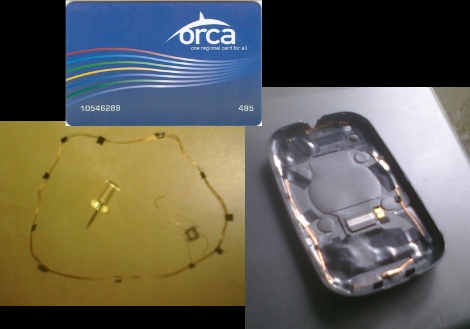
[Zach Charat] didn’t want to carry around yet another card with him so he transplanted the RFID guts from his card to his phone. Soaking the card in nail polish remover for twelve hours got him nowhere, but when he broke out the acetone the card was falling apart in 30 seconds. Above you can see the tiny chip and loop antenna that were left after ditching the plastic. The black bits are electrical tape which he then used to embed this in his Palm Pre’s touchstone charger plate ( which we just saw this in a hack last week).

This works, and while you’re waiting for the world to implement the Leeloo Dallas Multipass it’s a great solution.

[Thanks Coveredwagonkid via Pre Central]

Microcontrollers Access The Web

[youtube=http://www.youtube.com/watch?v=ExoJDxBGEBU]

[Kenneth Finnegan] is back with another video showing some cool stuff he’s doing to connect his microcontrollers to the internet. Usually, we see this done with a prebuilt module like an iobridge. [Kenneth] is using a Microchip ENC28j60 module for the communication and he’s managed to stuff it all onto a tiny Electroboards piece.  [Kenneth] is starting to become a regular around here.

[via HackedGadgets]