DPAC Put Your Alarm Clock To Shame

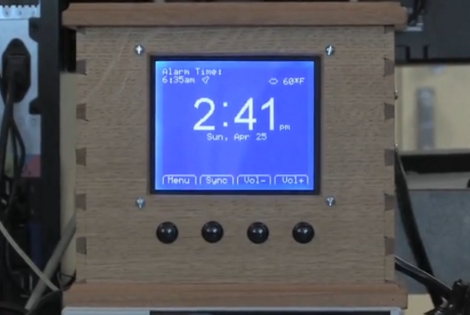
DPAC, the Dynamically Programmable Alarm Clock, goes far beyond what you would expect an alarm clock to do, yet we find all of its features useful. You can see there are four buttons at the bottom that control the menu scrolling. The second from the left currently reads “Sync”, a feature that the clock uses every 10 minutes but can be forced manually. This will check your Google Calendar, schedule an alarm for the next event while factoring in driving distance, traffic, and weather conditions. It’s got an audio system for radio and iPod operation, but also includes some home automation options. Using the X10 communication protocol it can turn on lights, start the coffee maker, and open the blinds as part of a gentle wake-up cycle. All of this is configurable through the clock itself, or via the web interface. The prototyping was done on an Arduino but the final version uses an AVR ATmega324 along with a Roving Networks RN-134 WiFi module (datasheet) for connectivity. Check out the demonstration video that [Eric Gaertner] and his fellow developers filmed after the break.
Continue reading “DPAC Put Your Alarm Clock To Shame” →

CPU As A Heat Sink

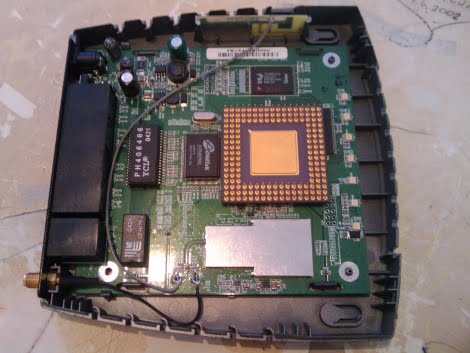
We’ve noticed that wireless routers pump out a bunch of heat. [Jernej Kranjec] wanted to make sure that he didn’t fry it once he started adding more load to his router using OpenWRT. What he came up with is the idea of using an old CPU as a passive heat sink. He applied a bit of thermal paste to the center and some super glue to the corners. You can see the finished product is an old AMD chip adhered “dead bug” style to the stock processor. We’d bet it’s not very efficient compared to an aluminum or copper heat sink, but it normally would have no help in shedding those extra degrees.

Motorcycle computer

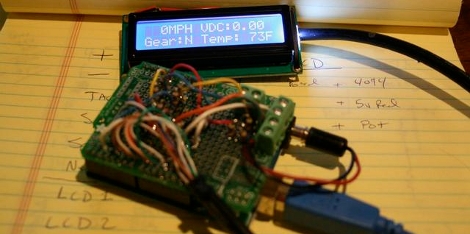
Hackaday writer of yore [Will O’Brien] has been working on this hardware for his motorcycle. Speed, voltage, gear, and temperature data is displayed on a 16×2 character LCD. The speed is pulled from the bike itself and the gear is calculated by comparing engine RPM to wheel RPM. He’s using the popular DS1820 1-wire temp sensor along with an Arduino to pull everything together. At this point he estimates there’s about $50 worth of parts, but that can be reduced by etching a board and just using the necessary components.

Adding Reset To An FTDI Cable

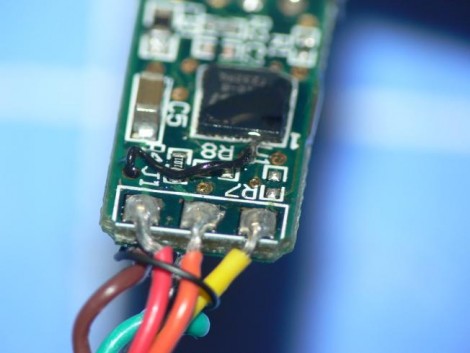
Hackaday alum [Adam Harris] hacked an FTDI cable to use for programming his Arduino. After cracking open the plastic case he found the FTDI chip used is the same as the one in the SparkFun programmer. The only real difference was that his cable wasn’t resetting the Arduino, he had to do that manually. The solution was to reroute the RTS wire so that it connected up to the DTR pin. This proved difficult because of the tiny footprint of the chip, but after many tries he managed to get a piece of wire wrap soldered in place.

Using A/C Frequency As A Clock Signal

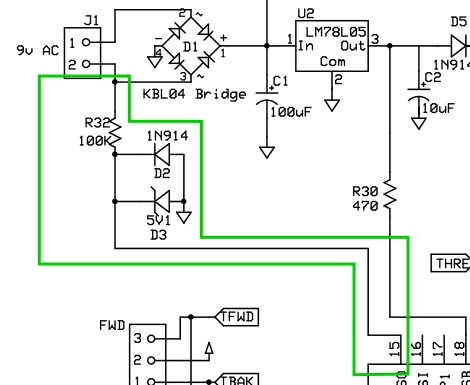
A while back we saw a logic clock that used the alternating current frequency from the power grid to keep time. We asked for information on your projects that use this method and we got a lot of comments and tips. Today we’re sharing [Doug Jackson’s] method which he used in his word clock.

The schematic above is from that project and we’ve outlined the important part in green. [Doug] pulls a signal from the 9V AC power before it hits the bridge rectifier, using a 100K resistor and a zener diode to protect the microcontroller pin. The code for that project comes as a hex file but he sent us the C code pertaining to this timing circuit. It’s written for PIC but you’ll have no trouble adapting it to other microcontroller families. Take a look after the break.

Continue reading “Using A/C Frequency As A Clock Signal” →

Ball Inverted Pendulum

[youtube=http://www.youtube.com/watch?v=bI06lujiD7E]

We’ve seen several different balancing bot styles over the past few years, but this one is new to us. The BallP, short for Ball inverted Pendulum, balances on top of a ball. We’re not sure what the advantages are to this layout though. Anyone care to enlighten us? Even though we hadn’t seen this style, it is apparently not new. The Ballbot has been around for a while and might seem even more impressive visually.

Optiboot Makes Your Arduino Faster, Sleeker

Tired of waiting for that Arduino sketch to upload? Find yourself limited by code space? Optiboot eases both of these problems. The package is an alternative bootloader that runs at a higher baud rate (115200 versus 57600) and it takes up 1.5 KB less space than the stock version. This means your sketches can be larger without upgrading to a beefier chip and they will take less time to upload, a lot less.

This fully compatible alternative to the Arduino bootloader requires an AVR ISP programmer to burn it to the chip on your Arduino. If you have an extra AVR lying around you could use the Arduino as a programmer and then physically swap the chips.

[Thanks Peter]