Induction Furnace

induction furnace

[Tim Williams] made his own induction furnace. A copper tubing coil forms the primary winding, as the material to be heated becomes the short circuited secondary. The load material is subject to high power magnetic fields operating at radio frequency. The rapidly changing field induces current flow within the material, creating a great deal of heat. The brute power required a cooling system to match. In the video below, the induction furnace can be seen melting common table salt.

Continue reading “Induction Furnace” →

Arduino Nixie Shield

AN_Board_FirstBuild2

Reader [Bradley] sent in his ArduiNIX project, an Arduino shield designed for driving nixie tubes. The shield allows the Arduino to drive and multiplex nixie tubes without any additional hardware. These antique-looking displays are commonly hacked into clocks. It takes 9 volts from a wall wart and steps it up to over 200V in order to drive the displays. The shield is capable of multiplexing up to 80 individual elements. He has example code for driving a 6-digit display and a clock on his site. He is selling kits and completed shields too.

Related: Victorian nixie tube clock

[thanks Bradley!]

Adafruit Introduces The Sensor Pack 900

adafruit

Our friends over [adafruit] recently released the Sensor Pack 900, a collection of parts for anyone who is interested in using analog sensors with their projects. The pack includes 9 sensors. They range from simple thermistors and hall effect sensors to sharp distance sensors. Also included in the pack are 3 unidentified components that can be used to interface with the analog sensors in the pack. At only $30, the Sensor Pack 900 seems to offer a great set of introductory components for anyone prototyping a new device.

TwypeWriter

3651494046_ccd4f5e99a

in the oomlout offices, everyone loves twitter. They love it so very much, they decided to find new and fun ways to participate. This one is the TwypeWriter. It searches for a keyword and then physically types out the results for everyone to peruse. There are a couple videos of it in action on their site, as well as the source code to make one for your self.

[via the Hack a Day flickr pool]

Atari 2600 Slim

chriskoopa_2222 (Custom)

[Chris-Koopa] sent in this sweet little throwback to the good ol days of Atari 2600. He had been playing his old unit, lamenting the poor visual quality on his new TV when he had an idea. He picked up an Atari flashback2 and began modding. He added a cartridge slot and made some case modifications to make it look more like the 2600. The final result is that he can switch between the built in games, or play strait off of the cartridges with crisp clean video. There are other methods of doing this, like modding the Atari itself or building a whole new console, but this is pretty sweet too.

VR Game Gun

[youtube=http://www.youtube.com/watch?v=7Ym0tZSWGMc]

Many of you have probably experimented with alternative gaming interfaces. Here’s a well done little hack where they created a gun with a display mounted on it, for video gaming.  At a glance you can probably figure out exactly what they’ve done. They’ve attached a gyration mouse to the gun for tracking and gutted a keyboard for the buttons.  We have to give them some credit, they seem to have packaged it all nicely. Since it’s a standard mouse and keyboard, it just plugs in and works with any game.  As you can see in their version, the screen works very well in this configuration, almost seeming like a giant scope. You can see the wireless version and hear their aspirations for projector based models after the break.

Continue reading “VR Game Gun” →

Homemade Toroid Winder

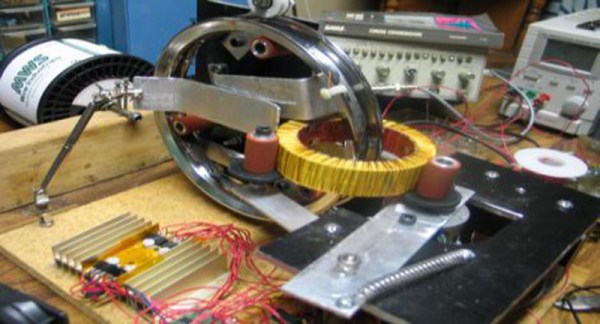
[eclipsed78], built an automatic toroid winder (Internet Archive). The drum splits in order to load the toroid. Then wire is wound on the drum, much like any other coil would be wound. The drum rotates as a slider pulls the wire off the drum, while revolving in and out of the toroid. A side tension keeps the slack out of the wire during operation. The winding coil is stepped as the drum rotates, in order to control the turns ratio. [eclipsed78] created a stepper driver from a schematic, so he could drive the motors. You can watch the winder in operation  as a series of videos. The first of which is embedded below. If you have ever needed to wind a massive toroidal transformer, this is the project for you.

Continue reading “Homemade Toroid Winder” →