IR Glass Level Detection

[youtube=http://www.youtube.com/watch?v=DG3_2lvoL8A]

[Johnny Lee]’s colleague [Paul Dietz] has done some interesting work using interactive tables. He’s specifically researched how to determine how full a drink glass is. In the video above, he’s using Microsoft’s Surface, but this technique should work with any IR camera based multitouch table. Determining the drink level requires custom glassware that has a small prism inside. When the liquid level is above the prism, light passes through, but when it’s below the top it reflects more IR light back into the table. Using this information, restaurant staff could serve drinks in a more efficient manner.

[Paul] has worked on another project that uses RFID and capacitive sensing to a similar effect.
CatGenie Hacking

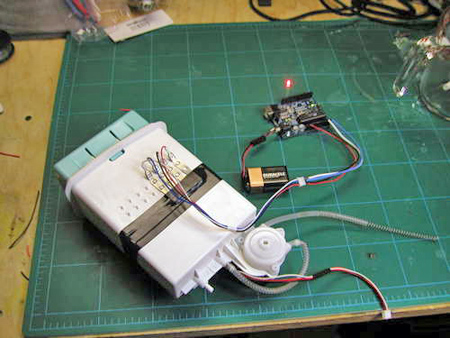
[ScottSEA] has six cats. As you can imagine, with six cats, a simple litter box just doesn’t cut it. [ScottSEA] uses the CatGenie. While a self cleaning cat toilet is a technical marvel, it has one major drawback. Much like an ink jet printer, it has disposable cartridges. Those cartridges, just ike some print cartridges, have a built in counter that disables them after so many uses. After adding up the totals for six cats worth of cartridge use, [ScottSEA] started hacking. He has posted directions on how to manually refill them, as well as reset the internal counter using an Arduino.

We suggest that he find a way to harness all that cat power for his home electronics. How many watts could you produce per cat?

Acidmods Custom FPS Controller

fpsutil3

Yet another custom X Box controller has come out of the acidmods foundry. This one, specialized for FPS games opts for two analog sticks up front, and complete removal of the D pad and buttons. They break down the process quite nicely with very detailed pictures of how to modify the case and move the analog stick.  Check out the video of it in action after the break.

Continue reading “Acidmods Custom FPS Controller”

Arduino RC Airplane

arduino_airplane

[Olivier] told us about this fantastic project where he built his own RC airplane. The airplane itself is nothing special, it is the controls that are worth paying attention to. He used an Arduino Diecemilla , some XBee transceivers, and a SparkFun Wee. The main site is a general overview, but there are links to more detailed breakdowns of how to build some of the parts. There are several videos of him flying it as well.

3D Printer Uses Office Paper

3dhouse
Mcor Technologies recently launched a brand new rapid prototyping machine. The Mcor Matrix forgoes the standard of expensive and rare build materials by using A4 office paper. The machine selectively deposits glue on the sheet of paper: more glue on the cross-section, less on the waste. It then uses a blade to cut out the part profile. The vertical resolution is determined by the paper thickness. You can use either 20lb paper, which has a thickness of .1mm, or 40lb, which is twice as thick, so it will build twice as fast. The final part can be sanded and painted like wood. The idea is similar to LOM, but those machines require specialized paper. It’s nice to see a company intentionally target a low cost of ownership. If they had used a laser though, you’d only have to worry about sourcing the glue. Machine and material prices have yet to be announced.

[via Fabbaloo]

Official Arduino Ethernet Shield

ethernetshield
Arduino has just released an official ethernet shield. It’s based on the same WizNet W5100 chip that was used in the tiny ethernet board we covered earlier. The W5100 handles the full IP stack and can do TCP or UDP with four simultaneous sockets. The board has a power indicator plus six LEDs to debug the connection. It works with the standard ethernet library. The reset button resets the shield and the Arduino. The SD adapter is not currently supported by the Arduino software.

Design Robots To Hunt Humans

gladiator_240g

The Department of Defense wants you to design a pack of robots that would hunt humans. Or, as they put it, “search for and detect a non-cooperative human subject”. While the project brings to mind Terminators, there are also non-terrifying uses for these robots, including search and rescue missions. The robots should be about 100 kilograms or less, provide immediate feedback, and defer to a human operator in the event of a difficult decision. This project presents some interesting challenges for robot designers. They’ll need to consider several key issues, like robot cooperation and decision-making abilities. We knew it was only a matter of time before the DoD turned the Grand Challenge into Death Race.

[via Warren Ellis]