
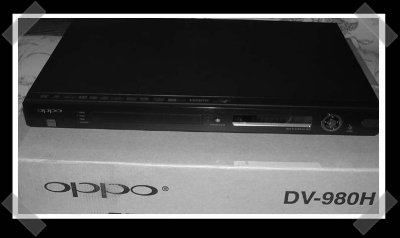
There’s an interesting thread discussing mods to improve the inexpensive Oppo 980 DVD player for better performance. The power supply, capacitors and opamps can benefit from some higher end components. [Occam] suggests several replacement opamps options for upgrading the audio output. The realatively low cost of Oppo gear makes it a better risk than modding a multi-thousand dollar DVD player.
Hacking At Random 2009

Hacking At Random 2009 has recently been announced. It’s brought to you by the same people who held the outdoor hacking event What The Hack, which we covered in 2005. Date, location, and many other details are still up in the air. They’re looking to host 3000 attendees and we’re guessing it will be similar in nature to last Fall’s incredible Chaos Communication Camp near Berlin. 2009 will also feature the beta run of outdoor hacker event ToorCamp near Seattle. Two great events we’re certainly looking forward to.
[photo: mark]
Name That Ware
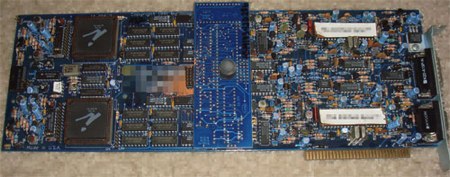
Last month we mentioned [bunnie]’s Name that Ware competition where participants try to guess the functionality of a random bit of hardware. We thought you might want to see another example; pictured above is the June 2008 ware provided by [xobs]. You can see a high res version here and an image of the daughter card as well. Be forewarned that someone has already posted the solution in the comments. At first glance there are quite a few interesting bits: board is copyright 1991, the 8-bit ISA connector doesn’t have any data lines connected, just power, and it’s got a lot of analog circuitry. Take a guess and then check out the comments on [bunnie]’s site to see the solution.
Home Made PCB Drill Press
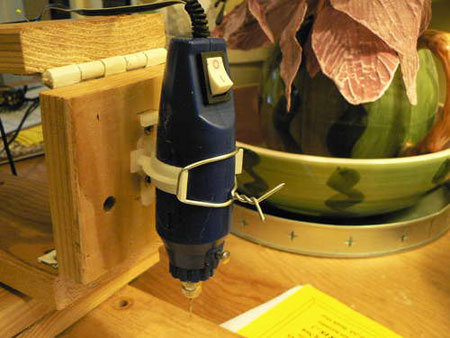
[yellowduck] took some fantastic initiative with this home made PCB drill press. Many people have a rotary tool already. Just add some scrap wood and four hinges. The drill press isn’t perfect; it pivots a little as it lowers. This shouldn’t be a problem for drilling printed circuit boards though. The PCB should be thin enough for the pivot to have little effect. After some test runs, he added a lamp for better lighting and intends to add a return spring and foot switch. It’s definitely a better solution than drilling multiple holes with a hand drill.
Annoy Your Friends With High Pitched Noise
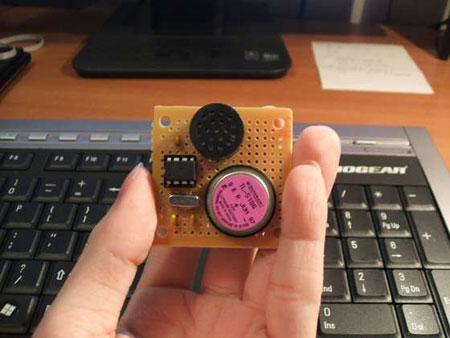
[Hungry_Myst] has put together this fantastic device to annoy your friends. It randomly emits high pitched sounds, then stops for a while to make it very hard to locate. He has added an extra level of annoyance by putting the noise in vicinity of 17KHz thus making it almost undetectable by people over the age of 30. The fact that not everyone in the room can hear it makes people go even crazier trying to find it.
The parts list is fairly short, and the directions concise. One thing that is fantastic about this article is that he encourages people to improve it. That alone is not a huge deal, but he mentions in several areas specific additions that would make it more user friendly: on/off, pitch control, and delay control.
Related: [jay]’s Picaxe based Brain Assailant
1-wire Barometer
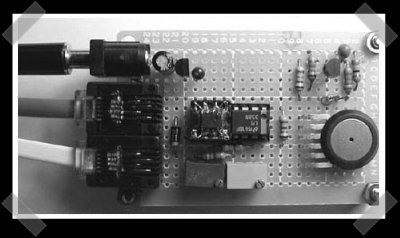
[David] put together this rather nice 1-wire barometer. An MPX4115 measures the pressure while an SMD DS2438 mounted to an 8 pin DIP socket provides the 1-wire interface. The writeup includes a nice description of the board layout and wiring, making this project accessible to just about anyone with a decent tip on their soldering iron.
ReWalk Suit For Paraplegics
We here at Hack a Day are really interested in power suits, so the ReWalk suit for paraplegics immediately caught our attention. By using unique robotic control algorithms, the suit works with the user rather than for the user. This allows the user to experience the sensation of walking autonomously and a chance at a normal life. Argo, the design company, also claims that a suit like this will end up saving the user money considering the high price of medical and transportation equipment. The core design is not entirely new. It has a batterypack and DC motors placed at the joints. The wearer uses crutches and the sensors and software monitor upper body movement to predict when and where the user wants to move their leg.
[via Medgadget]








