Twittering Teddy Bear

This may be the deathblow that kills Nabaztag: using text-to-speech software, this animatronic bear speaks a Twitter stream aloud and in real time.

The gurus at My Home 2.0 made the bear talk by replacing its integrated circuit board with an Arduino loaded with custom software. A Bluetooth audio adapter was added as a channel for the bear’s voice, and a circuit with an H bridge chip was added to address power issues. The Arduino translates the income audio signal into movement. From there the process moved to the computer that feeds the bear audio data, they parse the Twitter stream and use OSX’s built in “say” command to generate the voice stream that’s sent to the bear via Bluetooth.

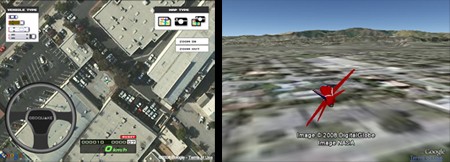
Gaming With Real-world Data


We were pretty excited by the prospect of location-aware software and its ability to pull map data into its functions, but what do you get when build software on top of a map-based service? Well, one possibility is 2D gaming on real maps.

Continue reading “Gaming With Real-world Data” →

Don’t Talk To The Police


As builders of improvised electronic devices, we’re worried that we may find ourselves running afoul of the law. Lucky for us, we’ve got the advice of Regent University Law Professor James Duane on using the 5th amendment. He runs through many examples where saying anything at all, truth or otherwise, can get you into trouble. Embedded below is the other side: Officer George Bruch discussing some of the interview techniques he uses.

Continue reading “Don’t Talk To The Police” →

Electric Recumbent Bicycles


If you liked our post about bikes and skates with weed whacker engines but want more power and more challenge, we have good news. We’ve found some great instructions on adding motors to recumbent bicycles, which we’ll take you through after the break.

Continue reading “Electric Recumbent Bicycles” →

Twitter Security Cam


It seems that people keep coming up with ingenious things to with Twitter. Reminding you to water your plants is relatively inventive, but for shear practicality, [Shantanu Goel] created a security camera using a webcam, a few freeware apps, and a Twitter account.

To make this work, install Motion on a system running Linux. As its name suggests, Motion is a free motion-detecting application that monitors movement in a webcam’s field of view. Once installed, it should be configured to take a snapshot of the event whenever something moves; with the locate option turned on, it draws a square frame around the area where motion occurred. The program includes http server functionality, so the photos can be viewed from a remote location. When all of that is properly configured, motion can be set to trigger cURL, Wget, or [Goel]’s Perl script to post a message to Twitter about the event. From there the Twitter account can be configured to send text messages to a phone, creating a virtually instant notification of motion sensed by the webcam.

[via Hackszine]

Geo Metro Halved For Better Mileage


[Doug Heffron] modified this 1989 Geo Metro way back in 1993. Gas prices had just started breaking $1.00/gallon and he wanted to show manufacturers how to build a fuel efficient vehicle in such troubling times. The car already got 58mpg (Prius: 46mpg), but [Doug] decided he could do better with some aero modifications. The car was converted to tandem seating and stripped of any extra weight. In its final form, it got 75mpg, but then gas prices stabilized and it was laid to rest in a shed. You can find out more about the car and see photos from the build on its site (painful resizing).

[via Autoblog]