[Barry] got his hands on an interesting electronic lock pick. The ‘Ring of the Devil’ is made of aluminum and has four magnets inside. By rotating it against an electric lock, (like the one in our RGB keypad lock How-To) the magnetic force can cause the electric motor inside the lock to turn and unlock. More details and commentary are on [Barry]’s site.
Nokia Color LCD Flickr Frame
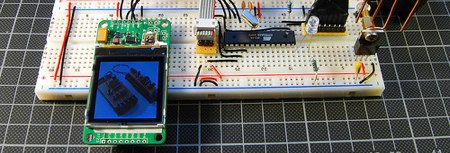
Tinkerlog got their hands on a color LCD from SparkFun and set it up to receive images from Flickr. These color LCDs are 128×128 pixel and the include a breakout board with a separate power supply for the backlight. Communication is via a three wire SPI bus plus a reset line. [Alex] used an ATmega48 for control, which is connected to the computer using an RS232 to USB converter. The wiring schematic is here.
For the software side of things, he adapted Sparkfun’s example ATmega8 code for the microcontroller (he couldn’t get the Arduino code to work). Beej’s Python Flickr API was used to grab the images. The Python Imaging Library converted them, and finally, they were sent to the display using pySerial. SparkFun has been offering these displays for quite some time; it’s good to see a quality writeup of one in use.
[via Make Flickr Pool]
Laser Insect Photography Rig
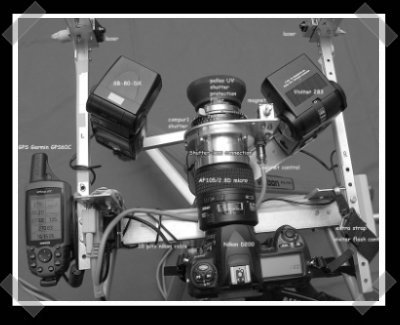
[Marc] sent in this awesome insect photography rig. The camera is manually pre-focused and set for a 30 second exposure at ISO100. The aluminum cylinder in front of the lens is an external shutter mounted with a custom turned lens adapter. It’s used because the built in shutter is too slow for insect capture. The camera/shutter is triggered by a pair of lasers with photo detectors. When both beams are broken, the insect should be in front of the lens. A Garmin GPS provides position information that’s tagged on the image by the Nikon D200. A large photo of the rig is here, while a more detailed writeup on building it is here.
Update: It looks like we covered a previous version of this rig, but the old links are down and we didn’t have a shot of the setup. Oh, and I forgot to mention [Marc] new control box for running this rig.
Laser Based Night Light

[the4est] put together this quick how to for making a laser based light bulb night light. First, you need to break out the black glass base of the bulb and remove the filament. Scrub the inside of the bulb and pour in the paraffin. Once it sets, you can break the glass, leaving a solid wax bulb. Hollow out the inside, insert a laser pointer, and you’ll have fine glowing night light.
Game Boy Foot Controller Demo
[youtube=http://www.youtube.com/watch?v=lQdqudTzyBs&hl=en&rel=0&color1=0x3a3a3a&color2=0x999999]
This is a video of [Joey Mariano] from animal style demoing his Game Boy pedal board. He added a D15 port to the back of the Game Boy, which is wired to each of the 8 buttons. The port is connected to a breakout box for 8 piano sustain pedals. The box also provides power to the Game Boy. The Game Boy is running the Nanoloop step sequencer. If you’re wondering about the guitar sound, he’s probably using an 8-Bit Fuzz pedal.
[via GetLoFi]
Pegboard Cable Organizer

In our integrated desk post, we mentioned using pegboards and zip ties to organize cables. Lifehacker has a collection of pictures from their readers that are using this solution. We especially love [Steve Price]’s fliptop solution pictured above. It may not look too attractive, but we’d do pretty much anything to avoid crawling under a desk.
Asus WL500GP Audio Hack
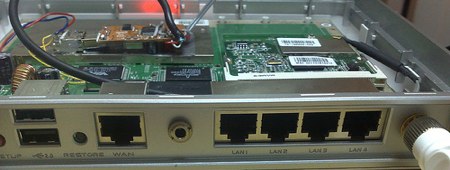
The Asus WL500GP wireless router runs Linux and has two USB ports. [equinoxfr] wanted to install audio support internally to the router though (translated). Luckily, it uses a VIA VT6212 4port USB controller. So, he was able to wire two more internal ports. A Brando USB soundcard is plugged into one of those ports and wired to an external headphone jack. He wanted dual RCA connectors, but they just wouldn’t fit. The router is running OpenWRT Kamikaze. MPD is used to serve music with the wymypy frontend since it has its own lightweight webserver.