Bow Tie Kindly Suggests That You Back Off

personalSpaceBowtie

Everyone’s had their “personal space bubble” burst. You just wanted a friendly conversation, but now some overzealous blockhead is standing on your shoes and breathing in your face, making you guess what he had for lunch. Fortunately, [Grissini] has created this sylish bowtie solution. Stand too close (within 19 inches) and the LEDs come to life, flashing a warning that indicates a personal space violation. [Grissini’s] tie is 3D printed to accommodate most of the electronics, which snugly snap into place. The rest of the wiring appears to run through the neck strap and connect up to a battery pack hidden elsewhere. You can check out a brief description and demonstration in a video after the break.

We’ve seen this hack for the ladies: [Jeri’s] dress performs a similar function. We’re unsure, however, if these LEDs can deter your average socially-awkward space invader. What we’d really like to see is someone take these hacks to their logical conclusion and make a wearable out of the non-lethal dazzler clone…hopefully the victim would back up a step or two before they spewed.

If you’re lonely and want to encourage people to come closer, maybe this LED bow tie will help. Or, who knows, maybe it’s yet another way to scare people off.

Continue reading “Bow Tie Kindly Suggests That You Back Off”

3D Printering: Where Can I Get The Cheapest Filament?

printering

We’ve complained about the price of 3D printing filament, and cheered at the machine that makes filament out of plastic pellets. Still, the price of filament for our 3D printers is climbing ever higher, leaving us to wonder, where can I get the cheapest filament?

Now, I’m going to start this of by saying this is a work in progress. Canvassing suppliers on every continent for 1.75 and 3mm ABS and PLA for every possible color while accounting for different amounts of filament and shipping is a whole lot of work. Therefore, we’re going to do this in parts, first starting with how much it will cost me to get a kilogram of PLA shipped to my door. This should be a valid test for just about everyone in the USA.

The test criteria is simple: find a supplier of PLA on the Reprap wiki printing material suppliers page and figure out how much it would cost me to get 1 kg of white or natural PLA shipped to my front door. I’ve organized this in a spreadsheet (below) that contains the supplier, size (1.75 mm or 3mm), weight (usually 1 kg although some suppliers are about three ounces short), color, and price with shipping included.

Continue reading “3D Printering: Where Can I Get The Cheapest Filament?”

Dual Extruders In The Space Of One Stepper Motor

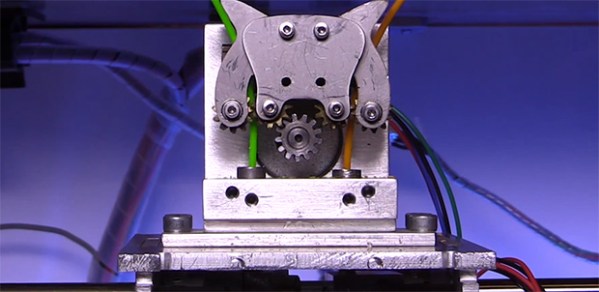
The new hotness in 3D printers is – and has been for a while – dual extrusion. With two extruders and the requisite filament supply, it’s possible to print objects in two colors or two different materials. There’s a problem with this setup, though: each extruder requires a separate motor, greatly reducing the print area should you want to print in two or more colors. [Carl] and [Brian] think they have the solution to this with their dual extruder that is powered by one stepper motor.

As you can see from the pic above, the idea is relatively simple. Two strands of filament are fed past one gear attached to a stepper motor. Each strand is moved into the hot end through two idler gears and side of the extruder feeds into the hot end is determined by the rotation of the motor. It’s really one of those, “why didn’t I think of that” ideas.

[Carl] and [Brian] are also offering a quad extruder, a dual-sized extruder able to pump four different filaments onto a printer bed. With this, we expect some people to experiment with CMYK (or CMYW) prints, truly turning any 3D printer into a machine that prints full color parts.

Continue reading “Dual Extruders In The Space Of One Stepper Motor”

3D Printering: Remote Control Of 3D Printers

extrude

With new owners comes new editorial direction. You’re looking at the first evidence of that right now. We’re going to be doing some weekly columns dedicated to certain subjects, and with our fascination of all things three dimensional, it only made sense our first weekly column was dedicated to 3D printers. And using 3D printers, stuff made with 3D printers. Also, things that can be used with 3D printers. Great wordsmiths we are, we’re calling this column ‘3D Printering.’ If you have a better name (or a title pic) send it in and we’ll probably use it.

With that out of the way…

This week we’re taking a look at remote printing. With anything from an Android tablet to a Raspberry Pi, it’s possible to have a networked 3D printer, the perfect thing for hackerspaces or anyone who wants to print objects from multiple computers. One of the most-used tools for this is OctoPrint, a printer host designed to be run on small embedded devices such as a Raspi.

We’ve seen OctoPrint before. but since then it’s matured a whole lot. with a ton of reports of successes running on everything from a Raspberry Pi, BeagleBone Black, and even an OUYA. All the major electronics boards – RAMPS, RAMBo, Sanguinololu – and firmwares should work with OctoPrint, making an Internet-connected 3D printer simply a matter of connecting a Raspberry Pi.

Of course OctoPrint isn’t the only networking solution for a 3D printer. PrintToPeer is deep into development and should be released sometime this fall. It’s a much more sophisticated way of networking a printer that includes an iPad app and ‘enterprise class’ functionality.

The PrintToPeer team is offering private beta invitations, but with a catch: you need to print out a piece of a sculpture and send it to them. These pieces will be unveiled in September as the largest 3D printed sculpture, and the word’s first collaborative 3D sculpture.

Printing An Aston Martin DB4

CAR

With 3D printers finding their way into the workshops of makers the world over, it was bound to happen sooner or later. [Ivan Sentch] is making an Aston Martin DB4 with a 3D printer.

Before we board the hype train, let’s go over what this is project is not: [Ivan] isn’t making any metal parts with his 3D printer, and the chassis and engine will be taken from a donor car. Also, the printed plastic parts won’t actually make their way into the final build; the 3D printed body panels will be used to pull the final panels in fiberglass. That being said, it’s still an impressive undertaking that’s going to cost [Ivan] $2250 NZD in plastic alone.

[Ivan]’s body panels are made by taking a DB4 model in Solidworks, slicing it up into 105mm squares, giving each square extruded sides, and finally securing them to the wooden form after the parts are printed. There’s still an awful lot of work to be done once the 3D printed parts are all glued together, but it’s still an amazingly impressive – and cheap – way to create a replica of a very famous automobile.

Cyclone PCB Factory: 3d Printable Circuit Board Mill

printable-cyclone-pcb-factory

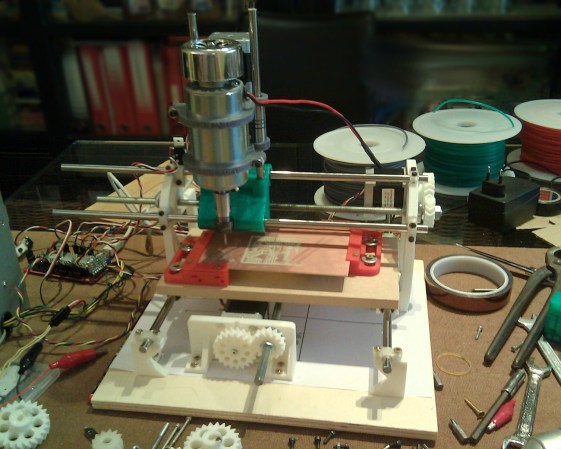
If you can 3D print most of the parts for another 3D printer, why not also for a PCB mill? That’s the question answered by the Cyclone PCB Factory. It will help you kiss those toner transfer or photo resist days goodbye.

Homemade circuit boards tend to be rather small, which really helps keep the cost and scope of this project down. Most of the mounting parts, as well as the gears, are 3D printed. Of course there’s the usual machine tool items which you pretty much have to purchase: the ball screws, precision rod, stepper motors, and a motor to spin the routing tool.

Check out the video below to see where the project is right now. One of the crucial aspects of PCB milling is to have a level build table. The cutter head tends to be ‘V’ shaped so cutting just a bit too deep can blow out the traces you’re trying to isolate. The demo shows that this can automatically calibrate the software to account for any variances in the height of the copper clad.

We remember seeing a snap-together PCB mill. But we’re pretty sure that that one used parts milled from HDPE rather than 3D printed components.

Continue reading “Cyclone PCB Factory: 3d Printable Circuit Board Mill”

Is A LEGO 3D Printer By Definition Self-replicating?

lego-3d-printer

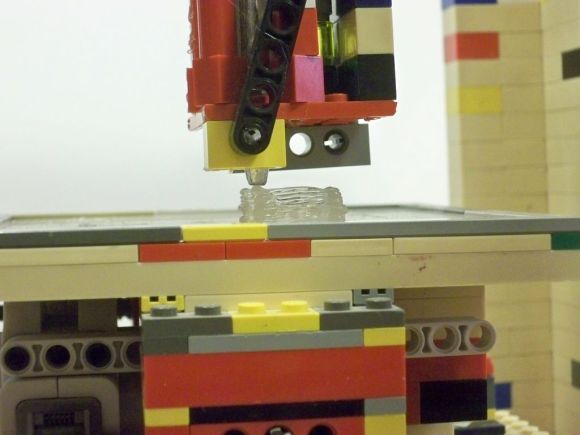
LEGO parts are plastic. 3D printers make parts out of plastic. So the transitive property tells us that a LEGO 3D printer should be able to recreate itself. This one’s not quite there yet, mostly because it doesn’t use plastic filament as a printing medium. Look close and you’ll probably recognize that extruder as the tip of a hot glue gun. If all else fails you can use the machine as a precision hot glue applicator.

The instructions to make your own version include the design reference and a few ideas for getting the most out of the glue dispenser. For the design phase [Matstermind] used LEGO Digital Designer. It’s basically CAD with the entire library of LEGO parts available as building blocks. from there he assembled the machine which is controlled by an NXT brick. He goes on to link to a few different printing mediums. There’s instructions for using crayons to make colored glue sticks, as well as a method of printing in sugar using the hot glue extruder.

We remember seeing one other LEGO 3D printer. That one didn’t use an extruder either. It placed blocks based on the design to be printed.

Continue reading “Is A LEGO 3D Printer By Definition Self-replicating?”