Tweaking Designs For [Theo Jansen] Walking Machines

image

We love the look, and most especially the gait, of [Theo Jansen’s] walker designs. We don’t fully understand them or the math behind them. But that could change if we spend enough time studying [Aaron Birenboim’s] body of work. He wants to incorporate the legs in a project so he’s been trying to optimize the Jansen leg design.

The calculations are delivered in a source code package available from his site. To make heads or trails out of the numbers you need a way to visualize them. He has provided that as well in the form of a MATLAB script which shows leg piece design and can even spit out an animated .gif file of the virtual legs in motion.

If you have no idea what we’re talking about make sure to check out [Jansen’s] original creations. We’re also excited to read more about the Klann and Ghassaei linkage designs which [Aaron] talks about in his post.

Timelapse Of The 3d Printed Gun Being Printed.

Once the DoD requested the 3d printed gun files be removed from the internet, a couple things happened.

  1.   The Streisand Effect went into full force. The file was shared all over and can still be found easily.
  2.   I suddenly realized that I was going to be printing a 3d printed gun and doing another article on it even though I had just written an opinion piece about how I don’t care.

I’m not above admitting that it is childish of me. I was told I couldn’t have this thing and suddenly I knew I had to make it. I see it with my kids all the time. Toys can sit in a corner collecting dust for ages, but the second it is in threat of being removed, they have renewed interest, at least for a few minutes.

I figured, if I’m going to be childish about it and print a gun that a) won’t work because I don’t have the right printer, and b) I won’t use anyway because I don’t generally play with guns, I might as well make a fun timelapse video of the more recognizable parts being made.

It initially seemed like it was going to be quick and easy. However, I quickly found that just printing this thing was going to be a time consuming and frustrating task.

1. the scale on the individual files was way off. 

I suspect this has something to do with the printer it was designed for. It seemed very close to being 1 inch = 1 mm. Not a completely uncommon problem. Manually resizing got some files to look right, but I found many simply wouldn’t resize.

2. Almost every single item had errors.

If you’ve done 3d printing, you’ve found that a model can have all kinds of issues that will stop it from printing correctly. I found every single item for the gun had errors. I actually learned a lot about how to repair non-manifold items from this exercise, so it was good in the end.

Some items, like the hammer and the hammer springs simply would not print. I ran them through systems to repair them and fix errors. It would say that everything was fixed, but when I tried to “slice” them for printing, the software would crash.  This means that my gun is incomplete. It has no hammer. Not really that big of a deal to me.

photo(53)
the whole gun
photo(52)
Note that it is missing the hammer mechanism. More on that later.
photo(51)
disassembled

Do I care now?

Nope. I climbed to the top of the fridge and got my cookies. I’m a happy child. The reality is that a zip gun is still cheaper, easier, safer, and more reliable.  Here’s an example.

Update: Lost PLA Metal Casting — The Movie

lost-pla-metal-casting-movie

Turning 3D printed plastic parts into metal objects is not a new concept. But we don’t see a lot of it and enjoyed watching the documentary version of [3DTOPO’s] lost PLA metal casting process so much we figured you’d want to see it too.

The thirty-five minute video walks through every part of the process which we originally learned about in September of last year. The process was developed as a way to fabricate parts that will be used in high-stress applications. For instance, the part seen above is a mounting bracket for the ball screws that moves the Z axis on a huge CNC build he’s been working on. A plastic part will break under the strain so he needed to make it out of aluminum alloy.

To start, the piece is modeled and printed in plastic to check the fit. Once it’s just right he scales it to 103% and prints it again to account for the shrinking of the metal as it cools. The next step is pictured above, adding paths using rigid foam insulation that allow for the metal pour and for air to escape. This is packed into a plaster and sand mold which dries before being cooked in a furnace to vaporize the foam and PLA. This leaves a perfect mold for the metal pour.

After the break you can see a 5-minute overview version of the project.

Continue reading “Update: Lost PLA Metal Casting — The Movie”

3D Printer Used To Make Custom Blade Server Type Mounting System

3d-printed-blade-server-mounts

We usually have no problem hacking together electronics into something useful. But finding an enclosure that makes sense for the build can be a real drag. In this case [Vincent Sanders] already had a working ARM build farm that leveraged the power of multiple ARM boards. But it was lying in a heap in the corner of the room and if it ever needed service or expansion it was going to be about as fun as having a cavity drilled. But no longer. He took inspiration from how a blade server rack works and 3D printed his own modular rail system for the hardware.

Each group of boards is now held securely in its own slot. The collection seen above mounts in a server rack which has its own power supply. This image is part way through the retrofit which explains why there’s a bunch of random pieces lying around yet. Instead of printing continuous rail [Vincent] uses a threaded rod to span the larger frame, securing small chunks of rail where needed by tightening nuts on either side of them. The white and red trays are prints he ordered from Shapeways designed to secure the eurocard form factor parts.

[Thanks Thomas]

The First 3d Printed Gun Has Been Fired, And I Don’t Care.

3d-printed-gunSeveral people have sent us this story. I’ve seen it everywhere. A lot of people are upset, on several sides.  A gun has been 3d printed that can actually fire a round.

First, we have people scared that this will bring undetectable guns to people who wouldn’t have had access before. Then we have the gun fans that are reacting to the others with shouts of freedom and liberty and stuff.  The 3d printing community has had mixed reactions, but many are concerned that this will harm 3d printing in general.

I simply don’t care.

Continue reading “The First 3d Printed Gun Has Been Fired, And I Don’t Care.”

Scratch-built 3D Printer Shows Rock-solid Performance

scratch-built-3d-printer

These days it’s super-easy (not super-cheap) to go out and buy a 3D printer. But if you’ve got the mad skills like [Mario Lukas] maybe you can build a 3D print using a bunch of scavenged parts (translated). He’s published six posts on the build, and put together an overview video which you can watch after the break.

A pile of salvaged parts were found in a scanner and four different printers. He’s also powering the thing with an old PC PSU. The hot bed and extruder are brand new, which is a wise investment. We’re not sure about the threaded rod and bearings but we’d bet those are new as well. When it came time to work on the electronics he chose an Arduino board as the go-between for the printer and computer. It uses four stepper motor driver boards to drive the axes. Connections can be a bit complicated and he actually ‘smoked’ one of the boards during the development phase.

One of the mechanical build posts shows a belt routed in a T-shape. We wonder if it’s function is similar to what this H-bot style printer uses?

Continue reading “Scratch-built 3D Printer Shows Rock-solid Performance”

Cube 3D Printer Hack Lets You Use Bulk Filament

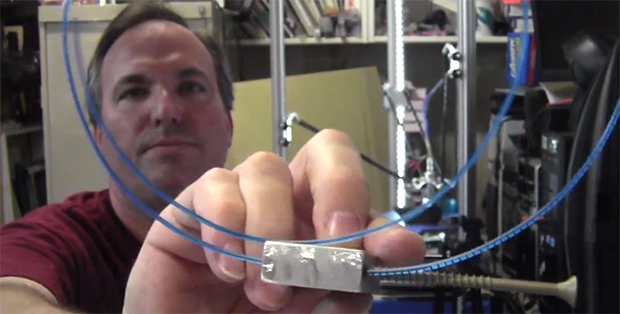
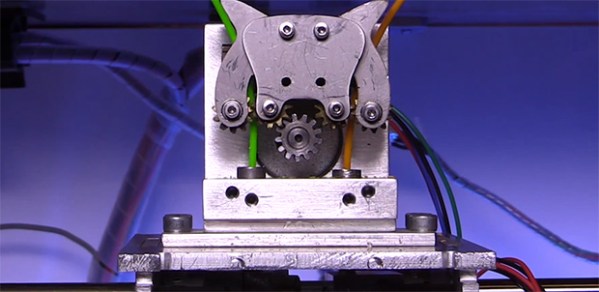
[Chris Nafis] crunched the numbers and found out he could get filament for his 3D printer in bulk for about one-fifth the cost of the cartridges the company sells. This led him to print a feeder for his Cube 3D printer.

We’re skeptical about the Cube 3D printer’s cartridges. They contain a spool of filament, but also include a chip which reports back the filament color and length remaining. We’re sure this provides some nice functionality for those looking to press a button and walk away. But we see it as an annoyance like the laser toner cartridges that stop working based on page count rather than remaining toner.

The solution [Chris] went with still uses the cartridges to ‘trick’ the machine into printing. Basically the interface will tell you that you don’t have enough filament left, but as long as there’s a cartridge in place you can tell it to print anyway. The green adapter he printed has a pass-through for the stock cartridge as well as the bulk spool you see to the left.