Yet Another RepRap Host Looks Pretty Cool

Joining the pantheon of other RepRap host software packages such as ReplicatorG, RepSnapper, and Skeinforge is Yet Another RepRap Host, a project by [Arkadiusz] that combines a lot of neat features into a very cool package.

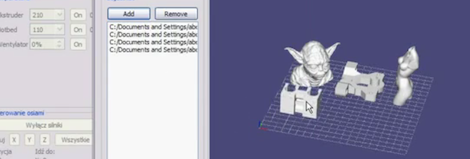
One thing we’ve really got to give [Arkadiusz] credit for is a virtual table that allows you to import several .STL files, place them on a virtual build platform, and print them all at once. Previously, the only way we knew how to do this was by either creating a single .STL file with all the desired parts already in place, or arraying several object to increase production. The virtual table feature allows anyone to bypass those steps and print out a lot of objects all at once.

YARRH also allows you to view the GCode in 3D. This feature is a little kludgy at the moment, but [Arkadiusz] says it’s functional and more than serviceable to run a 3D printer.

Right now, YARRH is only available for Windows, but a package for Ubuntu (and hopefully OS X) are coming down the pipe. You can check out some videos of YARRH in action after the break.

Continue reading “Yet Another RepRap Host Looks Pretty Cool”
Drag And Drop Images For 3D Printing

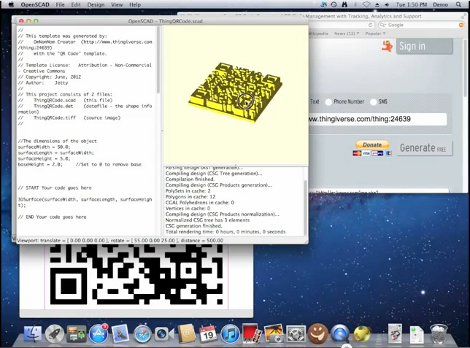
This piece of software called OmNomNom works with OpenSCAD to turn 2D images into 3D models. It’s literally a drag-and-drop process that renders almost instantly.

Here the example is a QR code, which is perfect for the software since it’s a well-defined black and white outline in the source image. But the video after the break shows several other examples that don’t rely on this simplicity. For instance, the Superman logo, which uses four different colors, is converted quite easily. There’s also a depth map of [Beethoven’s] bust that is converted into a 3D object. The same technique can be used to create terrain from topographic source images.

Once the file has been converted to a model it can still be tweaked like normal. This allows you to customize size and depth to suit your needs. This is where OpenSCD comes into play, but if you don’t use that program you can still export an STL file directly from OmNomNom for use on your 3D printer.

Continue reading “Drag And Drop Images For 3D Printing”

Printing A Boat Made Out Of Milk Jugs

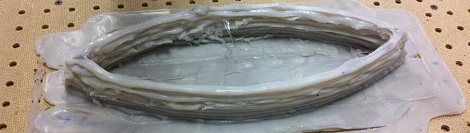
Today, groups from all over the Pacific Northwest will take up their oars and head over to Green Lake for the 42nd annual Seafair Milk Carton derby. The team who builds the fastest boat made out of milk cartons wins the regatta (and $10,000). This year, we’d put our money on the 3D printer group from the University of Washington; they printed a boat large enough to carry a person using crushed melted milk jugs.

After building a huge extruder to feed shredded HDPE plastic through a nozzle, the team repurposed an old plasma cutter to serve as an 8-foot-long 3D printer. There were a number of problems the team ran into – getting layers to fuse together, finding a suitable printing surface, and perfecting the art of squeezing melted milk jugs through a heated metal tube – but the final result is impressive, to say the least.

As far as how lake-worthy the UW team’s boat is, we have no idea. The milk jug regatta will be held later today, and if you have an update of how the team fared, send us a tip.

3D Printing With A Delta Robot That Seems To Simplify The Concept

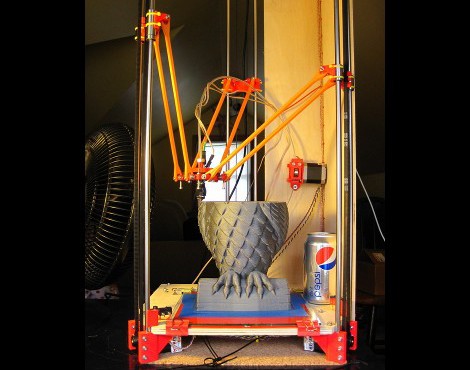
This 3d printing delta robot really seems to solve a lot of the hurdles faced by previous offerings. With other delta printers we’ve looked at the motor control of the three arms is usually a it complicated. On this build the motors can just be seen in this image at each corner under the build platform. Each motor has a belt that loops from the bottom to the top for the machine, driving an arm along two precision rods.

It’s also interesting to note that the printer head doesn’t have a motor mounted on it for feeding the filament. Instead, the motor is mounted remotely. You can see it above the soda can in this image. It feeds the filament through a hollow tube spanning the gap between the extruder and the motor. This acts as a Bowden cable. With less mass to move this may make it easier to control the location of the print head.

After the break you can catch a clip of the team showing off the speed and dexterity of the delta bot, followed by a printing demo.

Continue reading “3D Printing With A Delta Robot That Seems To Simplify The Concept”

RA 3D Printer Controller Board Does Everything, Has Disco Lights

3D printers are getting far, far more complicated than a 4-axis, plastic-squirting CNC machine. These days, you really haven’t earned your geek cred unless you’ve hacked an LCD and SD card interface into your 3D printer, or at least experimented with multiple extruders. There’s a problem with the controller boards everyone is using, though: most boards simply don’t have enough output pins, greatly reducing the number of cool things a 3D printer can do.

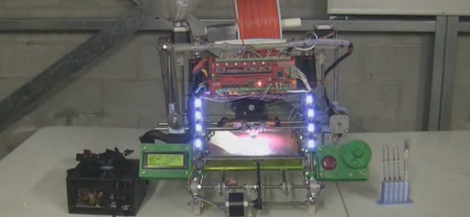
Enter RA. It’s a new 3D printer controller board with IO for any imaginable setup. Going down the feature list of RA, we’re wondering why we haven’t seen some of these features before. A 24-pin ATX power header is soldered directly to the board, giving RA users a stupidly easy way to power their printer. Of course there are outputs for LEDs, camera triggers (printer time-lapse movies are really cool), light rings, buzzers, an LCD/rotary encoder/SD card control panel, and support for two heated beds for gigantic printers. If printing in one color isn’t good enough for you, RA has support for three extruders

Compared to other 3D printer boards such as RAMPS or the Sanguinololu, the number of outputs on this board is simply amazing. If you’re planning to build a huge, feature-laden 3D printer, you probably couldn’t do much better than what RA is offering.

3D DLP Printer Builds An Orange TARDIS

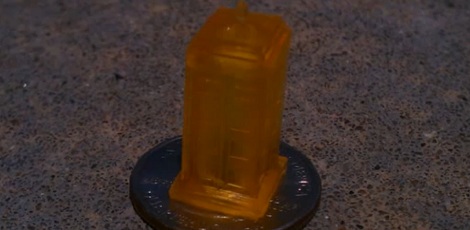
This micro-sized TARDIS is the latest print from [Ron Light]’s Sedgwick 3D DLP printer. Yes, it’s orange, but the print quality for such a small object is pretty astounding.

The Sedgwick 3D printer is currently available as a kit on Kickstarter. For five hundred bones, the Sedgwick provides all the parts – minus a DLP projector and resin – to make your own miniature Type 40 with a broken chameleon circuit. There’s a lot more this printer can do, from miniature cathedrals to hollow geodesic spheres.

This is the latest in what will be a long line of DLP projector / resin 3D printers, and the most affordable one to date. The last one we saw was an awesome $2400 machine that included a projector and resin. At $500 for a projector-less kit, the Sedgwick still handily beats even the cheapest option we’ve seen so far.

[Ron Light] is from Kansas City, and our boss man [Caleb] ran into him at the KC Maker Faire a few weeks ago. You can check out that little interview and a few videos of the Sedgwick doing its thing after the break.

Continue reading “3D DLP Printer Builds An Orange TARDIS”

Printing Organs With A 3D Printer

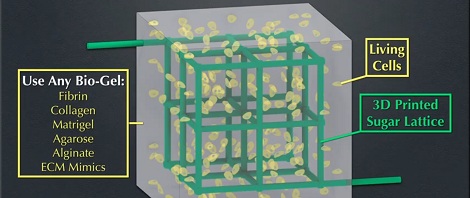
[Jordan Miller], [Christopher Chen], and a whole bunch of other researchers at the department of bioengineering at U Penn have figured out a way to print 3D tissues using a 3D printer. In this case, a RepRap modified to print sugar.

Traditional means of constructing living 3D tissues face a problem – in a living body, there’s a whole bunch of vasculature sending Oxygen and nutrients to the interior cells. In vitro, these nutrients can’t get to the cells in the core of a mass of tissue. [Jordan], [Chris], et al. solved this problem by printing a three-dimensional sugar lattice. After encasing this lattice in a gel embedded with living cells, the sugar can be dissolved and the nutrients pumped through the now hollow capillaries in the gel.

If you have access to Nature, the full text article is available here. There’s also a great video showing off this technique after the break.

Continue reading “Printing Organs With A 3D Printer”