Hackaday Links: September 21, 2014

hackaday-links-chain

Obviously the best way to show you’ve pwned a piece of hardware is to run Doom on it. This time around it’s not just a hardware hack but a security hack. [Michael Jordan] demonstrates a network vulnerability on a Canon printer by making it run Doom. [Thanks to all who sent this tip to us]

Fans of the photo-resist method of PCB etching will appreciate this Bromograph built from an old all-in-one-printer. When gutted, the body of the printer makes a nice enclosure for four UV Lamps. The treated copper clad goes face-down on the scanner glass with the printed transparency between the two. [Michele’s] early testing shows really great results.

[Tom] sent in a link to this video biography of the rLab hackerspace. It shows off the space and its members but also tells the story of a tight-knit community. We enjoyed hearing that almost everything in the space is salvaged and repaired; a great way to acquire equipment on a tight budget while also building the skills of the members.

The bulbs in projectors can be quite expensive to replace. This hack adds an RC filter to the bulb and claims to greatly extend its life. Does this really work and why isn’t it built into the projector?

[Steve Maher] built a GRBL board that is the same form-factor as a DB25 connector housing. It’s basically an Arduino derivative that includes a USB connection, a separate jack for STOP and CYCLE START switches. If you’re not familiar, GRBL is an open source project that lets your drive parallel-port-based hardware with a machine that doesn’t have a parallel port.

Finally, have you heard of the ZofzPCB program before? It’s a way to visualize your gerber files in order to perform a final sanity check before sending your deign off for fabrication. [Thanks Boldport]

Ask Hackaday: How Would You Build A Clock Clock?

Hotel art often elicits less than a glance from most patrons. But we have to admit if we came across a piece like this we’d be compelled to record a video for later reference. That’s actually where the video came from, this was spotted in a hotel called Ham Yard.

The concept seemed familiar to us and a bit of Google-fu brings up our previous coverage of the concept back in 2010. The display is made up of circular analog clocks and we’d wager this is a version of “a million times” by Human Since 1982, the same artist who brought us the earlier concept.

Since we’re covering this once again we thought it would be fun to ask: how would you go about building your own? There are several challenges that come to mind. First, notice both hands of the analog clocks appear to be exactly the same (there is no short hour hand). Driving the coils of a cheap clock directly (a la Lord Vetinari clock hacking) seems an obvious approach. But look closely and you’ll see the hands sometimes move in opposite directions. There must be a simple way to implement the control, or are we chasing a pipe dream of a low cost version for our workshop clock?

[Thanks Munit]


Thumbnail that say The Hacklet

Hacklet 16 – Terrific Telepresence Technology

16

This weeks Hacklet is all about being there when you can’t through the magic of telepresence. More than just teleconferencing, telepresence takes things a step further to put the user in a remote space. That might be a robot platform, VR goggles, or a actuators to interact with the remote environment. It’s also a field filled with opportunities for creative hackers!
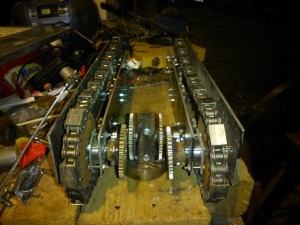
sidWe start with [PJK’s] Subterranean investigation device. [PJK] is exploring a castle for a hidden basement. To get there he has to traverse a tiny passageway with a rubble floor. Nicknamed “Sid The Weedy”, [PJK’s] bot is radio controlled and uses a webcam to send images back to [PJK]. Much like the robots used to explore pyramids, [PJK] has gone with a track drive system. Unlike the pyramid bots, [PJK] is on a budget, so his track system is a modified chain with block treads. [PJK] doesn’t want to get too attached to his robot – he may well lose Sid on his maiden voyage.
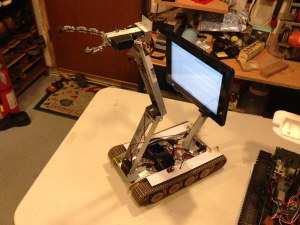
skypeRobotNext up is [JackRC] with his Skype robot. [Jack] is building a relatively low-cost (approx $200 USD) robot using the Skype API. Both his Mark I and Mark II models are based on R/C tanks. Tanks can carry a surprising amount of weight when you remove the turret and cannon. [Jack] added a mounting arm for a tablet and a robot arm for disarming bombs and/or angry children. His craftsmanship skills really show through in the completed ‘bot. Without a size reference, it could pass for a police issue bomb disposal robot!
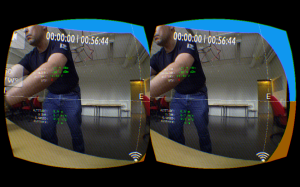
rift[Gary Firestone] takes us to the skies with his Minimal Latency Oculus Rift FPV. [Gary] is using an Oculus Rift Head Mounted Display (HMD) for First Person View (FPV) piloting. His aircraft is a quadcopter.  [Gary’s] video source is a GoPro camera. His quadcopter transmits the video on 5.8GHz using a standard analog video system. On the receiving end, a laptop captures the video, removes the fish eye warp from the GoPro lens, the re-warps the image for the Oculus. His latency is down around 50 – 100ms, which is pretty good for a system capturing analog video.
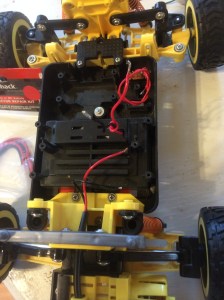
rover-americaNext [Brad] rolls cross-country with Chipbot: 4G Telepresence Rover Across America. [Brad] and his 5-year-old stepson are converting an R/C truck into a telepresence rover. Chipbot’s electronics have been given a major upgrade. [Brad] added a Raspberry Pi and an Arduino with an SN75441 chip for motor control. Connectivity is via WiFi using a TP-LINK router, or cellular using a 4G modem. Rather than a Raspberry Pi camera, [Brad] chose to go with a Ubiquiti IP camera. The Ubiquiti uses power over ethernet, so he’s added a POE injector. Chipbot is still in development, but as [Brad’s] last update shows, Chipbot is already responding to commands from the interwebs. It’s been about a month since the last Chipbot update, so if you see [Brad] tell him to stop by Hackaday.io and let us how things are progressing!

android-teleFinally, we have [Joe Ferner] with his generically named Telepresence Robot. [Joe] is controlling his android telepresence avatar with Google’s Android Operating System. His on-board computer is a Nexus 7 tablet. A custom board with an STM32 ARM microcontroller allows the Nexus to interface to the robot’s motors and sensors. [Joe] is using a web interface to control his robot. The early demos are promising, as the telepresence bot has already been taken for a drive in Reston, VA by a user in Milwaukee, WI.

That’s a wrap for this episode of The Hacklet.  As always, see you next week. Same hack time, same hack channel, bringing you the best of Hackaday.io!

Update – Check out our telepresence list right here!

Fail Of The Week: Robotic 1950 Mercury Boogies, Won’t Come Back From Dead Man’s Curve

[Dave] wanted to make an Arduino robot out of a remote-control 1950 Mercury. He removed the RC portion from the car and kept the drive and steering motors. The idea was to use three ultrasonic rangefinders in the grille real estate and move the car forward based on the longest distance detected.

He initially used a Seeed motor controller and some Grove cables soldered to his sensors to power the steering. It went forward, but only forward, and [Dave] decided the motor controller and the car’s steering motor weren’t playing well together.

[Dave] had the idea to use relays instead to both power the motor and determine polarity. Now, the Merc was turning and avoid obstacles about half the time, but it was also getting dinged up from hitting walls. He figured out that his sensor arrangement was making the car turn immediately and decided to give the program information from the wheels with a reed switch and a rare earth magnet. The only problem is that the caliber of magnet required to trip the reed switch is too heavy and strong. [Dave] and has concluded that he simply can’t exercise the kind of control over the car that he needs. and will build his own robot chassis.

Update: Check out a video of [Dave]’s car after the break.


2013-09-05-Hackaday-Fail-tips-tileFail of the Week is a Hackaday column which runs every Wednesday. Help keep the fun rolling by writing about your past failures and sending us a link to the story — or sending in links to fail write ups you find in your Internet travels.

Continue reading “Fail Of The Week: Robotic 1950 Mercury Boogies, Won’t Come Back From Dead Man’s Curve”

image of the face of einstein

The Spooky Nature Of Electromagnetic Radiation

Our story begins a little over one hundred years ago in Bern, Switzerland, where a young man employed as a patent clerk went off to work. He took the electric trolley in each day, and each day he would pass an unassuming clock tower. But today was different, it was special. For today he would pose to himself a question – a question whose answer would set forth a fascinating dilemma.

The hands of the clock appeared to move the same no matter if his trolley was stopped or was speeding away from the clock tower. He knew that the electromagnetic radiation which enabled him to see the clock traveled at a finite speed. He also knew that the speed of the light was incredibly great compared to the speed of his trolley. So great that there would not be any noticeable difference in how he saw the hands of the clock move, despite him being at rest or in motion. But what if his trolley was moving at the speed of the reflected light coming from the clock? How would the hands of the clock appear to move? Indeed, they could not. Or if they did, it would not appear so to him. It would appear as if all movement of the clock’s hands had stopped – frozen in an instant of time.  But yet if he looked at the hands of the watch in his pocket, they would appear to move normally. How does one explain the difference between the time of the clock tower versus the time of his watch? And which one was correct?

There was no way for him to know that it would take three years to answer this question. No way for him to know that the answer would eventually lead to the discovery of matter and energy being one and the same. No way to know that he, this underemployed patent clerk making a simple observation, would soon unearth the answer to one of the greatest mysteries that had stumped every mind that came before his – the very nature of time itself.

Now it might have taken Einstein a few years to develop the answer we now know as the Special Theory of Relativity, but it most certainly took him no longer than a few days to realize that Isaac Newton…

must be wrong.

Continue reading “The Spooky Nature Of Electromagnetic Radiation”

Retrotechtacular: The CURTA Mechanical Calculator

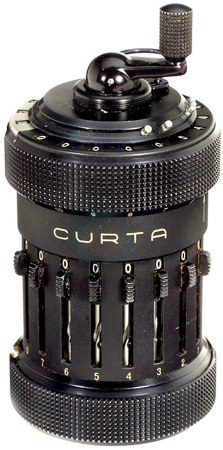
The CURTA mechanical calculator literally saved its inventor’s life. [Curt Herzstark] had been working on the calculator in the 1930s until the Nazis forced him to focus on building other tools for the German army. He was taken by the Nazis in 1943 and ended up in Buchenwald concentration camp. There, he told the officers about his plans for the CURTA. They were impressed and interested enough to let him continue work on it so they could present it as a gift to the Führer.

This four-banger pepper mill can also perform square root calculation with some finessing. To add two numbers together, each must be entered on the digit setting sliders and sent to the result counter around the top by moving the crank clockwise for one full rotation. Subtraction is as easy as pulling out the crank until the red indicator appears. The CURTA performs subtraction using nine’s complement arithmetic. Multiplication and division are possible through successive additions and subtractions and use of the powers of ten carriage, which is the top knurled portion.

Operation of the CURTA is based on [Gottfried Leibniz]’s stepped cylinder design. A cylinder with cogs of increasing lengths drives a toothed gear up and down a shaft. [Herzstark]’s design interleaves a normal set of cogs for addition with a nine’s complement set. When the crank is pulled out to reveal the red subtraction indicator, the drum is switching between the two sets.

Several helper mechanisms are in place to enhance the interface. The user is prevented from ever turning the crank counter-clockwise. The crank mechanism provides tactile feedback at the end of each full rotation. There is also a lock that disallows switching between addition and subtraction while turning the crank—switching is only possible with the crank in the home position. There is a turns counter on the top which can be set to increment or decrement.

You may recall seeing Hackaday alum [Jeremy Cook]’s 2012 post about the CURTA which we linked to. A great deal of information about the CURTA and a couple of different simulators are available at curta.org. Make the jump to see an in-depth demonstration of the inner workings of a CURTA Type I using the YACS CURTA simulator.

Continue reading “Retrotechtacular: The CURTA Mechanical Calculator”

Developed On Hackaday: Mooltipass Arduino Shields Compatibility

Some of our dear readers may already have an infallible system to remember different complex passwords for the different websites they visit daily. This is why they may have not been following the offline password keeper that the Hackaday community is building.

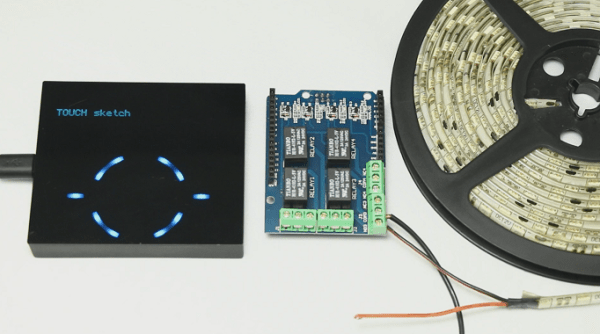
The Mooltipass has a characteristic that may regain their interest: it is possible to connect Arduino shields to it. In the video embedded below you can see the Arduino conversion process our development team imagined a few months back. The operation simply consists in using a knife to remove plastic bits on top of standard Arduino headers. We also embedded a few use cases with their respective sketches that may be downloaded from our official GitHub repository.

As with stacking several shields, a little tweaking may be required to keep the functionalities from both the Mooltipass and the connected shield. We therefore strongly welcome Arduino enthusiasts to let us know what they think of our setup.

In the meantime, you may want to subscribe to our official Google Group to stay informed of the Mooltipass launch date.

Continue reading “Developed On Hackaday: Mooltipass Arduino Shields Compatibility”