OTTO, Beat Slicing Interface

otto

Create Digital Music has a great post on [Luca De Rosso]’s OTTO. Built as part of his masters’ thesis, it’s a unique tangible music interface. You load a sample into the software which displays it on the instrument surface. The user can then manipulate the sample using various hardware inputs while watching the LED representation. The device uses just one Arduino for the display and inputs. It works with Max/MSP and is designed to give the performer only the information they truly need. You can find more pictures of the device on Flickr and a picture of the guts on CDM. Embedded below is the ‘Getting Started’ video that shows it in use.

Continue reading “OTTO, Beat Slicing Interface”

D-touch Tangible Drum Interface

[youtube=http://www.youtube.com/watch?v=AmGP3eCOF5A]

yes, drums are tangible. We know. What this is, however, is a tangible interface that is a drum machine. The software is freely available for download, after registration. For hardware, all you need is a webcam, a computer, and a way to print out the pieces. D-Touch is cross platform which is very nice. Please note that the software will not run until you activate it by putting in your user account from their site. If you like this project, you might also get a kick out of the Go Sequencer.

Wii Balance Board

[youtube=http://www.youtube.com/watch?v=t4UciZLl2Hk]

[Matt Cutts], head developer for google’s anti spam team, describes how to attach a Wii balance board to a linux computer. He even shows how to make a GUI to show the input. The entire project is done in about 200 lines of python.The process assumes that you can already make a bluetooth connection to a WiiMote, but if you can’t, he’s got instructions for that too.

[via hackawii]

AVR RFID Tag

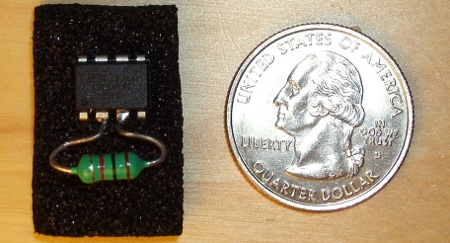
[pc486] sent in his hack that uses an ATtiny85 to act like an EM4102, a chip used for RFID tags. Minimally, all that is needed is the AVR and a coil, but he recommends some filtering capacitors. Depending on the size of the coil, different frequencies and ranges can be achieved. This project actually includes several hacks, such as using the coil for not only power, but a clock signal. The coil is actually able to power the chip without being connected to the power pins due to clamping diodes on the connected pins. The firmware is short but available on subversion.

Related: Scratch-built RFID tags

Econo Monome

[youtube=http://www.youtube.com/watch?v=6mKjRakndSk]

[Mike] really liked the thought of the Monome, especially the green aspect of their construction. He felt he could take it a step further. After 40 years of electronics tinkering, he had quite a spare parts box. He constructed his monome clone from stuff he just had laying around.  All of his pieces were either rejected samples from his company or outdated parts destined for the trash bin. Great job [Mike]. If you are planning to build one and don’t have the buttons laying around, you can get a more typical monome look and feel by going with the sparkfun RGB pads, like we did back in March.

[via Makezine]

VR Game Gun

[youtube=http://www.youtube.com/watch?v=7Ym0tZSWGMc]

Many of you have probably experimented with alternative gaming interfaces. Here’s a well done little hack where they created a gun with a display mounted on it, for video gaming.  At a glance you can probably figure out exactly what they’ve done. They’ve attached a gyration mouse to the gun for tracking and gutted a keyboard for the buttons.  We have to give them some credit, they seem to have packaged it all nicely. Since it’s a standard mouse and keyboard, it just plugs in and works with any game.  As you can see in their version, the screen works very well in this configuration, almost seeming like a giant scope. You can see the wireless version and hear their aspirations for projector based models after the break.

Continue reading “VR Game Gun”

Theremin Controlled Mario

[youtube=http://www.youtube.com/watch?v=YnZeI8uLJnw]

In the video above, [conquerearth] is using a theremin to control Super Mario Bros. Moving his hand toward and away from the vertical antenna increases the theremin’s pitch. The computer monitors this in real time and moves Mario left and right. The loop antenna controls the theremin’s volume and acts as the jump button. The controls seem to work well, much better than the sound of one man flailing at a theremin.

[via Gizmodo]