Vocera B1000A Teardown

vocera_teardown

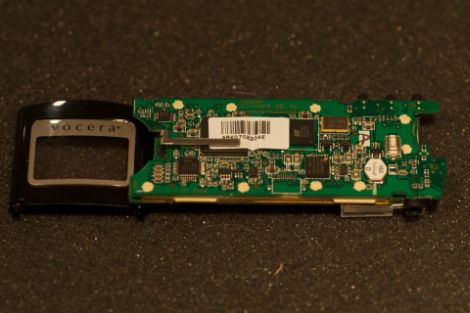
[Gray] over at Geek Chique had a bit of an eBay mishap and was suddenly the proud owner of 16 Vocera B1000A badges. If you are not familiar, these badges are small, lightweight communications devices similar to the famous Star Trek communicator, which allow users to talk to other individuals via VOIP. He was working on getting the remaining badges up and running by reimplementing the server software, and figured that since one of the badges he purchased was not working, he might as well take it apart.

It took him awhile to get the well-made badges apart, requiring a rotary tool and some elbow grease to get the job done. Inside, he found that the device was split into two circuit boards, one being the “WiFi” board, and the other the “CPU” board. The WiFi board uses a Prism WiFi chipset, which was incredibly common at the time of construction. The CPU board sports small SRAM and flash chips as you would expect, with a Texas Instruments 5490A DSP running the show.

While it remains to be seen if tearing the device down helps [Gray] to get things up and running again, it never hurts to take a closer look to see what you are working with.
FBI Tracking Device Found; Disassembled

[ifixit] has apparently grown tired of tearing apart Apple’s latest gizmos, and their latest display of un-engineering has a decidedly more federal flair. You may have heard about Yasir Afifi’s discovery of a FBI-installed tracking device on his car back in October of last year. Apparently, the feds abandoned a similar device with activist Kathy Thomas. Wired magazine managed to get their hands on it, and gave it to ifixit to take apart. There’ve even posted a video.

The hardware itself isn’t that remarkable, it’s essentially a GPS receiver designed before the turn of the century paired with a short range wireless transceiver. The whole device is powered by a set of D-sized lithium-thionyl chloride batteries which should be enough juice to run the whole setup for another few decades–long enough to outlast any reasonable expectations of privacy, with freedom and justice for all.

oscope_teardown

Rigol Oscilloscope Teardown And Repair

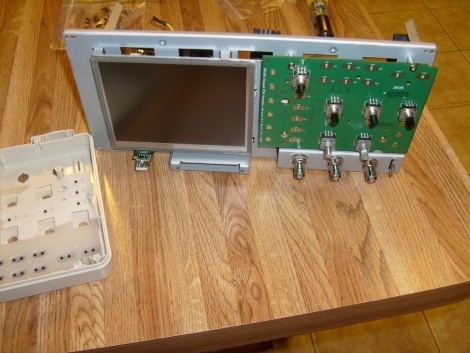
[Hotsolder] encountered a bad encoder in his Rigol Oscilloscope, so he opened it up in order to replace the damaged part. According to him, it was quite an adventure, so he documented the disassembly and component swap for the benefit of anyone else out there that might have to do the same.

The teardown is in the form of a slideshow, which is available on his site. The images are all pretty well annotated, so you should be able to follow along quite easily if you happen to be tearing one apart yourself. There’s not a ton of exotic things to see inside the scope, it pretty much contains what you would expect to see if you cracked one open.

The encoder replacement went off without a hitch, and he even took pictures of the defective one to discuss how it works.

It’s definitely a quick and interesting read if you are simply curious about oscilloscopes, or if you happen to need to dismantle yours.

[Thanks, oakkar7]

Nintendo 3DS Teardown

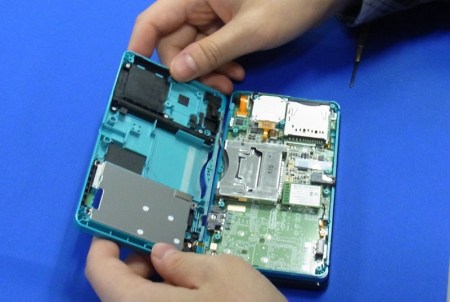
The Nintendo 3DS has been out for a couple days now (in japan) and the folks over at [tech on] were nice enough to do a teardown. Besides all the regular teardown goodies you can also get a good look at the 3DS’ 3D screen with a microscope. Turns out its a parallax barrier display which means that there are slits on top of the LED array to create a 3D effect without the use of special glasses. The rest of the hardware seems pretty standard, running an ARM based processor with some DRAM and NAND flash. Apparently the 3DS didn’t get much of an upgrade (downgrade?) as far as DRM is concerned because there are already examples of the 3DS running pirated games using a R4 card on youtube.

[via engaget]

Continue reading “Nintendo 3DS Teardown”

The Energy Detective TED 5000-G Teardown

Ted 5000-G Teardown

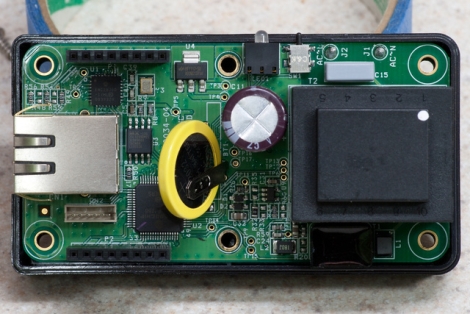
Before [Steve] realized that it didn’t play nice with his network, he dismantled his Energy Detective TED 5000-G to see what made the device tick. He put together a nice teardown with high-res pictures throughout.  Each component of the TED 5000-G is dissected, with the exception of the current transformers, which he claims are pretty boring anyhow.  The gateway module is particularly interesting as it contains both an Ethernet interface as well as a 802.15.4 radio for wireless communications.  While the device is still a bit expensive at the moment, the gateway module could be useful in projects requiring PLC or ZigBee communications some time down the road, once prices ease a little.

Radar Gun Teardown

[Jeri Ellsworth] is at it again, this time she takes apart a hot wheels speed gun and in the process she does a good job of  explaining how radar can be used to measure speed.  She also demonstrates a way to determine if an object is approaching or receding from the radar gun.

The Doppler shift is one way to remotely measure the speed of an object. It works by measuring the change in frequency of a wave after it strikes an object. Rather than measuring the Doppler shift of the returning wave most radar guns use the phase shift. The reason is that the frequency shift of a relativly slow object (60mph), to a relitivly high frequency signal(10GHz) is small (about 0.893Hz), where the phase shift varies based on the distance of the object.  This is all just a stepping stone in her quest to build a crude TSA body scanner.

EEVblog Dissects A Kindle 3

guts!

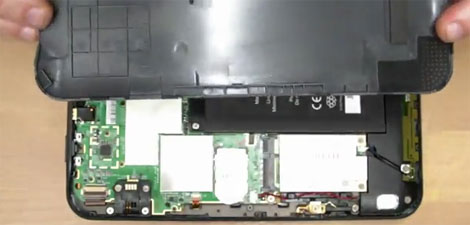
[Dave] over at the EEVblog did a review of the kindle 3 recently, but never got to the good stuff, the guts.  He is now rectifying this with a full video dissection of the eReader. Full of details on how to open it up as well as specifics on the internals, this is a fun video to watch. One thing that caught our attention was the RFID tag on the inside of the case.  It is probably for inventory tracking, but we can’t help but have a few tinfoil hat type thoughts. You can watch the video after the break.

Continue reading “EEVblog Dissects A Kindle 3”