Urine Territory Marking, Now For Humans!

Although Dogs and other animals love to mark their territory with urine, this technique has been generally ignored by human beings. Despair no more, fellow homo sapiens, we have now developed the ability to check-in on foursquare through your information stream. This device is descriptively called “Mark your Territory.”

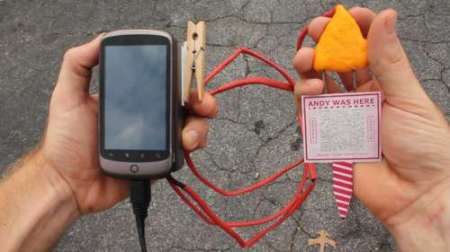
Although this is not currently available to buy in stores (although apparently $10,000 will get you one built), [Instructables] user [blorgggggg] has furnished directions on building your own. The system is powered by an Arduino and an Android phone. The urine tags have both a pointed end for sticking in grass and the like, and a sticky back to be used in a “more urban settings.”

The video after the break gives quite a bit of background trying to justify such a system in terms of communicating in the physical world, animals, et cetera, but it’s doubtful that this excuse will get you out of a public urination charge.  You’ve been warned.

[youtube http://www.youtube.com/watch?v=rRdfeb7vDWg&w=470&h=315%5D
The Rube-Goldberg Of Car Audio

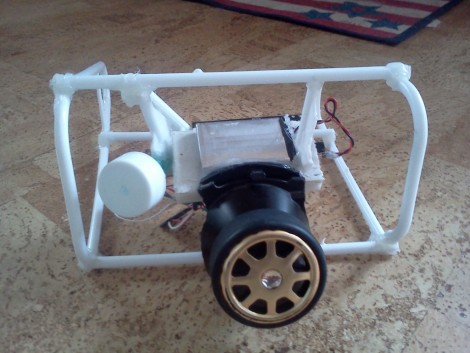
[Anthony Pray] had his car stereo stolen. When thinking about replacing it he realized the he and his wife never used it for anything other than an Auxiliary connection to play songs from their cellphones. So instead of buying a head unit he pulled an unused home audio amplifier out of a dark corner of his house and wired it to the car speakers. Problem solved, except that the under-dash installation meant the only volume control is on the phone playing the audio. He decided to build a wireless audio controller that would let him send commands to the phone without quite as much distraction from the road.

The device you see above is his creation. What a beauty. But seriously, it’s so random and hacked together how can you not love it? And, it works!

The frame is made from plastic coat hangers, and the wheel is an old RC control knob. There’s even a play/pause feature built from the clicking properties of a retractable ball-point pen. A Cypress PSoC board reads the knob and pen positions, then pushes commands via a Bluetooth module in order to control the phone. He recorded a testing video (after the break) which gives you a better look at the functionality of this setup. Continue reading “The Rube-Goldberg Of Car Audio” →

3G Connected Hotspot Hangs Out At Your House

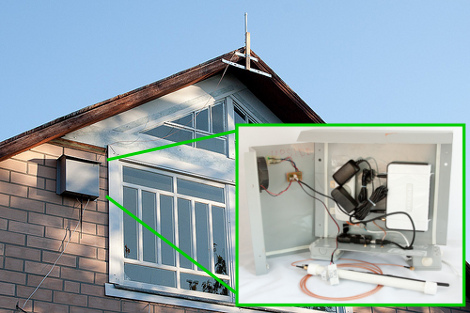
[Drug123] made the most out of this inconspicuous gray box on the gable end of his father’s home. It serves up a 3G Internet connection that was otherwise unavailable..

The project idea was sparked by the absence of wired or fiber optic broadband in the community where his dad lives. He knew some neighbors were using 3G connections, but he couldn’t get it to work inside the house. So he set about developing an external installation that would both communicate with the cellular network, and provide a WiFi connect to it. Hardware for that is relatively expensive; a USB 3G modem and a WiFi router with a USB port.

The box itself is made of plastic, but even without the Faraday cage effect that would have been formed by using a metal housing, the 3G modem’s internal antenna just doesn’t do the job. You can see that [Drug123’s] solution was an external antenna which is mounted at the peak of the roofline. Inside the box there’s an exhaust fan to cool things off when they get too hot, as well as some power resistors which provide a heat source on the coldest nights. The low-cost build certainly fits the bill, and it’s not too hard on the eyes either.

Cellphone Battery Booster Built At The Checkout Counter

When you’re away from home and your cellphone runs out of juice it can be a real downer. Sure, you could find a store and buy a wall charger, but wouldn’t it be more fun to build your own battery booster without using tools? [Spiritplumber] did just that, popping into a Radio Shack for the parts, then making his how-to video (embedded after the break) while standing at the checkout counter. You can see he hust set his camera on top of the battery display case and got to work.

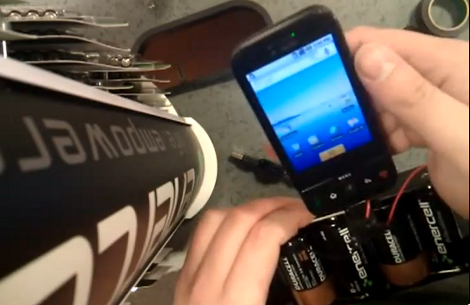
He’s using four D cell batteries to provide 6 volts of power. Assuming your phone charges at 5 volts this is going to be just a bit too high, even though there’s some tolerance with most phones. To overcome that obstacle he added a diode to the circuit, taking advantage of the 0.7 volt drop that it brings to the mix. Grab a plug adapter for your model and then just hand twist the connections. [Spiritplumber] admits it would be better to solder these, but in a bind you can get away with it. We looked up some prices for this method and we figure this would cost around $18 (batteries included) depending on the price of the plug adapter for your phone.

Of course if you’re just looking for a way to charge your phone without paying consumer prices there are ways of accomplishing that as well.

Continue reading “Cellphone Battery Booster Built At The Checkout Counter” →

A Smartphone Dock For Your Arm? Why Not?

Why not that is, if you have a prosthetic arm. Although it’s hard to believe we haven’t seen this before, [Trevor Prideaux], according to [The Telegraph’s] article, “has become the world’s first ever patient to have a smartphone docking system built into his prosthetic arm.”

[Trevor] was born without a forearm, and, as he puts it, he’s used to adapting to things.  However, he thought others might be struggling with the same problem, especially those that become disabled later in life. Once their help was secured, Nokia and the Exeter Mobility Centre got to work on his new limb and produced a prototype in five weeks!

[Trevor] is quite pleased with his new phone docking system. Texting especially is much easier and safer, and the phone can be removed when needed for making calls. We love to see hacks like this where people enhance their abilities using technology! For another hack helping those with disabilities, check out this wheelchair elevator/winch made for a non-accessible apartment.

via [reghardware.com]

How To Record 3D Video In 3D

Legalities of doing something like this aside, this concept by [MadSci labs] gives some insight into how one would go about recording a 3D movie in 3D.  Probably many of you have wondered if this could be done, but they took it one step further and actually made a device capable of doing just that.

[MadSci labs] solution involved taking some 3D glasses home from a theater, cutting them to size, and taping them to a HTC EVO 3D phone.  Each lens piece was taped over a different camera lens to separate out the two 3D elements needed to produce a stereoscopic image. Their experiment was successful, however some loss of quality was experienced.  Because of this, we’re not expecting to see a lot of in-theater movies pirated this way, but given a more professional-quality build, you never know what will happen.

You can see the “results” of their experiment after the break. As it’s not in 3D, it should give you an idea of what is going on. Continue reading “How To Record 3D Video In 3D” →

Cellphone Microscope For About $20

Medical-grade microscope photography for $20 might be a game changer in areas where medical services are unavailable. This particular hack uses an iPhone’s 2 megapixel camera, as well as a tiny glass marble, to magnify a sample to about 350 times its actual size. The two images seen on the left are red blood cells photographed with the improvised microscope. The main issue with this magnification method is a very thin plane of focus that is overcome with processing in software.

This makes us think of the microscope hack that shined a laser through a droplet of water, to project the image on a wall. The concept was later refined to work with samples on glass slides. There are a couple of distinct advantages to using this cellphone-based method. First, the sample can be seen with its true colors. Second, you not only magnify the sample, but you have a digitized image already on a device that connects to the Internet. If you’re trying to make a medical diagnosis this can easily be sent to a qualified professional for analysis.

The team that came up with this technique also figured out how to build a cellphone-based spectrometer for just a few bucks. The image in the upper right is the result of that hack. Both have a step-by-step build guide on the page linked at the top. The microscope is just a glass bead in a piece of rubber, as seen here. The spectrometer is a bit more involved.

[Thanks Fabien]