Boiling Acid Used To See Chip Die

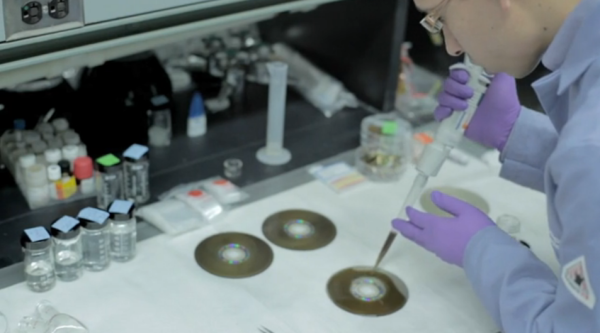
When a project starts off by heating acid to its boiling point we say no thanks. But then again we’re more for the projects that use ones and zeros or a hot soldering iron. If you’re comfortable with the chemistry like [Michail] this might be right up your alley. He used boiling acid to expose and photograph the die from several integrated circuits.

The title of our feature is a play on words. In this case, die refers to the silicone on which the IC has been etched. To protect it the hardware manufacturer first attaches the metal pins to the die, then encapsulates it in plastic. [Michail] removes that plastic case by heating sulfuric acid to about 300 degrees Celsius (that’s 572 Fahrenheit) then submerges the chips in the acid inside of a sealed container for about forty minutes. Some of the larger packages require multiple trips through the acid bath. After this he takes detailed pictures of the die and uses post processing to color enhance them.

This isn’t the only way to get to the guts of a chip. We’ve seen nitric acid and even tree sap (in the form of bow rosin) do the trick.

DIY Tin Plating For Bus Bars

Copper bus bars are commonly used instead of wire for carrying high currents. [Dane] needed some bus bars for a project, but he was worried about corrosion. His solution was tin electroplating the bus bars to lower the risk of corrosion while keeping the conductivity high.

The process requires only two chemicals: hydrochloric acid and tin. The electrolyte solution is made by dissolving tin into the acid. Then the bus bar is placed in a diluted solution and a 1 A current is run through it. The result is a fine coating of tin on the copper, which will not corrode in water.

[Dane] mentions that he’d like to try the process with silver solder in the future, since it is easier to find than tin. He also wants to find a way to measure the amount of tin deposited onto the bus bars. This process could be helpful for anyone who needs some corrosion resistant high current conductors.

Check out a video of the plating process after the break.

Continue reading “DIY Tin Plating For Bus Bars”

Through-hole Electroplating In Your Home Lab

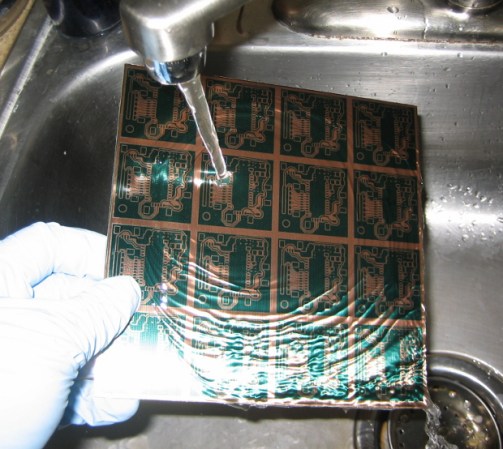
For the few double-sided PCBs we’ve actually etched at home we simply soldered a piece of wire to either side of a via and clipped off the excess. But if you want to go the extra mile you can’t beat electroplated through holes. The setup seen above is an electroplating tank build from simple materials which [Bearmos] has been working on.

The two sets of copper structures are both used as anodes. Some copper water pipe (like you’d use for a refrigerator ice maker) was cut into short rods and soldered onto pieces of bus wire. The portion of the metal which will stick above the chemical bath was coated with a generous layer of hot glue. This will protect it from corrosion cause by the off-gassing during the plating process. The traces of the etched PCB act as the anodes, but the holes themselves must be conductive in order for the plating process to work. A water proof glue with powdered graphite mixed in is applied to all of the holes in the substrate. This technique is based on the huge electroplating guide published by Think & Tinker.

Tens Of Thousands Saved By Building A BAM Microscope Out Of LEGO

A Brewster Angle Microscope (BAM) can run you around $100,000. If you don’t have that lying around you could just use some LEGO pieces to build your own. Having been faced with no budget to buy the hardware, and needing the data to finish his PhD, [Matthew] figured out a way to build something passable on the cheap.

These microscopes bounce a light source off of a pool of water and into the lens of a camera. The thing is the angle of the sender and receiver must be just perfect at 53.1 degrees. [Matthew] was able to afford a used camera, and started experimenting with some lab equipment to mount the rig. But he just couldn’t get the adjustments right. Since he had to move the mounting hardware by hand it was impossible not to over or under shoot the corrections. But then he had a eureka moment. LEGO pieces have very accurate tolerances, and you can get geared and motorized parts. He leveraged the quality of the toy into a BAM whose alignment can be tweak with great precision.

It may not look like much, but you can see stearic acid floating through the microscope’s field of vision in the clip after the break. This is exactly the type of observations he needed to perform. Of course if you just need a microscope you can use a laser and a drop of water.

Continue reading “Tens Of Thousands Saved By Building A BAM Microscope Out Of LEGO”

Water Purification Uses Home-built Electrolysis Rig

If you plan ahead a little bit you could have your own system of water purification to use in emergencies. Everyone needs clean drinking water and this gadget will let your produce your own purification drops quite easily.

The solution contains chlorine, which is created through electrolysis. The PVC cap seen near the bottom of the image has two electrodes sticking out of it. These are titanium plated mesh plates separated by a rubber ring. The cap has a small hole in it to keep the flow rate low and the fitting at the top acts as a funnel. When you pour in a salt water mixture it passes through the energized plates and a chemical reaction splits the sodium from the chlorine.

A twelve volt power source is necessary for this to work. But since the electrolytic process takes just a minute or two you could easily source the power from batteries charged with solar cells. Check out a full build walk through and demonstration video after the break.

Continue reading “Water Purification Uses Home-built Electrolysis Rig”

Hybrid Rocket Engine Uses Acrylic As Fuel

We are fascinated by the hybrid rocket engine which [Ben Krasnow] built and tested in his shop. It is actually using a hollow cylinder of acrylic as the fuel, with gaseous oxygen as an oxidizer. We’re already quite familiar with solid rocket propellant, but this hybrid approach is much different.

When a rocket motor using solid propellant is lit it continues to burn until all of the fuel is consumed. That is not the case with this design. The acrylic is actually burning, but if the flow of oxygen is cut off it will go out and can be ignited later. This also opens up the possibility of adjusting thrust by regulating the pressure of the oxygen feed.

[Ben] milled the test rig in his shop. It’s a fat acrylic rod through which he bored a hole. There are two aluminum plates which complete either end of the chamber. The intake has a fitting for a valve which connects to the oxygen tank. There is a nozzle on the outflow end. Check out the video after the break to see a full description. You’ll also get a look at the toll the combustion heat takes on the rig.

Continue reading “Hybrid Rocket Engine Uses Acrylic As Fuel”

An Actively Cooled Cloud Chamber

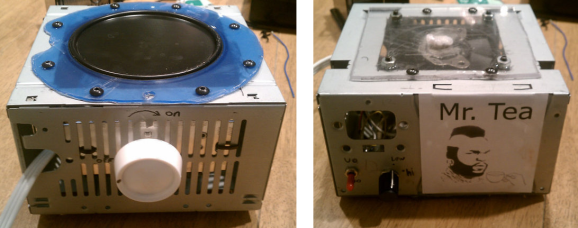
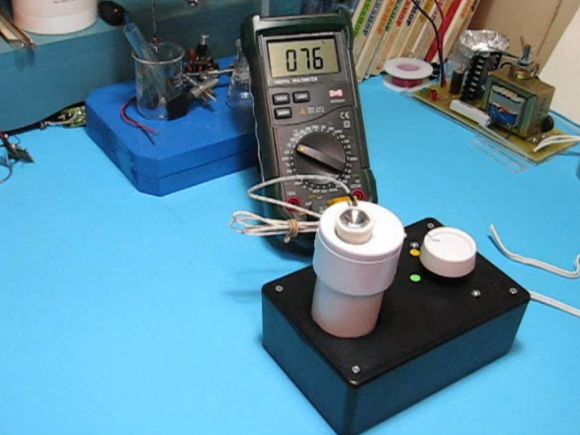
This cloud chamber is designed to keep the environment friendly for observing ionizing radiation. The group over at the LVL1 Hackerspace put it together and posted everything you need to know to try it out for yourself.

A cloud chamber uses a layer of alcohol vapor as a visual indicator of ionizing particles. As the name suggests, this vapor looks much like a cloud and the particles rip though it like tiny bullets. You can’t see the particles, but the turbulence they cause in the vapor is quite visible. Check out the .GIF example linked at the very bottom of their writeup.

The chamber itself uses a Peltier cooler and a CPU heat sink. The mounting and insulation system is brilliant and we think it’s the most reliable way we’ve seen of putting one of these together. Just remember that you need a radioactive source inside the chamber or you’ll be waiting a long time to see any particles. They’re using a test source here, but we saw a cloud chamber at our own local Hackerspace that used thoriated tungsten welding rods which are slightly radioactive.

[Thanks JAC_101]