Anodize Titanium At Home

We don’t really have any titanium lying around, it’s not exactly a cheap material. But this hack that shows you how to anodize titanium in your home laboratory (or kitchen for that matter) and it might help the metal make its way into a future project. It seems the process is not overly difficult or dangerous and it’s possible to achieve a lot of different colors in the finish.

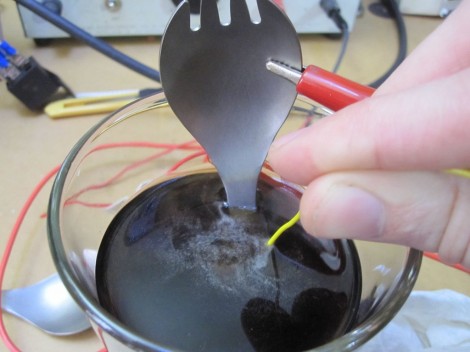
In the image above [PinkFlute] is using Coke Zero, a sugar-free soda, as the chemical agent in the process. The alligator clip attached to the utensil is providing the positive voltage and the yellow wire dipped in the drink is negative. Finish color is determined by the voltage supplied. You can choose various shades of green, purple, yellow, and blue based on a voltage range of about 100V to 20V.

This is one of two anodizing methods shown. the other uses a foam brush dipped in soda with the negative lead clamped onto it. You just brush in the electrified substance to alter the camping spork’s finish.

[via Reddit]

silver-ink-on-glass

DIY Conductive Ink Lets You Freehand Circuits On The Cheap

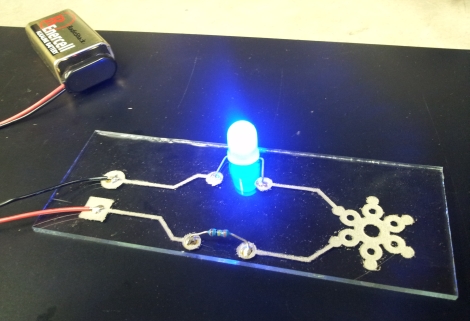
[Jordan] likes the flexibility that conductive inks offer (dead link, try Internet Archive) when putting together electronic circuits, but says that they are often too expensive to purchase in decent quantities, and that they usually require substrate-damaging temperatures to cure. After reading a UIUC Materials Research Lab article about making conductive ink that anneals at relatively low temperatures, he decided to give it a shot.

[Jordan] started out by picking up various chemicals and lab supplies online, setting up shop at Pumping Station: One. The process is pretty straightforward, and seems like something just about anyone who took high school chemistry can manage. That said, he does note that some of the chemicals, such as Formic Acid, can be quite painful if mishandled.

After just a few minutes of work and about 12 hours waiting time, [Jordan] had himself a decently-sized vial of conductive ink. He tried it out on a few different substrates with varying results, and in the end found that etched glass made the best circuits. He says that there are plenty of experiments to try, so expect even more helpful info from him in the near future.

[via Pumping Station: One]

Etching PCBs With Vinegar

When we hear about etching PCBs at home we assume that either Ferric Chloride or Cupric Chloride were used to eat away unmasked copper from the boards. But [Quinn Dunki] just wrote up her PCB etching guide and she doesn’t use either of those. Instead, she combines vinegar, hydrogen peroxide, and salt. It’s easier to find vinegar than muriatic acid (Cupric Chloride is made using this, peroxide, and adding the copper) so this is something to keep in mind if you’re in a pinch (or a Macgyver situation).

The rest of the process is what we’re used to. She’s using photoresistant boards which can be masked with a sheet of transparency instead of using the toner-transfer method. Once they take a bath in the developer solution she puts them in a shallow dish of vinegar and hydrogen peroxide along with a teaspoon of salt. She wipes the surface with a foam brush every minute or so, and inspects them every ten minutes to see if they’re done.

She does discuss disposal. Seems that she throws the solution in the garbage after each use. The liquid will contain copper salts which are bad for wildlife. We’ve heard that you should neutralize the acid and make a block of concrete using the liquid, then throw it in the garbage. Does anyone have a well-researched, ethical, and environmentally friendly way of getting rid of this stuff?

Create PCBs In Just Minutes With This Awesome Spray Etching Machine

pcb-sprayer

If you have ever produced your own PCBs at home, you know that it can be somewhat of a time consuming process. Spending 20 or so minutes manually agitating a board is a drag, and while aquarium bubbler setups improve the process, they are far from ideal. [Christian Reed] knew that if he really wanted to streamline his PCB production he had to emulate the big boys and build a PCB sprayer of his own.

His spray etcher is contained in a custom acrylic case built mostly of scraps from previous projects. It contains two compartments – one for spraying etchant on the PCBs, and another for rinsing the finished work. The system is impressive to say the least, featuring a maze of tubes and piping which allow him to etch boards and manage his chemicals with ease.

[Christian] says that although the parts list might seem daunting at first, it really is pretty easy to assemble the device. Seeing as he can etch and wash a board in about two minutes flat, we think that any amount of effort would be worth the results.

[Christian] points out that he was unable to find a guide for building this type of PCB sprayer anywhere online, so he documented the process in painstaking detail in order to make it as easy as possible to replicate his work. Be sure to check out the video below to see his etch tank in action – we’re pretty sure it will have you itching to build one this weekend.

Continue reading “Create PCBs In Just Minutes With This Awesome Spray Etching Machine”

Freeze Drying Astronaut Ice Cream

In our younger and more vulnerable years nothing was greater than visiting a museum, going to the gift shop, and badgering our parents to buy a pack of astronaut ice cream. Freeze dried ice cream leaves a taste of nostalgic chalky sweetness in our mouths, so we’re very excited to see that [Ben Krasnow] is now making his own astronaut ice cream.

The basic principle of freeze drying is simple. All you have to do is reduce the pressure and temperature of the food below the triple point of water and pump the sublimated water vapor out. For [Ben], this meant he needed to cool his Neapolitan Klondike bar to -30° C in a bath of chilled ethanol and pump out the air with a vacuum pump.

Interestingly, [Ben] found it necessary to heat his ice cream while under vacuum to extract more water vapor. This makes sense; at the pressures he was dealing with, [Ben] would never come across water in a liquid state. The entire process took about 18 hours. [Ben] admits this may have been a little longer than necessary, but it’s a small price to pay for reliving childhood memories.

A Salinometer Built For The Science Olympiad

This is a Digital Salinometer which [Daniel Kramnik] built as a Science Olympiad entry. He’s a Junior in High School and when looking for a project to enter into the Water Quality event he was interested in achieving greater accuracy than a mechanical hydrometer provides.

We think the circuit design is very impressive for anyone who hasn’t complete formal training as an engineer, and outstanding for someone as young as [Daniel]. Measurements depend on two main parts, a temperature control and a salinity sensor. These are both necessary because fluctuation in sample temperature will affect the salinity reading.

A Peltier element is used to heat the water sample if it doesn’t fall within a set range of temperatures. From there, an Op-Amp circuit conditions a signal running through the sample, passing an output to the ADC converter chip which drives the three-digit readout. [Daniel] calculates an accuracy within 0.0014%. He must be on the mark because he’s won his regional competition and will soon compete at the state level.

Making Pure Caffeine At Home

If you’ve ever thought about extracting caffeine from coffee beans, [Ben] is the guy for you. The last time we ran into him, he had already produced a few aerogel monoliths with a few chemicals, pipe fittings, and some CO2. We’re guessing he needed another use for his supercritical drying chamber, so after looking over a few patents, he decided to make pure caffeine in his garage.

The extraction began with green coffee beans inside the drying chamber. Liquid CO2 is pumped in and heated to the supercritical point. After a few hours, the caffeine will have been extracted from the beans and can be drained from the chamber. Right now, the process results in an inky goo that contains caffeine. [Ben] refined this a little further with Methylene Chloride, a process he’ll document in a future video.

Of course it goes without saying that this build is a little bit on the dangerous side. We’re confident in [Ben]’s abilities to know what he’s doing, but we’re not going to endorse this for every joker on the Internet. Also, two spoonfuls of caffeine will kill you, so try not to screw around with that either.

Continue reading “Making Pure Caffeine At Home”