A 3D Printed 16mm Movie Camera

The basic principles of a motion picture film camera should be well understood by most readers — after all, it’s been well over a hundred years since the Lumière brothers wowed 19th century Paris with their first films. But making one yourself is another matter entirely, as they are surprisingly complex and high-precision devices. This hasn’t stopped [Henry Kidman] from giving it a go though, and what makes his camera more remarkable is that it’s 3D printed.

The problem facing a 16mm movie camera designer lies in precisely advancing the film by one frame at the correct rate while filming, something done in the past with a small metal claw that grabs each successive sprocket. His design eschews that for a sprocket driven by a stepper motor from an Arduino. His rotary shutter is driven by another stepper motor, and he has the basis of a good camera.

The tests show promise, but he encounters a stability problem, because as it turns out, it’s difficult to print a 16mm sprocket in plastic without it warping. He solves this by aligning frames in post-processing. After fixing a range of small problems though, he has a camera that delivers a very good picture quality, and that makes us envious.

Sadly, those of us who ply our film-hacking craft in 8mm don’t have the luxury of enough space for a sprocket to replace the claw.
Continue reading “A 3D Printed 16mm Movie Camera”

Magazine Transistor Tester Lives Again

One of the lost pleasures of our modern world is the experience of going shopping at a grocery store, a mall, or a drugstore, and finding this month’s electronics magazine festooned with projects that you might like to build. Sure, you can find anything on the Internet, but there’s something to be said about the element of surprise. Can any of those old projects still be of interest?

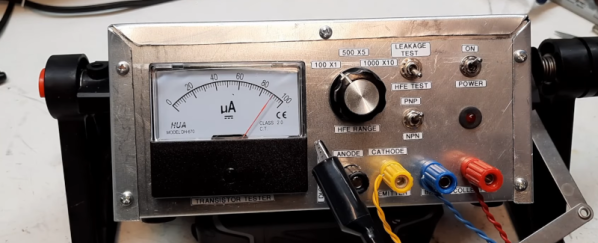
[Bettina Neumryr] thinks so. She has a hobby of finding old magazine projects and building them. Her most recent installment is a transistor tester from the June 1983 issue of Everyday Electronics.

The tester was quite a neat job for 1983, with a neat case and a PC board. It measures beta and leakage. There’s an analog meter that can measure the collector current for a fixed base current (beta or hfe). Leakage is how much current flows between emitter and collector with the base turned off.

In 1983, we’d have loved to have a laser printer to do toner transfer for the PC board, but of course, that was unheard of in hobby circles of the day. The tester seemed to work right off the bat, although there was a small adjustment necessary to calibrate the device. All that was left was to put it in a period-appropriate box with some printed labels.

We loved the old electronics and computer magazines. Usually, when we see someone working on an old magazine project, it is probably not quite a literal copy of it. But either way is cool.

Continue reading “Magazine Transistor Tester Lives Again”

VFETs Are (Almost) Solid State Tubes

We always enjoy videos from [w2aew]. His recent entry looks at vertical or VFETs, which are, as he puts it, a JFET that thinks it is a triode. He clearly explains how the transistor works as a conductor unless you bias the gate to form a depletion zone.

The transistors have a short channel, which means they conduct quite well. The low gate resistance and capacitance mean the devices can also switch very quickly. These devices were once in vogue for audio applications. However, they’d fallen out of favor until recently. The reason is that they work quite well in switching power supplies.

How good is the on resistance? So good that his meter reported the probes were shorted instead of measuring the resistance. Pretty good. We’ve seen these VFET transistors used as switches to drive magnetic field coils many years ago and they replaced much more complex circuitry.

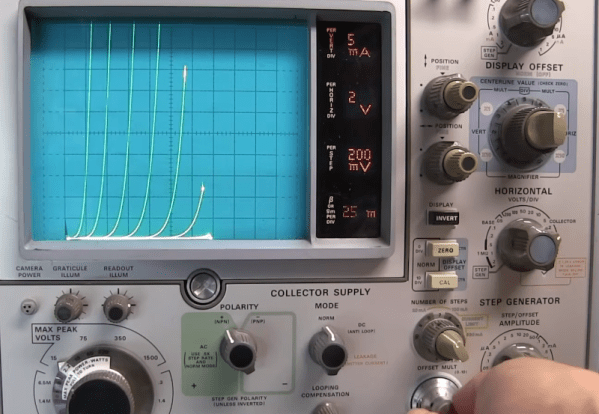
The curve tracer in the video is a beautiful instrument of its own. The digital displays give it a high tech yet retro look. A curve tracer, if you haven’t used one, plots stepped voltages against current flowing, and is very useful for examining semiconductor devices. While not as fancy, it is possible to make one to connect to a scope quite easily.

We are pretty sure that it is a Tektronix 576. We watched a repair of a similar unit, the 577, if you’d like to see some (probably) similar insides.

Continue reading “VFETs Are (Almost) Solid State Tubes”

Examining The First Mechanical Calculator

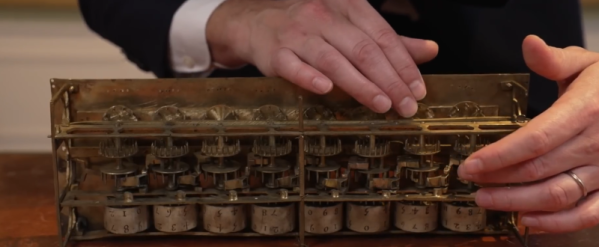
Blaise Pascal is known for a number of things, but we remember him best for the Pascaline, an early mechanical calculator. [Chris Staecker] got a chance to take a close look at one, which is quite a feat since there were only about 20 made, and today we only know where nine of them wound up.

This Pascaline was lost for many years, and turned up in an antique store, where they thought it was a music box of some kind. The recent owner passed away, and now this machine is going to go up for auction, probably for more than we can afford. While he wasn’t able to handle the antique, he has plenty of knock-offs that were made back when people actually used them, which wasn’t that long ago. One of these is transparent, so you can see the mechanism inside.

The idea is to use the wheels like an old-fashioned phone dial to add counts to an output wheel. A linkage moves the next input wheel every time the current output wheel passes nine. Of course, if you have a multi-digit carry, it might take a little more elbow grease than just flipping the dial one normal position.

Continue reading “Examining The First Mechanical Calculator”

Making WiFi Sound Like Dial-Up Internet

Dial-up modems had a distinctive sound when connecting, with the glittering, screeching song becoming a familiar melody to those jumping online in the early days of the Internet. Modern digital connections don’t really have an analog to this, by virtue of being entirely digital. And yet, [Nick Bild] decided to make WiFi audible in a pleasing tribute to the modems of yore.

The reason you could hear your dial-up modem is because it was actually communicating in audio over old-fashioned telephone lines. The initialization process happened at a low enough speed that you could hear individual sections of the handshake that sounded quite unique. Ultimately, though, once a connection was established at higher speed, particularly 33.6 k or 56 k, the sound of transmission became hard to discern from static.

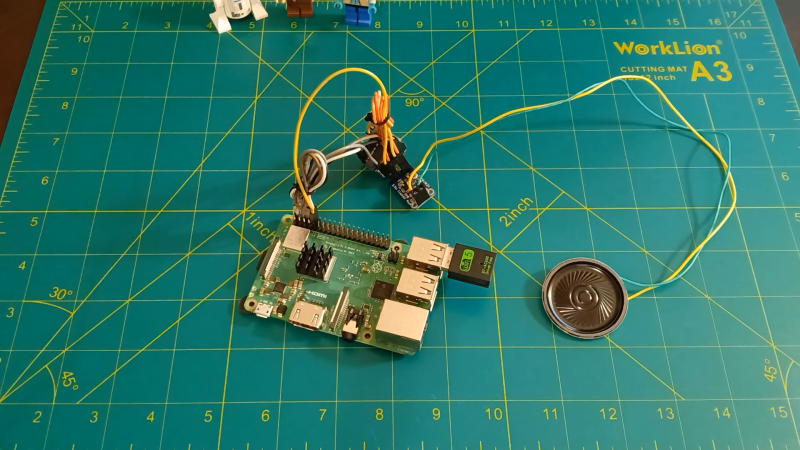
Modern communication methods like Ethernet, DSL, and WiFi all occur purely digitally — and in frequencies far above the audible range. Thus, you can’t really “listen” to a Wi-Fi signal any more than you can listen to the rays of light beaming out from the sun. However, [Nick] found an anachronistic way to make a sound out of WiFi signals that sounds vaguely reminiscent of old-school modems. He used a Raspberry Pi 3 equipped with a WiFi adapter, which sniffs network traffic, honing in on data going to one computer. The packet data is then sent to an Adafruit QT Py microcontroller, which uses the data to vary the amplitude of a sound wave that’s then fed to a speaker through a digital-to-analog converter. [Nick] notes this mostly just sounds like static, so he adds some adjustments to the amplitude and frequency to make it more reminiscent of old modem sounds, but it’s all still driven by the WiFi data itself.

It’s basically WiFi driven synthesis, rather than listening to WiFi itself, but it’s a fun reference to the past. We’ve talked a lot about dial-up of late; from the advanced technology that made 56 k possible, to the downfall of AOL’s long-lived service. Video after the break.

Continue reading “Making WiFi Sound Like Dial-Up Internet”

Positive Results With Negative Resistance

Try an experiment. Next time you are in a room with someone, ask them to name everything in the room. Only certain kinds of people will say “air” or “light.” For most people, those are just givens, and you don’t think about them unless, for some reason, you don’t have them. Resistance is like that in electronics. You use it constantly, but do you ever think much about what it is? For a resistor, the value in ohms really represents the slope of the line that describes the amount of voltage you’ll see across the component when it carries a certain amount of current. For resistors, that slope is — at least in theory — constant and positive. But [Void Electronics] made a video exploring negative resistance, and it is worth watching, below.

If you haven’t seen negative resistance before, you might wonder how that is possible. Ohm’s law is just a shorthand for calculating the slope of a graph with voltage on the Y axis and current on the X axis. It works because the voltage and current are always zero at the same time, so the slope is (V-0)/(I-0), and we just shorten that to the normal Ohm’s law equation.

But not everything has a linear response to current. Some devices will have different slopes over different current regions. And sometimes that slope can be negative, meaning that an increase in current through the device will cause it to drop less voltage. Of course, this is usually just over a narrow range and, as [Void] points out, most devices don’t specify that parameter on their data sheets. In fact, some transistors won’t even work in the circuit.

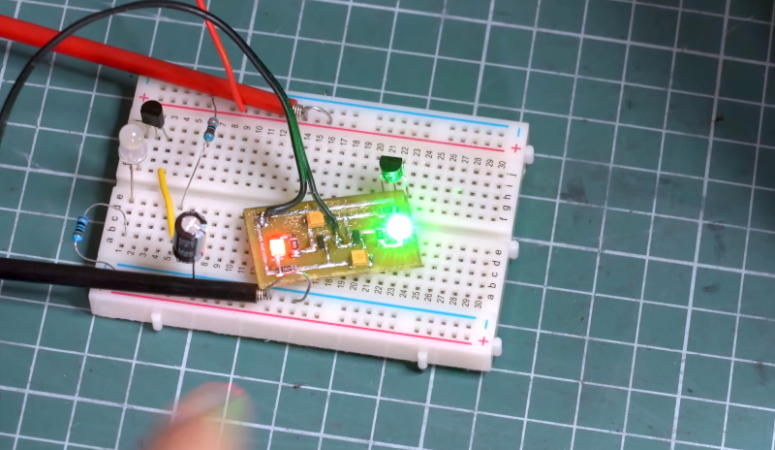
The circuit in question in the video below the break is an odd one. It uses two resistors, an LED, and a transistor. But the transistor’s base is left disconnected. No 555 needed. How does it work? Watch the video and you’ll see. There’s even a curve tracer if you don’t like to see hand-drawn graphs.

We’ve looked at negative resistance more than once. There are a few exotic devices, like tunnel diodes, that are explicitly used for the negative resistance property. When the gas in a neon bulb breaks down, you get the same effect. Continue reading “Positive Results With Negative Resistance”

A Deep Dive Into The Coolness That Was CRT Projectors

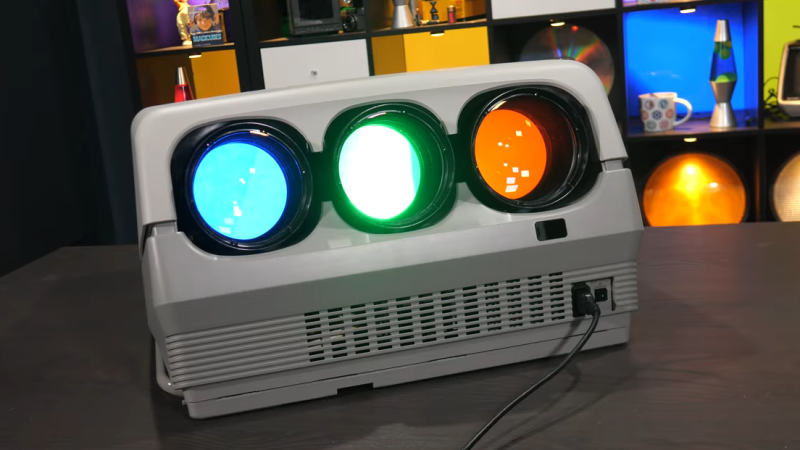
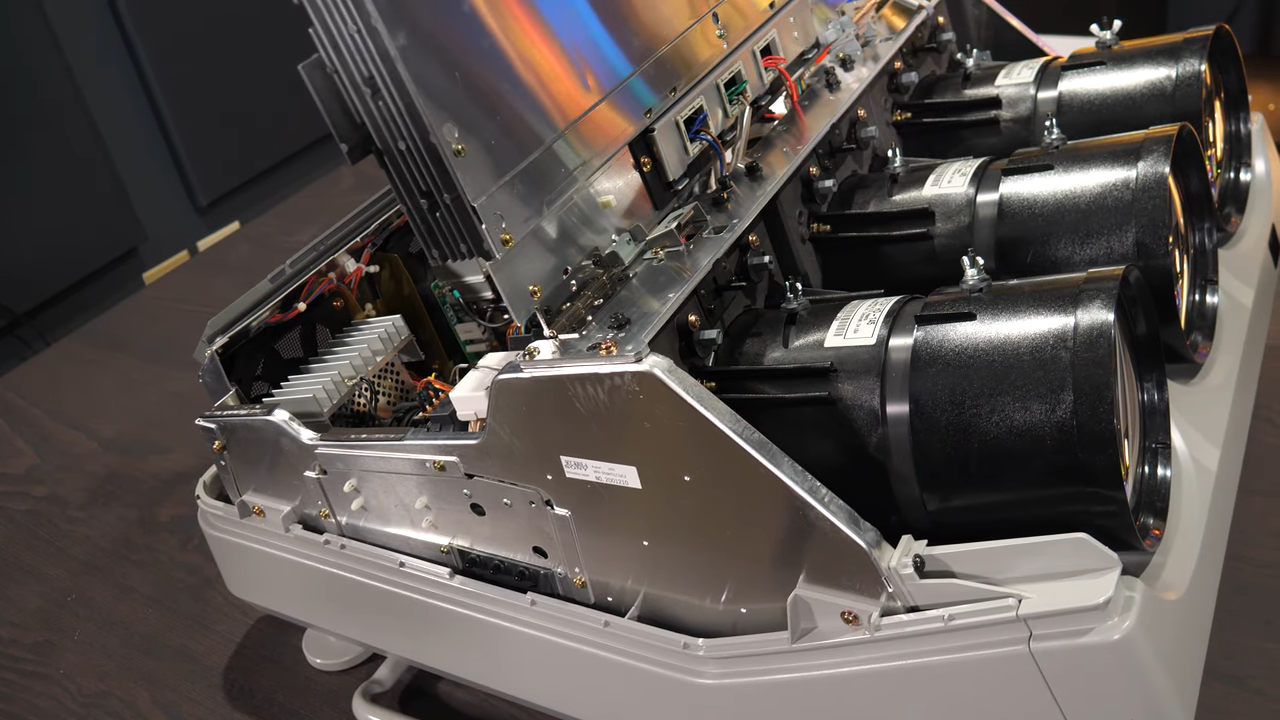
CRT monitors: there’s nothing quite like ’em. But did you know that video projectors used to use CRTs? A trio of monochrome CRTs, in fact: one for each color; red, green, and blue. By their powers combined, these monsters were capable of fantastic resolution and image quality. Despite being nowhere near as bright as modern projectors, after being properly set up, [Technology Connections] says it’s still one of the best projected images he has seen outside of a movie theatre.

After a twenty-minute startup to reach thermal equilibrium, one can settle down with a chunky service manual for a ponderous calibration process involving an enormous remote control. The reward is a fantastic (albeit brightness-limited) picture.

Still, these projectors had drawbacks. They were limited in brightness, of course. But they were also complex, labor-intensive beasts to set up and calibrate. On the other hand, at least they were heavy.

[Technology Connections] gives us a good look at the Sony VPH-D50HT Mark II CRT Projector in its tri-lobed, liquid-cooled glory. This model is a relic by today’s standards, but natively supports 1080i via component video input and even preserves image quality and resolution by reshaping the image in each CRT to perform things like keystone correction, thus compensating for projection angle right at the source. Being an analog device, there is no hint of screen door effect or any other digital artifact. The picture is just there, limited only by the specks of phosphor on the face of each tube.

Converging and calibrating three separate projectors really was a nontrivial undertaking. There are some similarities to the big screen rear-projection TVs of the 90s and early 2000s (which were then displaced by plasma and flat-panel LCD displays). Unlike enclosed rear-projection TVs, the screen for projectors was not fixed, which meant all that calibration needed to be done on-site. A walkthrough of what that process was like — done with the help of many test patterns and a remote control that is as monstrous as it is confusing — starts at 15:35 in the video below.

Like rear-projection TVs, these projectors were displaced by newer technologies that were lighter, brighter, and easier to use. Still, just like other CRT displays, there was nothing quite like them. And if you find esoteric projector technologies intriguing, we have a feeling you will love the Eidophor.

Continue reading “A Deep Dive Into The Coolness That Was CRT Projectors”