Challenge: Figure Out How This Logic-based Chaser Works

[Andrea] built this LED chaser using one logic chip. It illuminates all but one of the six LEDs, with the dim bit moving back and forth along the row in a chase sequence. This is something like an inverse Larson Scanner without the fading tail. But doing it with a logic chip instead of a microcontroller is a fun challenge.

Which brings us to the point of this feature. [Andrea] didn’t really post an explanation of how the circuit works. Usually missing details mean that we archive the tip and move on to the next one, but we think this provides a fun activity. Can you figure out how the circuit works? We already know that it’s using a CD4017 decade counter/divider chip. This gets its clock signal from a 555 timer circuit. [Andrea’s] schematic is a bit hard to read, but grab a copy, blow it up a bit (or use your browser zoom) and study the CD4017 datasheet (PDF) if you need to.

Want proof that it does actually work? It’s embedded after the break.

Continue reading “Challenge: Figure Out How This Logic-based Chaser Works”

Bending A Printer Control Board To Output POV Messages

Confronted with the issue of finding a use for his mounting pile of junk electronics, [Rue] set out to build a persistence of vision device using a hardware state machine. We have a suspicion that his original link may go down if there’s too much traffic so here’s a cached link just in case.

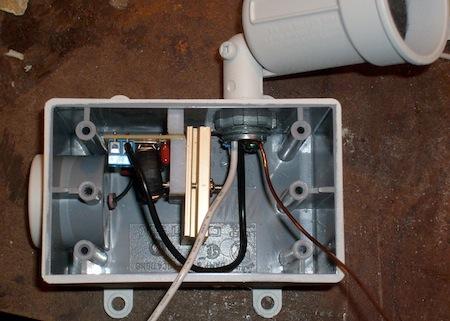
Any board that is MSC-51 or MCS-48 based would have worked for his purposes. This is because the addressing scheme of the hardware makes it an easy hack. The image above shows him cutting off the processor from this board. It was chosen because of a 74HC373; it was a mistake at first but since it’s pin compatible with the 74HC374 that he needed a simple swap did the trick. From there a clock source was added, and the address information necessary to display the message was burned into an EEPROM.

Step twelve of his writeup shows a Morse Code message created by attaching the board to a broomstick and twirling it around in an arc. We took  just a minute to decode the message and believe it’s a shout-out to Hackaday. Nice, thanks for reading [Rue]!

Investigating The Generative Properties Of A Stepper Motor

You probably know that if you spin a motor (mechanically) it generates electricity on what would normally be the inputs. This can be a problem when you shut off a spinning motor and is the reason that protection diodes are built into motor driver circuits. But [Dino] isn’t interested in driving a motor, he wanted to see what he could do with the electricity generated by spinning a stepper motor.

He built the test rig that you see above for this purpose. In the foreground a 12V DC motor is held in place with an electrical conduit clamp. This connects to the stepper motor being tested using a segment of rubber tube. The DC motor provides a reliable input for his experiments, but could be replaced in the future by a propeller to make it wind powered, or by a water wheel. Check out the video after the break to see what kind of juice [Dino] gets out of it, and how it can be used for powering LEDs, recharging batteries, or driving a motor.

Continue reading “Investigating The Generative Properties Of A Stepper Motor”

Whac-A-Banker To Relieve Your Frustration

[Tim Hunkin], builder extraordinaire and host of The Secret Life of Machines is a bit frustrated with the current economic climate and decided to take out his frustrations with a game of Whac-A-Banker.

[Tim]’s version of the classic Whac-A-Mole game uses tiny air cylinders to actuate five banker figurines up and down. The figures were cast with polyurethane and are reportedly holding up well. The cabinet is really interesting. When the game isn’t being played, a really boring front panel is displayed. After inserting a few coins, the panel drops into the machine to show the fun and exciting scoreboard.

If you’re ever around Suffolk, England, you can check out the Whac-A-Banker and a lot of other [Tim Hunkin] creations at the Southwold Pier. Thanks [John] for sending this one in. Yes, we did get The Secret Life of Machines in the states on the Discovery Channel, but it has been replaced with shows about trucking. Here’s an archive of the entire series for your viewing pleasure. Kiss your evening goodbye.

Maximite Harkens Back To The Days Of BASIC

Any self-identified geek that spent some time in the 80s will tell you how they used to type out programs into their ‘microcomputer’ with BASIC. It was a simpler time when a computer’s raison d’etre was simply being a BASIC interpreter. These days are long past us now; you can’t simply turn on a computer and have it load a BASIC prompt anymore. This is where [Geoff]’s Maximite single board computer comes in. It’s a tiny little box that whose only purpose is to play around with BASIC.

[Geoff]’s used a PIC32MX microcontroller with 128k of RAM for the CPU of his Maximite. Unlike an Apple ][ or TRS-80, the Maximite version of BASIC can do floating point arithmetic out of the box. To connect to the outside world, the Maximite has VGA or composite out to display the BASIC interepreter. A PS/2 keyboard port provides the input, and a USB port and SD card can be used to load and save programs from a PC.

The Maximite includes a 20-pin breakout for whatever IO you can imagine. This is duplicated on [Geoff]’s mini Maximite that is designed to be the retro throwback of an Arduino. We though those were called BASIC stamps, but if it gets kids programming, we’ll let it slide.

Computing With The Command Line

Here’s something we thought we would never see: computing with just pipes, /dev/zero, and /dev/null.

As a thought experiment, [Linus] imagined a null byte represented an electron. /dev/zero would have an infinite supply of electrons and /dev/null would make a wonderful positive power supply. With a very short program (named mosfet.c), [Linus] can use Linux pipes to control the flow of electrons between /zero and /null. [Linus] used mosfet.c with a very short shell script to create a NAND gate. From there all bets were off. He ended up creating a D flip-flop4-bit adder and a counter.

From a bit of cursory research, Linux has a maximum pipe capacity of 1,048,576 bytes and the maximum number of PIDs is 4,194,304 (correct us if we’re wrong). [Linus]  can theoretically build some of the classic CPUs of the 70s and 80s with his pipe logic. An Intel 486 is just out of reach, though. If you give someone a NAND or a NOR they’ll eventually build a computer; we thought we’d never see this, though.

Adding Digital Game Indicators To A Neo Geo Arcade Cabinet

neogeo

[George] is a Neo Geo aficionado, and among his collection of paraphernalia, he has a MVS-Mini game console. His mini “Multi Video System” is a 2-slot model, meaning that it can hold two game cartridges at a time, which are indicated by plastic cards inserted in the cabinet’s face plate. Instead of swapping those cards out each time he changed cartridges, he thought it would be far cooler to install digital displays instead.

He scoured just about every retail store he could before finding a handful of small 5” digital picture frames that looked to fit the bill. After some careful cabinet modifications he had them wired up and ready for display. The frames don’t hold a ton of pictures, but they do support the use of SD cards. [George] says that he’ll likely just buy a ton of small SD cards, swapping them out whenever he changes games, though over time that might become as tedious as swapping out the plastic cards.

We would love to see [George] take his new digital display up a level, so be sure to share your ideas in the comments. Perhaps we can persuade him to automate things a bit.