Human Tetris: Object Tracking On An 8-bit Microcontroller

Elaborating on an item previously mentioned among last weekend’s Cornell final projects list, this time with video:

For their ECE final project, [Adam Papamarcos] and [Kerran Flanagan] implemented a real-time video object tracking system centered around an ATmega644 8-bit microcontroller. Their board ingests an NTSC video camera feed, samples frames at a coarse 39×60 pixel resolution (sufficient for simple games), processes the input to recognize objects and then drives a TV output using the OSD display chip from a video camera (this chip also recognizes the horizontal and vertical sync pulses from the input video signal, which the CPU uses to synchronize the digitizing step). Pretty amazing work all around.

Sometimes clever projects online are scant on information…but as this is their final grade, they’ve left no detail to speculation. Along with a great explanation of the system and its specific challenges, there’s complete source code, schematics, a parts list, the whole nine yards. Come on, guys! You’re making the rest of us look bad… Videos after the break…

[G’day Bruce]

Continue reading “Human Tetris: Object Tracking On An 8-bit Microcontroller”

Minimalist AVR Programmer Is Just Fab!

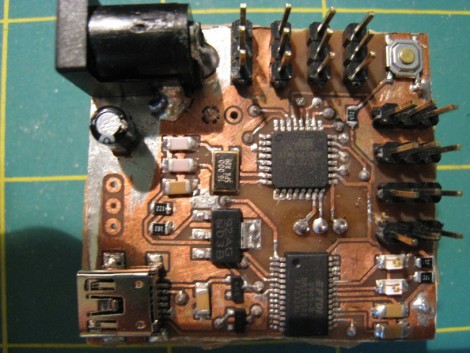
Whether you’re burning a new bootloader to an Arduino board, or doing away with a bootloader to flash Atmel chips directly, an in-system programmer (ISP) is an indispensable tool for working with AVR microcontrollers. If cost has held you back, it’s no longer an excuse: FabISP is a barebones USB-based AVR programmer that can be pieced together for about ten bucks.

FabISP was created by [David Mellis] as a product of MIT’s Fab Lab program, which provides schools with access to design and manufacturing tools based around a core set of fabrication capabilities, so labs around the world can share results. But the FabISP design is simple enough that you don’t need a whole fab lab. It’s a small, single-sided board with no drilling required; the parts are all surface-mounted, but not so fine-pitched as to require reflow soldering. Easy!

There’s still the bootstrap problem, of course: you need an AVR programmer to get the firmware onto the FabISP. This would be an excellent group project for a hackerspace, club or school: if one person can provide the initial programmer to flash several boards, each member could etch and assemble their own, have it programmed, then take these out into the world to help create more. We must repeat!

[Thanks Juan]

Transistor Fabrication: So Simple A Child Can Do It

If manufacturing printed circuit boards has become too easy you should try your hand at producing transistors. [Jeri Ellsworth] put together a collection of videos outlining the process. These go way beyond the IC fabrication we saw from her in the past. It doesn’t take much, a 1000 degree oven with steam option, silicone wafers, and a variety of chemicals. We’ve embedded the instructional video as well as two demonstrations of her N-style FET after the break. Continue reading “Transistor Fabrication: So Simple A Child Can Do It”

Original NES Plays Game Boy Games?

[Bunnyboy] pulled off some wizardry with this custom NES cartridge. Inside is the mainboard for a Game Boy as well as his own custom PCB with the comb connector needed to interface with an original Nintendo Entertainment System. In his own words it’s “a Super Game Boy without the Super”. The expansion port to for the handheld is still accessible for some head-to-head Tetris or use with the obscure Game Boy printer.

[Thanks Maxym]

Making A Bluetooth SNES Controller

[youtube=http://www.youtube.com/watch?v=OP8JgqmVES8&]

[MODDEDbyBACTERIA] has posted this instructible on how to make a bluetooth SNES controller. The bulk of the parts come from a bluetooth MSI game pad, so this isn’t a scratch build, but the amount of modifications required definitely qualify this as a hack. We were quite surprised that he managed to stuff all of that back into the case as well as he did. Great job.

Build Your Own Wikipedia Reader

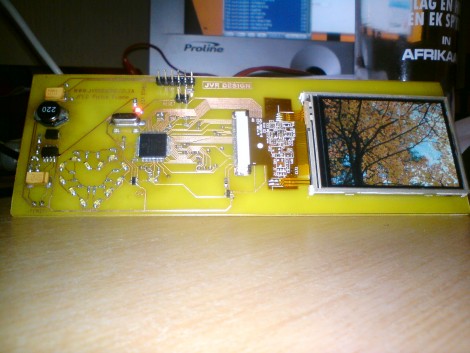
One part inexpensive uC, one part touch-screen, one part Internet knowledge-base all come together to make up this Wikipedia reader. It functions in a very similar way to commercial versions by parsing XML dumps from the popular website to an SD card for use on the device. This is not limited to Wikipedia, but could just as easily be an e-reader. [Rossum] developed the package using an NXP ARM Cortex M0 model LCP1114 microcontroller. They cost just a couple of bucks but pack a 50 MHz punch with 32 KB of program memory and 8 KB of SRAM. If the nanotouch and the AVR iPhone concept didn’t convince you that [Rossum] knows what he’s doing, the video after the break of this newest creation will seal the deal.

Continue reading “Build Your Own Wikipedia Reader”

When Multimeters Go Boom

[youtube=http://www.youtube.com/watch?v=M-FZP1U2dkM]

Ever wondered how expensive versus cheap multimeters hold up to abuse? [Dave] gives us a pretty good idea by, well, blowing them up. He’s using a capacitor bank to put roughly 4.2 KiloVolts into the poor little meters. If you absolutely must skip to the multimeters, go to about 5:00. You really will miss out on some good stuff though.

[via HackedGadgets]