MRRF 3D Printing Spectacular

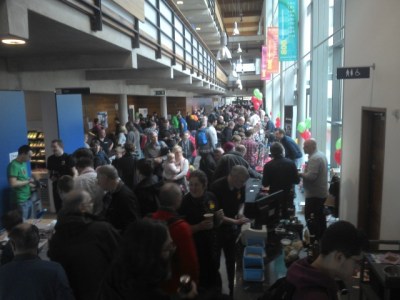
MRRF, the Midwest RepRap Festival, is in full swing right now. The venue is packed, attendance is way up this year, and the panorama is impressive:

Panoramamini
The 2016 Midwest RepRap Festival. Click to embiggen.

New Printers

MRRF is not really a trade show. Yes, there are companies here (Google is picking up the tab for Chinese food tonight), but this is assuredly a community-based event around open source hardware. That said, Lulzbot is here, SeeMeCNC is hosting, E3D, and Ultimachine are all here. This year, there are a few new printers.

Lulzbot’s Taz 6 – the latest update to their flagship printer made its first public appearance at MRRF this year. A product update from Lulzbot isn’t like a product announcement from a normal company. Lulzbot is using rapid prototyping for manufacturing (!). They can iterate quickly and release two new printers in the time it takes Stratasys to come up with a design. This also means the releases are incremental.

Click past the break for more photos and updates.

Continue reading “MRRF 3D Printing Spectacular” →

MRRF: Jellybox, A STEM-Oriented Printer

It’s the first full day of fun here at the Midwest RepRap Festival. This year’s turnout is quite impressive—as I’m writing this, we’re an hour or so in and there are already hundreds of people and a couple of R2D2 units milling about.

The talks will begin in a few hours. This year MRRF has expanded to another building, which should tell you something about the growth of this festival. We are excited to hear [Filip] and [Ladi] give a presentation about Jellybox, a STEM-driven project he started to bring 3D printing into education in a comprehensive and hands-on way. The initial idea was based on [Jean Piaget]’s theory of constructionism. [Piaget] was a clinical psychologist who helped advance the idea that human learning is greatly influenced by connecting a person’s ideas with their experiences.

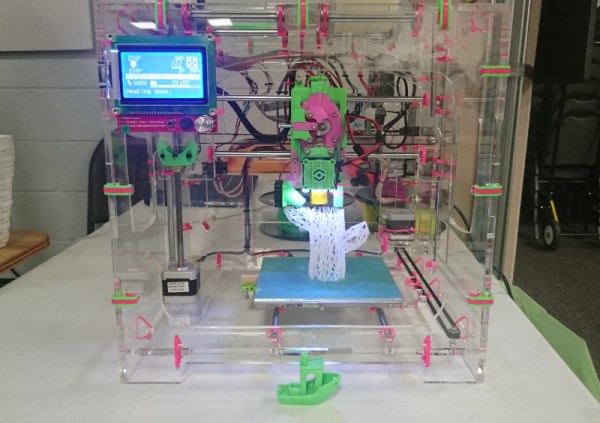
Building a Jellybox printer is about as easy as it gets, and takes about 4-6 hours depending on your skill level. The laser-cut clear acrylic panels are connected with zip ties that lock around 90° plastic brackets. The back panel even has a etched diagram that shows where all the connectors should go, and the wiring is neat and tidy by design. It’s meant to be easy to tear down so that teachers can use them again and again with middle and high school-aged students. The Jellybox is open-source; both the extruder and the hot end can be swapped out in a flash.

IMade3D offers one- and two-day intensive courses in the DC area that cover building a Jellybox and learning some things about 3D modeling. The kit is included in the price of admission. Jellybox kits will be available in a few weeks, but can be preordered today for $799.

Live From The Midwest RepRap Festival

It’s time once again for the world’s premier DIY 3D printer event, the 2016 Midwest RepRap Festival.

The 2016 Midwest RepRap festival is a yearly celebration of blue tape, aqua net, and tangled strands of 3D printer filament held at the Elkhart county fairgrounds in Goshen, Indiana. This year, the fairgrounds has fiber Internet, and we have a Dropcam. This can only mean one thing: live streaming from the best 3D printer convention on the planet.

The livestream is down because MRRF is over

This stream should be active the entire weekend, with the requisite breaks for sleep and to take the entire crew to the Chinese buffet down the street. Of course, if you’re in the area, you’re more than welcome to stop by. Registration is free, although a small donation would be appreciated.

The schedule for the event is as follows:

  • Friday: now until 10pm Eastern
  • Saturday: 10am to 6pm Eastern
  • Sunday: 10am to 3pm Eastern

The (incomplete) list of speakers (which might be livestreamed) is as follows:

  • E-Nable 3D printed prosthetics
  • B3 Innovations From MRRF to retail
  • IMade3D STEM + Jellybox
  • MakerOS Make Money with 3D Printing
  • J. Conway 3D Printer Adaptive Scanning Technologies

Birthday Celebrations The Pi Way

The William Gates Building concourse packed with Pi enthusiasts

On a damp and cold Saturday in early March the Cambridge University Computer Laboratory threw open its doors to the Raspberry Pi community. The previous Monday had been the fourth (or first, if you are a leap year pedant!) birthday of the little single-board computer, and last weekend saw its official birthday celebration.

The festivities took the form of an exhibition floor with both traders and community show-and-tell exhibits, plus a packed schedule of workshops and talks. With the Raspberry Pi 3 launch only a few days before there were no surprise announcements of exciting new hardware, but it did provide a good networking opportunity for the Pi community and a chance to test the state of the Raspberry Pi nation.

The most obvious first impression at the event was that it was one that catered for a diverse range of ages and ability groups. Side-by-side with parents and their children were educators, and the maker community. The range of exhibits was therefore slanted somewhat towards a younger age range with games and interactive exhibits, and there was more than a slight educational flavour to the event. This was entirely in keeping with the Foundation’s objectives, and since it is events like these that are inspiring the Hackaday readers of the next decade, a very welcome sight. Join us after the break for a look at all that was happening at the event.

Continue reading “Birthday Celebrations The Pi Way” →

Join Us At The Greatest 3D Printing Festival On Planet Earth

Winter is hanging on like clinical depression, which means it’s that time again for the greatest 3D-printing festival on the planet Earth. It’s time for the Midwest RepRap Festival, next weekend, March 18-20th in Goshen, Indiana.

I can’t explain why, but for some reason the Midwest RepRap Festival is an oasis of building, doing, and hacking right in the middle of the county fairgrounds for Elkhart County, Indiana. It’s free for everyone to attend. The event isn’t choked with vendors, leaving the people who actually do stuff left to fight over a few picnic tables on the outskirts of the venue. It is, by far, the most community-centered event we go to every year.

If you’re wondering what you can expect at a 3D printer convention in the middle of nowhere, check out a few of the posts we’ve published from MRRF over the last few years. We’ve seen 3D printed waffles, resin casting with 3D printed molds, bizarre movement platforms, Bioprinting, and stuff from Lulzbot. That’s just the stuff that has deserved its own Hackaday post: we’ve seen the world’s largest 3D printed trash can, R2D2, battle droids (it’s even money if BB-8 is going to show up this year), a Printer made out of K’nex, and the most beautiful 3D printer we’ve ever seen. There was a T-shirt cannon powered by 300 psi shop air.

Every year I write a post announcing that we’ll be heading to MRRF next week, simultaneously praising the event as one of the greatest ‘maker’ and ‘DIY’ meetups, while pointing out the local WalMart parking lot has a place to park horse-drawn buggies. Both observations are true. For one weekend a year, Goshen, Indiana is the place everyone reading Hackaday should go to, and that is why we are once again proud to sponsor this glorious event.

Hackaday At SXSW

It’s that time of year again. In March, Austin Texas transforms itself into a nexus of art and technology and holds a celebration of Music, Film, and something called Interactive. It turns out that we’re Interactive: Hackaday will once again be at SXSW and we want you to join us there — Austin is excellent at showing everyone a fun time (as long as you don’t need to drive anywhere).

We’ll be on site starting this Friday (3/11/16) and we want you to come party with us at the Hardware House starting at 6pm. This is the third year that Hardware House has hosted, and last year the party was packed with a ton of interesting people, including some Hackaday alums who were there by coincidence. This year you can expect the same, but the fun doesn’t stop on Friday. [Sophi Kravitz] will be hosting a panel on Sunday at 5pm about Technology and Social Change.

Our main event is on Monday (3/14) at noon: Lunch with Hackaday as we launch the world premier of the 2016 Hackaday Prize film. On hand for the SXSW events are [Sophi Kravitz], [Chris Gammell], [Aleksandar Bradic], [Amber Cunningham], [Michael Guilfoil], and [Ivan Lazarevic].

But even after SXSW, we’re not done with the Lone Star State. [Brandon Dunson] and [Mike Szczys] will be at Hackaday Prize Worldwide: Dallas the following weekend at the Dallas Makerspace. Get excited Texas, we certainly are!

Announcing Hackaday Belgrade’s Talks And Speakers

Hackaday is hosting a hardware conference in Belgrade on April 9th. This is arguably our first-ever European conference, and for the last few months we’ve been putting together a hackable conference badge, a list of speakers, and a set of hands-on workshops. Now, we’re finally ready to announce the workshops and talks for Hackaday | Belgrade. You can check out the scheduled talks and workshops below.

Tickets for Hackaday | Belgrade are still available, and tickets for the workshops will open up today. Tickets are also cheap – $35 for a regular ticket, and about $10 and $30 for the robot and DIY musical toy workshops, respectively. The workshop tickets are only to cover material cost, and you’ll get to take your project home with you.

The conference will be a blast. There will be bands and DJs, badge hacking competitions, and ten hours of talks and workshops. If you’re going, or are still on the fence, hang out on the event page to get the inside info on a few Hackaday events that will happen the night before and the day after.


The Workshops

Radomir Dopieralski – Tote, A Walking Quadruped Robot. Build your own spider-like robot and make it walk.

Anastasios Stamou – Hardware Hacking Musical Toys & DIY Electronic Musical Interfaces. Introductory circuit bending workshop teaching all the necessary techniques for designing and making experimental electronic musical interfaces out of recycled material.

The Talks

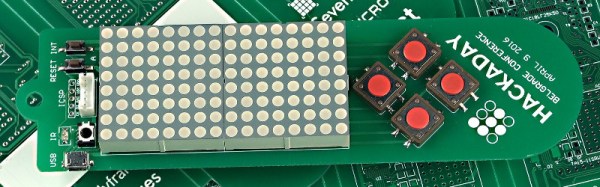
Voja Antonic – Hacking the Hackaday Belgrade Badge. The Belgrade conference features its own badge designed by Voja Antonic. Voja will introduce the Belgrade badge and the theory of operation behind the LED matrix, keyboard, power management, infrared transceiver, and accelerometer.

Navid Gornall – How To Eat Your Own Face. The story of hacking a 3D printer to print burger selfies with mayo. Printing with a non-Newtonian condiment presents a unique set of challenges which will be explored in this presentation.

Tsvetan Usunov – Hacker Friendly OSHW DIY Modular Laptop. Tsvetan is the mind behind Olimex, manufacturer of various embedded development platforms and tools. He will talk about the creation of a modular, hacker friendly laptop based on a 64-bit ARM processor.

Chris Gammell – Top Down Electronics

Dejan Ristanovic – Serbia: Long Road To The Internet. During the 1980s and 1990s, we had to hack the system in many ways just to stay connected, and to reinvent the wheel three times before breakfast. We also had some results, including Sezam, the biggest BBS in this part of Europe

Kristina Kapanova – Designing A High Performance Parallel Personal Cluster. This talk introduces an open source, homebrew mini cluster consisting of a Radxa Pro single board computer based on the quad-core ARM Cortex-A9 CPU. In particular, this talk demonstrates it is possible to achieve very advanced simulations in the field of quantum computing.

Sophi Kravitz – Creation, fabrication, and application by experimentation of the synchronization of a grid configuration of a light radiation orientation polarization illumination.

Seb Lee-Delisle – Making The Laser Light Synths. The Laser Light Synths are LED emblazoned musical instruments that anyone can play. Along with high power lasers, they form part of a large outdoor installation that switch the traditional roles of audience and performer.

Mike Harrison – Retrotechular : 1950s Video Projection Technology. A talk on the history and technology of the Eidophor, a little known, absurdly complicated, and very expensive product that dominated the large-screen projection market from the 1950s to the 1990s.

Peter Isza – Open Source Clinical Grade Electrocardiography. This talk covers the development of a true clinical grade, open source Holter ECG which will be sold for close to its manufacturing cost.

Paulina Stefanovic – Interactive Digital Storytelling Systems: Generative Interfaces, Authors and the Role of the Audience. This talk will cover the development and design of interactive content and interactive performance that shifts the focus from the creator of the system to the creative involvement of the audience.

BelgradeSpeakers-02-01