VCF East X: Virtual Reality With PETSCII

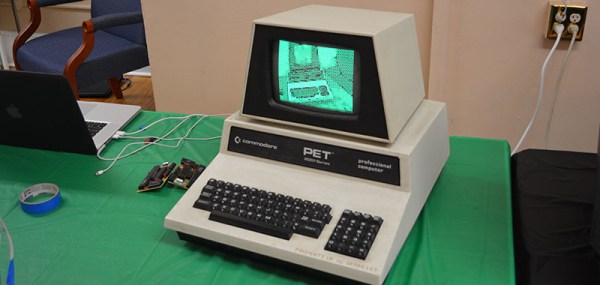
What would happen if Oculus-quality virtual reality was created in the 80s on the Commodore PET? [Michael Hill] knows, because he created a stereoscopic video headset using a PET.

This build is an extension of [Michael]’s exhibit last year at VCF East where he displayed a video feed with PETSCII. Yes, that means displaying video with characters, not pixels.

This year, he’s doubling the number of screens, and sending everything to two iPhones in a Google Cardboard-like VR headset. Apart from the optics, the setup is pretty simple: cameras get image data, it’s sent over to a PET, and a stream of characters are sent back.

It’s impossible to film, and using it is interesting, to say the least. Video below.

Continue reading “VCF East X: Virtual Reality With PETSCII”

VCF East X: The Quarternet Steering Committee

Today was the first day of the Vintage Computer Festival East X. As is the tradition, the first day was packed with talks and classes about various retrocomputing ephemera, with this year featuring a great talk from [David Riley] about 8-bit computer music, a class on system architecture from our own [Bil Herd] (video coming soon), and a talk about vintage teletypes. One of these talks was about creating new hardware: [Jim Brain]’s steering committee on a networking solution for vintage microcontrollers. It’s called Quarternet: a two-bit solution for an eight bit world.

While minicomputers are easily networkable, designed around multi-user operating systems, and have the hardware for a lot of networking hardware, 8-bit micros are the exact opposite. That doesn’t mean 8-bitters don’t have networking; you can get an Ethernet cart for a C64, and just about everything can connect to a BBS. [Jim]’s talk was about whittling down the use cases for the Quarternet to something that could be implemented easily, but still give the most capability.

During the talk, the audience settled on using a serial connection from the micro to the outside world; this makes sense, as everything has a serial port. A ‘lightweight API’ was suggested to take up the software side of the problem, but there wasn’t much agreement over what that API would actually do.

[Jim]’s idea is for a box that plugs into the serial port of any old microcomputer and would connect to the Internet somehow. Ethernet, WiFi, or even a modem isn’t out of the question here. That takes care of connecting to the Internet, but there’s also the question of the cooler side of networking – network drives, file sharing, and the like.

For this, [Jim] is imagining a box with a serial port on one end, and a network port on the other. In the middle would be a cartridge slot for any hardware imaginable. If you want to plug in an Apple II disk drive, just insert the right cartridge and you’re good to go. If you need network access to a Commodore 1541 drive, just insert another cartridge, and it’ll just work.

It’s an interesting idea, but [Jim] is really interested in getting even more feedback for a networking system for old microcomputers. If you have any ideas, leave a note for him in the comments.

RadioShack Demise Could Signal The Rise Of Mom-and-Pop

No matter how you feel about RadioShack, for many hackers it was the one place that components could be sourced locally. Upon hearing that the stores are being shuttered (at least for those seeking non-cellphone items) we wondered if someone would rise to meet the maker market. The answer may actually be mom-and-pops — independent stores owned by people passionate about hacking and making.

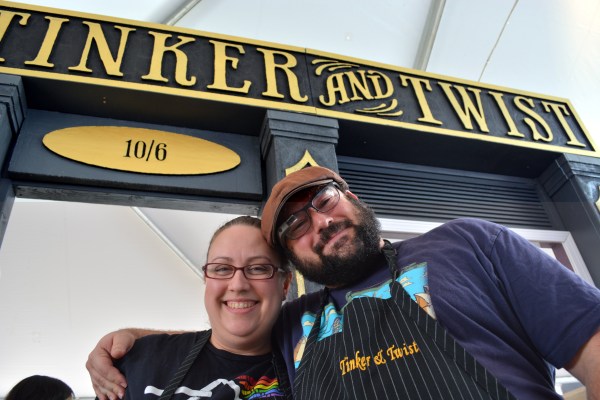
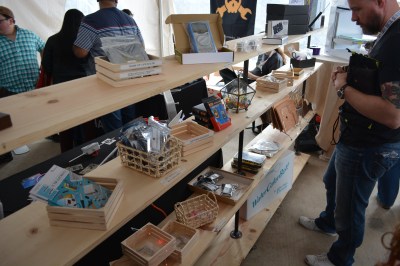
tinker-and-twist-boothAt SXSW Create in March the Hackaday booth was right next door one such establishment. [Martin Bogomolni] is hard at work launching his brick and mortar store called Tinker & Twist. In the video below he speaks briefly about the concept of the store, which focuses on curating the best products and tools available and stocking them locally.

The store will be located in a shopping mall in Austin, Texas. But it takes about 100 days launch a storefront considering the permits and build-out. [Martin] decided to take the store to the hackers by exhibiting (and selling products) at SXSW Create. How else would you do this than by building a store-front as your booth? The store’s sign was CNC routed from rigid foam, and combined with a set of columns and storefront window. We stopped by late on the last day of the event and they had been having a great weekend. What started as a very well stocked set of shelves looked nearly bare.

Tinker & Twist is just the most recent in a growing trend of standalone stores focusing on hackers and makers. Our friends at Deezmaker in Pasadena, CA gave us tour last year. They’ve married the concepts of hackerspace, small-run manufacturer (in the form of their 3D printers), and retail store all-in-one. These types of examples make us quite happy — it’s been years since RadioShack was tightly focused on those actually building things. We hope to see more stores like Tinker & Twist up and running to support and enhance hacker communities everywhere.

Retro Edition: VCF East X This Weekend

It’s mid-April and time once again for the Vintage Computer Festival East X. The X means 10. It’s a three-day weekend full of interesting people, cool tech, and computers you’ve only heard about. We’ll be there all three days, and if you’re in New York or are unable to pump your own gas (Oregon excluded), it’s a great way to spend the weekend.

The sessions for this Friday will include everything from chiptunes to retr0bright to emulating vintage computers on FPGAs. Sessions of note include our own [Bil Herd] giving a talk on system architecture. Think of this as a bunch of engineers in a room with a whiteboard. How could you not have fun with that. There will also be the first meeting of the Quarternet committee, headed up by [Jim Brain]. This session will be a discussion of implementing a vintage networking protocol across different models and different brands of vintage computers. Confused? It’s a, “two-bit solution for an eight-bit world.” That’s all we know, and I’m pretty sure that’s all anyone knows. It will be interesting.

Saturday and Sunday will feature an incredible number of exhibits that includes everything from Atari 8-bits, Hollerith cards, mainframes, an amateur radio station (KC1CKV) and somehow a Fairlight CMI. Since this is the 50th anniversary of the PDP-8, there will be a few of these ancient machines on display. A freshly restored Straight-8 will be up and working, as will an incredible emulation from hackaday.io.

Just because there are exhibits doesn’t mean the talks end on Friday. On Saturday the guest speaker will be [Brian Kernighan], the guy who literally wrote the book on C. Sunday will feature [Bob Frankston], co-developer of VisiCalc. There will be very important people here all weekend.

Even if vintage computers aren’t your thing, there’s still plenty of stuff to see at the venue. The InfoAge science center has technological curiosities stretching back a century, and recently they’ve rehabbed an old satellite dish and turned it into a radio telescope. Registration happens here, and if the last few paragraphs haven’t sold you on the event, you can check out [The Guru Meditation]’s VCF preview video below. We will, of course, be posting a lot of stuff from the event.

Continue reading “Retro Edition: VCF East X This Weekend”

Hackaday Part Of TechCrunch NY Hackathon

The Hackaday Prize Worldwide is coming to New York! Hackaday is adding a hardware-centric twist to the TechCrunch Disrupt in May. They’re kicking off the conference with a weekend hackathon which traditionally has been a software event. This year Hackaday is partnering with TC to make a change. If you’re a software-only sort of person, grabbing a ticket to the event is extremely tough. But those Hackaday community members who want to prove they can make electrons do their bidding still have hope; Hackaday can get you in!

Twenty Hours of Hardware

Show up at 12:30pm on Saturday, May 2nd. By 9:30am the next morning you must have a working piece of hardware having been totally built on-site. Starting at 11am on Sunday you have 60-seconds to show off your build. We’re not kidding around when we say the judging criteria for this hackathon is “Awesomeness”. TC is putting up $5,000 to the winning team. Obviously someone who hangs out around Hackaday should be the winner here so go sign up!

Ticket Registration is a Hack:

TC hackathon tickets are released in shifts and gobbled up immediately, but because you are a friend of Hackaday we’ll can get you in for some epic hardware hacking. Even signing up is a bit of hack but here’s how:

  1. Follow this link which includes a promo code to get a Hackers – Friends of TC ticket
  2. Form/Find a team (up to 5 people) in advance through ChallengePost or you may do so onsite. You’ll notice the tags are software-related so put in “other” and add “hardware” and specific tags you can think of.

The Hardware

We’ll be bringing the basics: lots of dev boards, sensor breakout boards, and tools you need to hook them together. We’ll be posting information about the items we are bringing on our Hackaday Prize Worldwide: New York City page. Make sure you check in for updates so that you can familiarize yourself with what we’ll have on-hand. It is highly recommended that you set up any IDE or other dev tools before arriving at the event.


The 2015 Hackaday Prize is sponsored by:

Mediated Matter At The MIT Media Lab

Few things have managed to capture the imagination of hackers and engineers around the world the way Synthetic Biology did over the last couple of years. The promise of “applying engineering principles to designing new biological devices and systems” just seemed way too sci-fi to missed out on, and everyone jumped on the bandwagon. All of a sudden, the field which used to be restricted to traditional research organizations and startups found itself crowded with all sorts of enthusiasts, biohackers, and weirdos alike. Competitions such as the International Genetically Engineered Machine (iGEM) paved the way, and the emergence of community spaces like GenSpace and BioCurious finally made DNA experimentation accessible to anyone who dares to try. As it often happens, the Sci-Fi itself did not go untouched, and a whole new genre called “Biopunk” emerged, further fueling people’s imagination and extrapolating worlds to come.

Continue reading “Mediated Matter At The MIT Media Lab”

MRRF: Hot Ends, Extruders, Extremely Posh Brits, And Stoic Swedes

As far as locations for the Midwest RepRap Festival go, it’s not exactly ideal. This is a feature, not a bug, and it means only the cool people come out to the event. There were a few people travelling thousands of miles across an ocean, just to show off some cool things they built.

Two Colors, One Nozzle

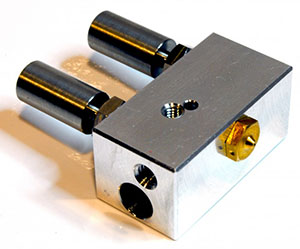
[Sanjay] and [Josh] from E3D came all the way from merry olde England to show off a few of their wares. The star of their show was the Cyclops extruder, a dual-extrusion hot end that’s two input, one output. Yes, two colors can come out of one nozzle.
cyclops

If you see a printer advertised as being dual extrusion, what you’re going to get is two extruders and two hot ends. This is the kludgy way to do things – the elegant solution is to make two colors come out of one nozzle.

The guys from E3D were showing off a few prints from their Cyclops nozzle that does just that, including a black and red poison dart frog, and a blue and white octopus. The prints looked amazing, and exactly what you would expect from a two-color print.

Rumor has it the development of the Cyclops involved extruding two colors, freezing the nozzle, and putting it in the mill just to see how the colors mixed. I didn’t see those pictures, but there’s a lot of work that went into this hot end.

The Power of Two Extruders

[Martin] of bondtech.se came to MRRF all the way from Sweden. He was there showing off his new extruder.

The extruder uses a normal stepper motor, but instead of the usual knurled or threaded feed wheel and bearing to push filament though, he’s using two counter-rotating feed wheels attached to a planetary gear system. That’s a lot of torque that doesn’t distort or strip the filament. When you consider all the weird filaments that are coming out – ninjaflex, and even 3D printable machinable wax filament, this is extremely interesting.

Even if your filament isn’t exactly 1.75 or 3mm in diameter, this setup will still reliably push plastic; there is a bolt that will move one of the feed wheels in and out 0.4mm.

[Martin] had a pair of his extruders hooked up to a strain gauge, and it’s strong enough to lift your printer off the table without stripping the filament. Here’s a video of that demo from the bondtech page.