Creating PCBs With 3D Resin Printers

PCB

The folks over at Full Spectrum Laser are Kickstarting their own 3D printer – a stereolithography machine like the Form 1 and B9 Creator printers. During their testing, they discovered a new application for these SLA printers that should prove to be very useful for the makers and builders using machines – manufacturing PCBs with UV-sensitized copper clad boards.

Full Spectrum Laser’s printer – the Pegasus Touch – uses a near UV laser and a galvo system to build objects in UV-curing resin layer by layer. In retrospect it seems pretty obvious a UV laser would expose UV sensitive boards, but this discovery simply reeks of cleverness and is a nice ‘value added’ feature for the Pegasus printer.

The Pegasus printer has a laser spot size of 0.25mm, meaning the separation between traces on Pegasus-produced PCBs will be just under 10 mils. That’s a bit larger than the limits of laser printer-based PCB fabrication but far, far less complicated. Making a PCB on an SLA printer is as easy as removing the resin tank and putting a sensitized board on the build platform. Draw some traces with the printer, and in a few minutes you have an exposed board.

We’d really like to see if this technique can also be used with other SLA printers. if anyone out there would like to experiment, be sure to send the results into the tip line.

Video from Full Spectrum Laser below.

Continue reading “Creating PCBs With 3D Resin Printers”

Rex, The ARM-Powered Robot Board

REX

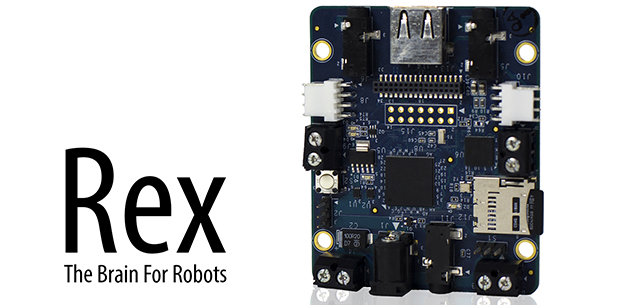
There are a million tutorials out there for building a robot with an Arduino or Raspberry Pi, but they all suffer from the same problem: neither the ‘duino nor the Raspi are fully integrated solutions that put all the hardware – battery connectors, I/O ports, and everything else on the same board. That’s the problem Rex, an ARM-powered robot controller, solves.

The specs for Rex include a 1GHz ARM Cortex-A8 with a Video SoC and DSP core, 512 MB of RAM, USB host port, support for a camera module, and 3.5mm jacks for stereo in and out. On top of that, there’s I2C expansion ports for a servo adapter and an input and output for a 6-12 V battery. Basically, the Rex is something akin to the Beaglebone Black with the hardware optimized for a robotic control system.

Because shipping an ARM board without any software would be rather dull, the guys behind Rex came up with Alphalem OS, a Linux distro that includes scripts, sample programs, and an API for interaction with I2C devices. Of course Rex will also run other robotics operating systems and the usual Debian/Ubuntu/Whathaveu distros.

It’s an impressive bit of hardware, capable of speech recognition, and machine vision tasks with OpenCV. Combine this with a whole bunch of servos, and Rex can easily become the brains of a nightmarish hexapod robot that responds to your voice and follows you around the room.

You can pick up a Rex over on the Kickstarter with delivery due sometime this summer.

Mooshimeter: The ‘Why Didn’t I Think Of That’ Multimeter

Despite how useful multimeters are, there are a lot of limitations you just don’t think about because they’re the way electronic measurement has always been done. Want to measure voltage and current simultaneously? Better get two meters. Measuring something in a dangerous, inaccessible, or mobile place? You could rig up a camera system to show the meter’s display on a monitor, you know.

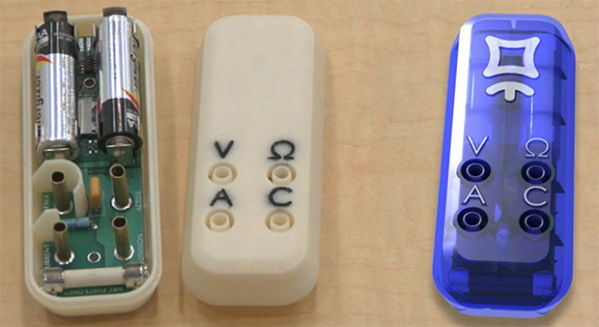
Mooshimeter is the better way of doing things. It’s a multichannel multimeter that communicates with your cell phone over a Bluetooth connection. With two channels. the Mooshimeter makes it easy to graph voltage against current to plot a beautiful IV curve on your smart phone. Being a wireless multimeter means you can stick the Mooshi inside a robot and get instantaneous feedback of how hard you’re driving your motors.

Far from being a two-trick pony, the Mooshimeter is actually a pretty good multimeter by itself. It can handle 600V and 10A with 24 bits of resolution. Here are the complete specs. The Mooshimeter is available for preorder here for $100 USD.

3DMonstr Printer: 8 Cubic Feet Of Build Volume

3D Monster

So you’re looking at 3D printers, but the build volumes for the current offerings just aren’t where you’d like them to be. [Ben Reylblat] had the same problem and came up with the 3DMonstr, an enormous printer that has (in its biggest configuration) a two foot cubed build volume, four extruders, and the mechanical design to make everything work.

Most of the ginormous 3D printers we’ve seen are basically upgraded versions of the common table-top sided models. This huge Ultimaker copy uses the same rods as its smaller cousin, and LeBigRap also uses woefully undersized parts. The 3DMonstr isn’t a copy of smaller machines, and instead uses very big motors for each axis, ball screws, and a proper welded frame. It’s highly doubtful anyone will call this printer a wobblebot.

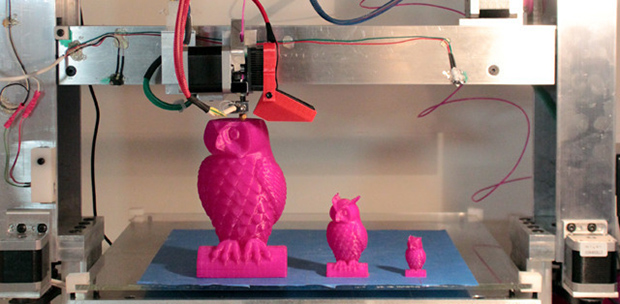
The 3DMonstr comes in three sizes: 12 inches cubed, 18 inches cubed, and 24 inches cubed, with options for two to four extruders.  We caught up with the 3D Monstr team at the NYC Maker Faire, and from first impressions we have to say this printer is freakin’ huge and impeccably designed.

FPGAs For The Pi And ‘Bone


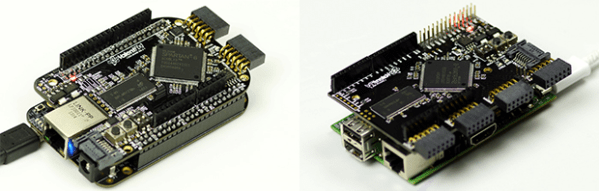
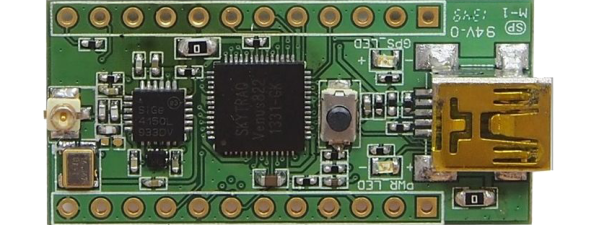
We’ve seen FPGA dev boards out the wazoo—even some following the current trend of putting an FPGA and an ARM processor on a single board. Take one good idea and mix it in with a few million Linux/ARM boards already piling up on workbenches the world over and you get LOGi: an FPGA designed to plug into the Raspberry Pi and BeagleBone.

Both the Raspberry Pi and BeagleBone versions of the LOGi feature a Spartan 6 FPGA with 9152 logic cells, 16 DSP Slices, 576KB of RAM, and 96 I/O Pins. There’s also 256 MB of SDRAM and a SATA connector. The Kickstarter has a few demos for this board, namely a machine vision, Bitcoin mining (though don’t expect this board to make return-on-investment with mining), and an autonomous vehicle control demo. The LOGi’s hardware is comparable to the Papilio Pro, so potential projects may include generating NTSC video, adding a VGA out, and a few retrocomputer emulations via OpenCores.

For what this Kickstarter asks for the Pi or ‘Bone version of the LOGi—$89 USD for either—you’ll get a surprisingly capable FPGA dev board that’s a bit cheaper than comparable offerings. Sure, you won’t save any money buying a Pi and a LOGi, but if you have a few Raspberries lying about, you could do much worse for a starter FPGA board.

Thanks [hamster] for sending this one in.

A Really Big Extruder For Exotic Filaments

extruder

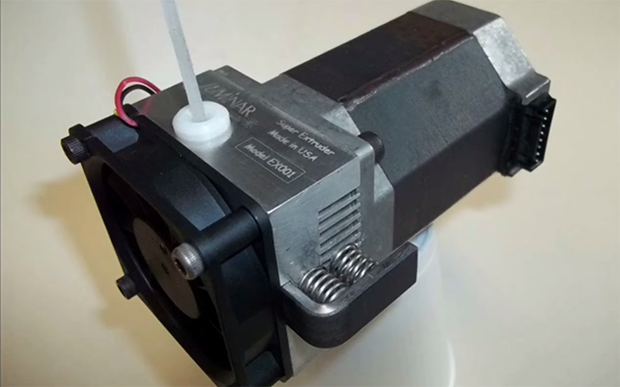
Even with ABS, PLA, Nylon, HIPS, and a bunch of Taulman filaments, the world of 3D printers is missing out on a great supply of spools of plastic filament. Plastic welding rod is available from just about every plastics supplier, and in more variety than even the most well-stocked filament web shop.

This Kickstarter hopes to put all those exotic plastic welding rods to good use. Instead of being designed to only use 1.75 and 3mm filaments, this guy will extrude welding rods up to 4.76mm in diameter. This opens the door for 3D printed objects made out of PDPF, PVC, Polypropylene, Polyethylene and other high molecular weight plastics.

Because these welding rods are much bigger than the usual plastic filament, this extruder also has the option for a very beefy NEMA 23 motor. It’s the perfect solution if you’re planning on building a homebrew ludicrous-sized printer, or you just to show off just how awesome you are.

The Sub-$500 Deltaprintr

delta

We’ve seen them before, but only now has the Deltaprinter, a very simple and affordable delta printer finally hit Kickstarter.

We saw the Deltaprintr at the World Maker Faire last September where the team showed off their fancy new printer and the very nice prints it can produce. The printer itself is unique in that it eschews printed parts and is instead made of lasercut parts. Instead of belts, each arm of the delta bot is lifted with spectra line, and the entire mechanism is billed as not requiring calibration probably due to the accurate laser cut parts.

On a completely different note, we did notice the rewards for the Deltaprintr Kickstarter are limited. Unlike the gobs of 3D printers on Kickstarter, the Deltaprintr team actually wants to stay on schedule for their shipping dates. That’s an admirable dedication to getting their printer out to backers in a reasonable amount of time.