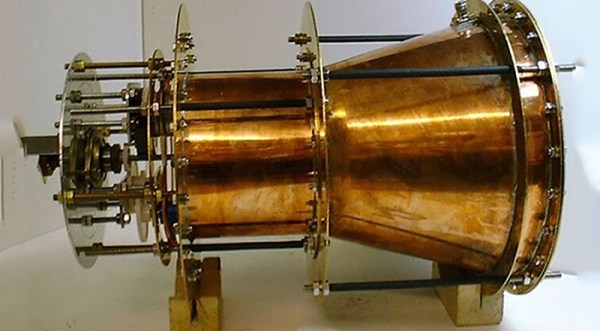
The EM Drive Might Not Work, But We Get Helicarriers If It Does

There is a device under test out there that promises to take humans to another star in a single lifetime. It means vacations on the moon, retiring at Saturn, and hovercars. If it turns out to be real, it’s the greatest invention of the 21st century. If not, it will be relegated to the history of terrible science right underneath the cold fusion fiasco. It is the EM drive, the electromagnetic drive, a reactionless thruster that operates only on RF energy. It supposedly violates the laws of conservation of momentum, but multiple independent lab tests have shown that it produces thrust. What’s the real story? That’s a little more complicated.

The EM Drive is a device that turns RF energy — radio waves — directly into thrust. This has obvious applications for spacecraft, enabling vacations on Mars, manned explorations of Saturn, and serious consideration of human colonization of other solar systems. The EM drive, if proven successful, would be one of the greatest inventions of all time. Despite the amazing amount of innovation the EM drive would enable, it’s actually a fairly simple device, and something that can be built out of a few copper sheets.

Continue reading “The EM Drive Might Not Work, But We Get Helicarriers If It Does” →

Mechanical Watch Hacker Gets An Apple Watch

Mechanical watch enthusiasts see the Apple watch as a threat to the traditional gear train. It does not tick, requires frequent re-charging, and it’s certainly not the most attractive of watches. But it can direct you to the local coffee shop, allow you to communicate with friends anywhere in the world, get you onto an airplane after the most awkward of arm gestures, and keep you apprised of the latest NCAA basketball scores. Is the advent of the smart watch the end to the mechanical watch?
Continue reading “Mechanical Watch Hacker Gets An Apple Watch” →

DEF CON Vs IoT: On Hackability And Security

Ahh DEF CON! One group of hackers shows off how they’ve broken into all sorts of cool devices and other hackers (ahem… “security professionals”) lament the fact that the first group were able to do so. For every joyous “we rooted the Nest thermostat, now we can have fun” there’s a doom-mongering “the security of network-connected IoT devices is totally broken!”.

And like Dr. Jekyll and Mr. Hyde, these two sides of the hacker persona can coexist within the same individual. At Hackaday, we’re totally paranoid security conscious, but we also like to tinker with stuff. We believe that openness and security are best friends forever. If you can open it, you can see if it’s well-made inside, at least in principle. How do we reconcile this with the security professional’s demand for devices that only accept signed binary firmware updates so that they can’t be tampered with?

We’ve got no answers, but we’ve got plenty of questions. Read on, and let us know what you think.

Continue reading “DEF CON Vs IoT: On Hackability And Security” →