Buzzword technology has two possible fates: they fail and disappear or they succeed and disappear. Remember at one time “multimedia” and “networking” were buzzwords. They succeeded and now they’ve vanished into ubiquity. Of course, there are plenty of failed buzzwords (like telecosm) that you probably don’t even remember. They just vanished into obscurity.
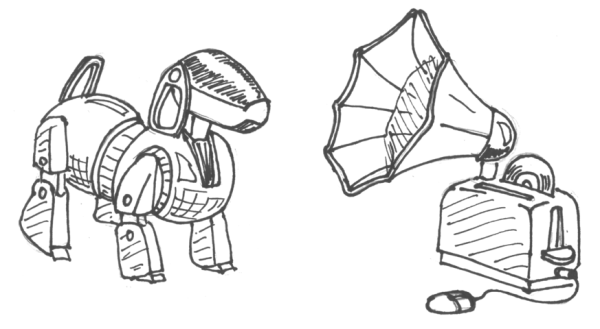
Unless you’ve been living under the CNC mill in your local hackerspace, you’ve probably heard or read about the “Internet of Things” (IoT). Companies big and small have realized that getting in early on The Next Big Thing is good for share prices and, right now, IoT is where everyone is trying to make a play.
There’s two things I’d observe, though: First, IoT is far from new. Connecting embedded systems to the Internet is old hat (I even wrote a book called Embedded Internet Design way back in 2003). Second, the way it is going, IoT–in its current incarnation–is doomed.
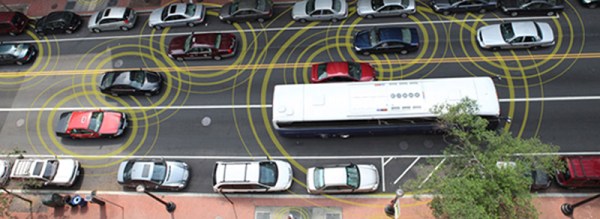
Every year, more than 30,000 people are killed in motor vehicle accidents in the US, and many many more are injured. Humans, in general, aren’t great drivers. Until dependable self-driving cars make their way into garages and driveways across the country, there is still a great amount of work that can be done to improve the safety of automobiles, and the best hope on the horizon is Vehicle to Vehicle communications (V2V). We keep hearing this technology mentioned in news stories, but the underlying technology is almost never discussed. So I decided to take a look at what hardware we can expect in early V2V, and the features you can expect to see when your car begins to build a social network with the others around it.
With the summer’s big security conferences over, now is a good time to take a look back on automotive security. With talks about attacks on Chrysler, GM and Tesla, and a whole new Car Hacking village at DEF CON, it’s becoming clear that autosec is a theme that isn’t going away.
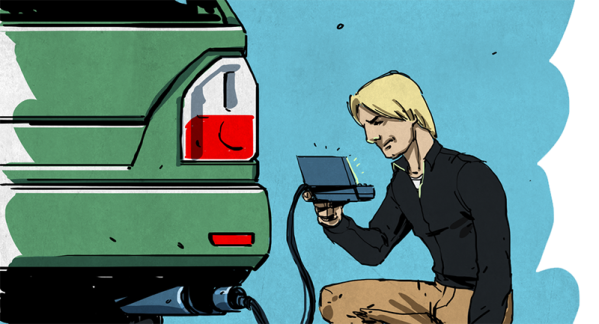
Up until this year, the main theme of autosec has been the in-vehicle network. This is the connection between the controllers that run your engine, pulse your anti-lock brakes, fire your airbags, and play your tunes. In most vehicles, they communicate over a protocol called Controller Area Network (CAN).
An early paper on this research [PDF] was published back in 2010 by The Center for Automotive Embedded Systems Security,a joint research effort between University of California San Diego and the University of Washington. They showed a number of vulnerabilities that could be exploited with physical access to a vehicle’s networks.
A number of talks were given on in-vehicle network security, which revealed a common theme: access to the internal network gives control of the vehicle. We even had a series about it here on Hackaday.
The response from the automotive industry was a collective “yeah, we already knew that.” These networks were never designed to be secure, but focused on providing reliable, real-time data transfer between controllers. With data transfer as the main design goal, it was inevitable there would be a few interesting exploits.
For many hardware enthusiasts, it’s hard to stop imagining the possibilities of an almighty fablab in our garage — a glorious suite of machines that can make the widgets of our dreams. Over the years, many of us start to build just that, assembling marvelous workbenches for the rest of us to drool over. The question is: “how do we get there?”
Ok, let’s say we’ve got a blank garage. We might be able to pick up a couple of tools and just “roll with it,” teaching ourselves the basics as we go and learning from our mistakes. With enough endurance, we’ll wake up ten years later and realize that, among the CNC mill, lathe, o-scope, logic analyzer, and the graveyard of projects on the shelves–we’ve made it!
Image Credit: [Rupunzell] on EEVBlog
“Just rolling with it,” though, can squeeze the last bits of change out of our wallets–not to mention ten years being a long journey while flying solo the whole time. Hardware costs money. Aimless experimentation, without understanding the space of “what expectations are realistic,” can cost lots of money when things break.
These days, the internet might do a great job of bringing people together with the same interest. But how does it fare in exchanging the technical know-how that’s tied directly to tools of the trade? Can we get the same experience from a chatroom as we might from a few minutes with the local ‘CNC Whisperer’ who can tell us the ins-and-outs about tuning the machine’s PID controllers?
I’d say that we just can’t. “Getting started” in any subject often seems daunting, but we’re at a compounded disadvantage in that the gurus on the forum have some shared implicit knowledge and jargon on the subject that we wont have if we truly are taking our first steps. (Not to fear, though; none of us were born with this stuff!)
Ruling out forums for taking our first baby steps, where can we find the “seasoned gurus” to give us that founding knowledge? It’s unlikely that any coffee shop would house the local hardware guru sippin’ a joe and taking questions. Fear not, though; there are places for hackers to get their sustenance.
When you are a hardware guy and you live in a time of crisis, sooner or later you find yourself working for some casino equipment company. You become an insider and learn a lot about their tricks. I’ve been in touch with that business for about 30 years. I made a lot of projects for gambling machines which are currently in use, and I had a lot of contact with casino people, both owners and gamblers.
Now I’m sure you expect of me to tell you about the tricks they use to make you spend your money. And I will: there are no technical tricks. This isn’t because they are honest people, but because they don’t need it. Mathematics and Psychology do all the work.
Does the risk of gambling pay off? Mathematically speaking, no – but it’s up to you to decide for yourself. One thing is for certain – whether you decide to gamble or not, it’s good to know how those casino machines work. Know thy enemy.
It happens with every generation – we’re born, our parents care for us and nurture us, we grow up, they grow old, and then we switch roles and care for them. Soon it’ll be my turn to be the caregiver to my parents, and I recently got a preview of things to come when my mom fell and busted her ankle. That it wasn’t the classic broken hip was a relief, but even “just” a broken ankle was difficult enough to deal with. I live 40 minutes away from the ‘rents, and while that’s not too bad when the visits are just the weekly dinner at Grammy’s, the time and the miles really start to add up when the visits turn into every other day to make sure Mom’s getting around OK and Dad is eating and sleeping.
I was sorely tempted to hack some kind of solution to give myself a rudimentary telepresence, but I couldn’t think of anything that wouldn’t have either been unacceptably intrusive (think webcams) or difficult to support from an IT perspective. Mom’s pretty handy with the iPad and she Skypes with my brother and his family out in California, but beyond leveraging that I was tapped out for ideas that I could easily deploy and would deliver sufficient value beyond the support burden within the time frame of healing the ankle. Consequently, I spent a lot of time in the car this summer.
This experience got me to thinking about how intergenerational caregiving will change with the rise of pervasive technology. The bad news: we’re still going to get old, and getting old sucks. The good news is, I think technology is going to make things easier for caregivers and elders alike. We have an incredible range of technology experiences among the generations present right now, from my parents who can remember phones without dials and nights spent listening to the radio, to my daughter’s generation that is practically growing up with supercomputers in the palms of their hands. How each generation ages and how it embraces technology as a solution for age-related problems are going to be vastly different.
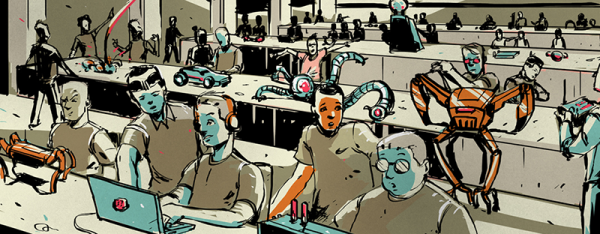
There is a lot to be said for replacing certain kinds of jobs with robots. Most people would agree that replacing physical human labor with automation is a good thing. It’s especially good to automate the dangerous kinds of labor like some facets of factory work. What about automation in fields that require more mental labor, where physical strain isn’t the concern? Is replacing humans really the best course of action? A year ago, a video called Humans Need Not Applyset forth an explanation of how robots will inevitably replace us. But that narrative is a tough sell.
Whether it is even possible depends on the job being automated. It also depends on how far we are able to take technology, and the amount of labor we are willing to offload. Automation has been replacing human workers in assembly and manufacturing industries for years. Even with equipment and upkeep expenses, the tireless nature of robotic workers means dramatically lower overhead for businesses.
Many of the current forms of factory automation are rather dumb. When something goes wrong and their task is compromised, they keep chugging away. That costs time and money. But there are companies out there producing robots that are better on many levels.
May Your Robot Overlords Be Cute and Cuddly
In 2013, Rethink Robotics started filling orders for a new line called Baxter. They are a class of general purpose robot that can be programmed to do many kinds of manual tasks. Baxter bots have vision, and they can learn how to do a job simply by watching. They don’t need to be programmed in the traditional sense.
Baxter even has a face – a screen that shows different expressions depending on his state. When he’s in the midst of a task, his eyes are cast downward. If something goes wrong, he stops what he’s doing. His cartoon face appears sort of shocked, then sad. He goes into safe mode and waits to be fixed.




 In 2013,









