Retrotechtacular: Robots, Robots Everywhere, With Kitschy Pronunciation

One of the great things about the human intellect is that we have the ability to build machines of varying complexity to do our bidding. As a major proponent of technology, the Chevrolet automobile corporation once dreamed of a future where the American housewife’s most mundane tasks are handled with the push of a button—one that sets a robot butler into action.

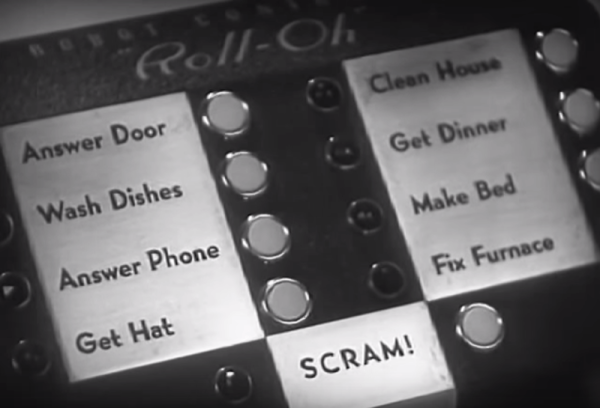
Chevy shows us what this future might look like in this short film, which they presented at the 1940 World’s Fair. A housewife’s faithful ‘robot’, pronounced throughout the picture as ‘robe-it’, has gone on the fritz. Naturally, she calls for a repairman. We see from the console controller that Roll-Oh the Robe-it can take care of all kinds of housewifely duties: he can answer the door and the phone, wash dishes, clean house, make beds, fetch hats, get dinner, and fix the furnace (and only the furnace). And that SCRAM! function? That’s never explained. We like to think it has to do with getting kids off the lawn, or could be used in conjunction with ‘get door’ to chase away would-be burglars. We get a glimpse of this when Roll-Oh answers the door and scares the daylights out of a young [Gary Sinise*] delivering flowers in a cop uniform.

Roll-Oh’s upper limbs have several Swiss Army knife-like implements in them. He uses a sharp one to cut the ribbon off of the flower box. Upon seeing the flowers, he gives them a gentle misting with his sprayer attachment. Dropped petals are no problem for Roll-Oh. He promptly vacuums them up from the thin industrial sound stage carpet with his big metal feet. Roll-Oh is then tasked with getting dinner. This amounts to him painstakingly opening a couple of cans and lighting candles with the torch hidden in his face.

While Roll-Oh the large ductwork butler is only a dream, Chevy wants you to know that smaller robe-its are all around us already. They’re regulating the heat in our stoves, browning our bread without burning it, and brewing our coffee in cool double-globe glass percolators. These tiny servants are capable of performing other tasks, like shutting off machinery when humans are too close, or sensing heat and engaging fire suppression systems. There is brief mention of something called the Petomat, an automatic dog feeding system which is essentially a bowl of food hidden in a latched box. The latch opens rather violently when the alarm clock connected to it goes off.

Robe-its are also performing more serious tasks, like keeping airplanes level and headed in the right direction. Of course, they’re also abundant in Chevrolet automobiles. A small one in the carburetor administers the proper mix of “gasoline calories and fresh air vitamins” to the engine. It’s rare to get to this level of technical detail, you know. Others watch over the spark, the intake manifold, and the voltage regulation. Up in the cab, friendly robe-its will happily traverse the AM dial at the push of a pre-set.

*Probably not actually [Gary Sinise].

Continue reading “Retrotechtacular: Robots, Robots Everywhere, With Kitschy Pronunciation”

Retrotechtacular: The Trautonium Was Elemental To Electronic Music

Electrical engineer and music enthusiast [Freidrich Trautwein] was dissatisfied. He believed that the equal tempered scale of the piano limited a player’s room for expression. And so in 1930, [Trautwein] and an accomplished pianist named [Oskar Sala] began work on an electro-mechanical instrument that would bring the glissando of the string section’s fretless fingerboards to the keyboard player. [Trautwein] called his creation the Trautonium.

Sound is produced in the instrument by sawtooth frequency generators. It is then passed through filters and manipulated by the resistive string-based manuals. Frequency and intonation are varied relative to the position of the player’s finger along a length of non-conductive string and to the amount of pressure applied. This resistive string is suspended above a conductive metal strip between a pair of posts. A small voltage is applied to the posts so that when the string touches the metal strip below, the player manipulates a voltage-controlled oscillator. A series of metal tongues, also non-conductive, hover above the string. These are placed at scale intervals and can be used like keys.

This early synthesizer is capable of producing many kinds of sounds, from crisp chirps to wet, slapping sounds and everything in between. In fact, all of the sound effects in Alfred Hitchcock’s thriller The Birds were produced on a modified Trautonium by the instrument’s one and only master, [Oskar Sala]. He went on to score hundreds of films by watching them with the Trautonium at his fingertips, recording and layering his compositions into an eerie wall of sound.

Continue reading “Retrotechtacular: The Trautonium Was Elemental To Electronic Music”

Retrotechtacular: Fantastic Backyard Inventions Of Yore

News corporation [British Pathé] created many newsreels and documentaries throughout their 60-year history. Recently, the company released scores of films from their archives and put them on the internet. Here is a delightful collection of short films they created that highlight strange and wonderful inventions in various fields, including transportation and communication.

One of the standout inventions is the Dynasphere, a mono-wheeled vehicle that probably deserves its own week in the Retrotechtacular spotlight. There are a couple of pedal-powered planes that may have inspired the Gossamer Condor, and a hover scooter that resembles an air hockey striker and doubles as a leaf blower. In another film, a man drives a Vespa to the banks of the Thames and parks it. He pulls a fin down from each side of the scooter, turning it into a seafaring craft. When he snaps his fingers, a cute girl appears from somewhere just outside the frame. She climbs on the back, and they take off across the water.

The average running time of these films is about two minutes. Some of them are much shorter, prompting many questions. Fortunately, most of the video descriptions have links with more information about these marvelous inventions. Almost all of the inventors in these films show a complete disregard for safety, but nearly everyone involved seems to be having the time of their lives.

Continue reading “Retrotechtacular: Fantastic Backyard Inventions Of Yore”

Retrotechtacular: Coopering Guinness Barrels By Hand

For almost exactly 200 years, the Guinness brewery in Dublin, Ireland employed extremely skilled craftsmen to shape and construct wooden casks by hand. These men were called coopers, and plying their trade required several years of apprenticeship. The cooperage was a kind of closed society as many of the positions were passed down through generations of families. With the rise of aluminium and then stainless steel barrels in the late 1950s, the master coopers of Guinness became a dying breed.

Almost every step of the coopering process shown in this film is done without any kind of precise measurement. A master cooper like [Dick Flanagan] here needs only his eyes and his practiced judgment. His barrels start out as oak planks called ‘staves’ that have been drying in racks for at least two years. A cooper selects the staves that strike his fancy and he saws off the ends. This seems to be the only part of the process where a power tool is used.

The cooper shapes each stave by hand with axe and adze so that its ends are tapered just so. Once he has shaped enough of them to make a barrel, he arranges them in a cylinder around the inside of a metal band known as a hoop. The bound staves are steamed for half an hour to make them pliable enough for shaping.

After steaming, the splayed end of the staves are bound with wire rope to pull them close enough together that a hoop can be fitted over them. The inside of the cask is then charred with burning oak shavings, a process that seals the wood and removes its acidity. After this, the ends are sanded and the bunghole is drilled.

For each barrel, the cooper crafts a custom set of hoops. These are installed after the outside of the barrel has been shaved smooth. Finally, the heads that cap each end of the cask are made from more oak staves held together with dowel rods. This is the only time the cooper uses a tool to measure anything, and he does so to achieve the proper circumference on the heads. He bevels the edges so the heads will fit into bored-out grooves in the cask walls. Once they’re seated, the keg is ready for dark, rich stout.

Continue reading “Retrotechtacular: Coopering Guinness Barrels By Hand”

Retrotechtacular: The J-57 Afterburner Engine

The J-57 afterburner engine appeared in many airplanes of notable make, including the F-101, -102, and -103. This USAF training film shows the parts of the J-57, explains the complex process by which the engine produces thrust, and describes some maintenance and troubleshooting procedures.

The name of this game is high performance. Precision thrust requires careful rigging of the engine’s fuel control linkage through a process called trimming. Here, the engine fuel control is adjusted with regard to several different RPM readings as prescribed in the manual.

One of the worst things that can happen to a J-57 is known as overtemping. This refers to high EGT, or exhaust gas temperature. If EGT is too high, the air-fuel ratio is not ideal. Troubleshooting a case of high EGT should begin with a check of the lines and the anti-icing valve. If the lines are good and the valve is closed, the instruments should be checked for accuracy. If they’re okay, then it’s time for a pre-trimming inspection.

In addition to EGT, engine performance is judged by RPM and PP7, the turbine discharge pressure. If RPM and PP7 are within spec and the EGT is still high, the engine must be pulled. It should be inspected for leaks and hot spots, and the seals should be examined thoroughly for cracks and burns. The cause for high EGT may be just one thing, or it could be several small problems. This film encourages the user to RTFM, which we think is great advice in general.

Continue reading “Retrotechtacular: The J-57 Afterburner Engine”

Retrotechtacular: The Omega Navigational System

In 1971, the United States Navy launched the Omega navigational system for submarines and surface ships. The system used radio frequencies and phase difference calculations to determine global position. A network of eight (VLF) transmitter sites spread around the globe made up the system, which required the cooperation of six other nations.

Omega’s fix accuracy was somewhere between one and two nautical miles. Her eight transmitter stations were positioned around the Earth such that any single point on the planet could receive a usable signal from at least five stations. All of the transmitters were synchronized to a Cesium clock and emitted signals on a time-shared schedule.

LOP-thumbA ship’s receiving equipment performed navigation by comparing the phase difference between detected signals. This calculation was based around “lanes” that served to divvy up the distance between stations into equal divisions. A grid of these lanes formed by eight stations’ worth of overlapping signals provides intersecting lines of position (LOP) that give the sailor his fix.

In order for the lane numbers to have meaning, the sailor has to dial in his starting lane number in port based on the maps. He would then select the pair of stations nearest him, which were designated with the letters A to H. He would consult the skywave correction tables and make small adjustments for atmospheric conditions and other variances. Finally, he would set his lane number manually and set sail.

Continue reading “Retrotechtacular: The Omega Navigational System”

Retrotechtacular: Building Hammond Organ Tones

Here’s a short film made by the Hammond Organ Company with the intent to educate and persuade potential consumers. Right away we are assured that Hammond organs are the cream of the crop for two simple reasons: the tone generator that gives them that unique Hammond sound, and the great care taken at every step of their construction.

Hammond organs have ninety-one individual electromagnetic tone wheel assemblies. Each of these generate a specific frequency based on the waviness of a spinning disk’s edge and the speed at which it is rotated in front of an electromagnet. By using the drawbars to stack up harmonics, an organist can build lush walls of sound.

No cost is spared in Hammond’s tireless pursuit of excellence. All transformers are wound in-house and then sealed in wax to make them impervious to moisture. Each tone wheel is cut to exacting tolerances, cross-checked, and verified by an audio specialist. The assembly and fine tuning of the tone generators is so carefully performed that Hammond alleges they’ll never need tuning again.

This level of attention isn’t limited to the guts of the instrument. No, the cabinetry department is just as meticulous. Only the highest-quality lumber is carefully dried, cut, sanded, and lacquered by hand, then rubbed to a high shine. Before it leaves the shop, every Hammond organ is subject to rigorous inspection and a performance test in a soundproofed room.

Continue reading “Retrotechtacular: Building Hammond Organ Tones”